

What is Goal-Line Technology?
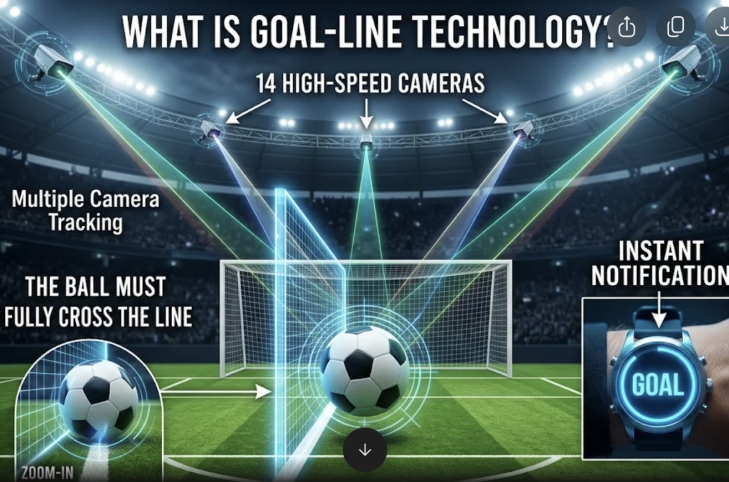
Increasingly, technology is being used in sports to ensure fair competition by assisting referees. One such solution is, of course, goal-line technology. It is used to verify whether the ball has fully crossed the goal line, as a goal can only be awarded if it has done so. It is particularly useful in situations where it is very difficult to determine conclusively whether a goal has been scored.
How Does Goal-Line Technology Work?
Goal-line technology utilizes specialized systems installed in the stadium that track the position of the ball. Depending on the solution used, they may rely on cameras or other sensors to precisely determine the exact location of the ball.
If the ball fully crosses the goal line, the system recognizes that a goal has been scored. The information is then instantly transmitted to the referee, who can quickly make the correct call.
Why Is This Technology Used?
The main purpose of goal-line technology is to reduce the number of errors regarding goal decisions. In football, situations often arise where the ball is extremely close to the line and players or the goalkeeper further obstruct the referee's view.
In such moments, even a few centimeters can make a huge difference. The technology therefore allows for resolving situations that can be very difficult for a human to judge in real time.
Goal-Line Technology vs. VAR
Goal-line technology and VAR are two different solutions, although both aim to assist in making correct decisions during a match. Goal-line technology focuses strictly on whether the ball has crossed the goal line.
VAR, on the other hand, has a much broader range of applications. The system can be used when reviewing goals, penalty decisions, direct red cards, or cases of mistaken identity. However, it is worth noting that goal-line technology can provide an immediate answer regarding the goal line without requiring lengthy replay analysis.
- If you frequently watch sports matches and want to see how others view a particular game, you can check out Today’s football betting tips.
When Is Technology Particularly Useful?
Goal-line technology is most crucial in situations where the ball bounces off the post or crossbar and returns to the pitch. It can also help when the goalkeeper stops the ball right at the goal line, making it hard to tell if it crossed in its entirety.
As a result, players and fans can be more confident that the goal decision was made based on precise data. This is particularly important in high-stakes matches where a single goal can determine the final outcome.
Is Goal-Line Technology Necessary?
Modern technologies are having an increasingly strong impact on how sports competitions are conducted. Goal-line technology is an example of a solution designed primarily to support the referee rather than replace them during a match.
It can therefore be considered a very useful tool in football. It allows for the swift resolution of one of the most critical questions whether a goal was actually scored. This minimizes the risk of incorrect decisions and makes athletic competition fairer.
