

The 2026 NFL season is two weeks old and the division races that decide January are already taking shape. Season-long questions tend to be easier to follow than week-to-week results, because they move slowly and the reasoning behind them stays visible.
They are also the questions prediction markets are built around. This guide covers how the season is structured, what season-long contracts actually ask and which platforms list them.
Key Takeaways
Seven teams from each conference reach the playoffs, four division winners plus three wild cards, so division standings and overall records both feed into season-long contracts.
A contract settles against the result source named in its own rules, which means the wording decides the outcome rather than the standings as you read them.
A displayed price is a quoted price rather than a clean probability, and thin trading can move one without any news behind it.
Event contracts are federally regulated products, but each platform sets its own account eligibility terms.
How the 2026 Season Is Built
The league has 32 teams split between the AFC and NFC, with each conference holding four divisions of four teams. Every team plays 17 games across an 18-week regular season with one bye, producing 272 regular season games in total.
The schedule follows a fixed formula: six games against division rivals, four against another division in the same conference, four against a division in the other conference, two more against same-conference teams matched by the previous season's standings and a 17th against a similarly matched team from the other conference.
This season opened on Wednesday, September 9 in Seattle, the league's first Wednesday season opener since 2012. The change cleared space for the following night, when the 49ers and Rams met at the Melbourne Cricket Ground in the first NFL regular season game played in Australia.
That fixture opened a record nine international games across four continents and seven countries, with Melbourne, Rio de Janeiro and Paris all hosting for the first time. Two weeks are now complete and Week 3 opens on Thursday, September 24.
Sunday's Week 2 card carried 14 games on its own, and several of the Week 2 marquee matchups already had early division consequences attached to them.
What Season-Long Markets Actually Ask
Season-long contracts map onto that structure. The common categories are playoff qualification, the eight division winners, the two conference champions, individual awards such as MVP and Coach of the Year and the best or worst regular season record.
Easier to follow does not mean easier to predict. Before reading anything into a contract, check its exact wording, the result source named in the rules and how ties or unusual outcomes are handled.
A contract on winning a division settles differently from one on reaching the playoffs, even when the same team is involved. The CFTC's overview of prediction markets and event contracts is a useful primer on how these products are structured, priced and settled.
How These Platforms Were Compared
Three things were weighed. Whether season-long NFL contracts are grouped in a dedicated place rather than scattered through a general feed. How clearly fees and settlement rules are documented. And how the account itself is held, since that is what shapes who can open one.
Where sources disagreed on a detail, it was left out rather than hedged.
Platform | NFL coverage | Notable for |
Fanatics Markets | Weekly game board plus a dedicated NFL Futures collection | Published per-contract fee schedule, live in-play section |
Kalshi | Game markets plus a deep season futures set | CFTC-regulated exchange, detailed contract rules |
Polymarket | Weekly matchups, division races and season futures | Separate US and international exchanges |
FanDuel Predicts | Team-based NFL futures and single-game markets | Financial and sports contracts in one product |
Robinhood Prediction Markets | Sports contracts inside a brokerage app | Contracts held alongside other account positions |
1. Fanatics Markets
Season-long contracts sit in a dedicated NFL Futures collection reached from the main navigation, separate from the weekly board. That collection currently lists both conference champion markets, all eight division winner markets, a playoff qualification market, best and worst regular season record and awards including MVP, Coach of the Year, Offensive and Defensive Player of the Year, Offensive Rookie of the Year and Comeback Player of the Year.
Readers comparing NFL betting options across platforms will find the weekly fixture board on its own page, with each card opening on a moneyline and a large secondary board sitting behind it. On the Week 3 fixtures that runs to more than 170 additional markets per game. A Live section in the main navigation carries markets trading while events are in progress.
Fanatics Markets publishes its costs in full. The fee disclosure effective September 2, 2026 states a total trading fee of between $0.00034 and $0.02 per contract, charged on each contract purchased or sold, generally highest for contracts priced near $0.50 and lower near $0.01 or $0.99.
Fees are calculated across the whole order and rounded up to the next whole cent, so a single-contract order can carry a $0.01 minimum. ACH deposits are free, while debit card, Apple Pay, PayPal and Venmo deposits may carry up to 2%.
2. Kalshi
Kalshi is one of the longer-running CFTC-regulated event contract exchanges in the United States, and it describes itself as matching traders rather than acting as their counterparty. Its NFL board pairs game markets with a deep futures set covering conference champions, division winners, win totals, best and worst record and awards.
Its published contract rules are detailed on data sources and settlement. Similarly named listings on different platforms do not necessarily settle the same way, so read the rules for the specific contract rather than assuming.
3. Polymarket
Polymarket runs a large global catalogue with a substantial NFL section covering weekly matchups, division races and season futures. Prices are presented as implied probabilities that can be bought or sold while a market remains open.
Access differs by location. The international platform and the US offering are separate exchanges with different contract lists. Identity verification applies, so confirm which one you are looking at.
4. FanDuel Predicts
FanDuel Predicts lists team-based NFL futures, including conference champions and the winners of all eight divisions, alongside single-game winners, totals and player markets. Financial benchmarks and economic indicators sit in the same product.
Individual award markets such as MVP have not been part of that lineup, so check the list before assuming a specific contract exists. The account entity is also worth confirming in the app before opening a position.
5. Robinhood Prediction Markets
Robinhood offers event contracts through a Prediction Markets Hub inside its brokerage app, launched with contracts listed on a CFTC-regulated partner exchange. For existing users the appeal is holding contracts in the same account as other positions rather than opening a separate one.
Its infrastructure has shifted as the category matured, and its exchange arrangements have been changing. Check the current setup rather than assuming.
Reading a Market Without Chasing It
Prices reflect what traders are paying. A quarterback injury, a lineup change, a difficult stretch of fixtures or a tiebreaker scenario can all move expectations, but so can a simple shortage of buyers and sellers.
A price change does not always signal news. Injury news also works in both directions over a full season. Adrian Peterson's 2012 MVP campaign came one year after he tore his ACL and MCL, a reminder that an early setback does not settle an awards race on its own.
Plenty of what surrounds a fixture gets discussed far more than it moves a season-long price. Fan forums are a good example. Live game threads on communities such as CFB Reddit surface reactions and breaking news within minutes, but a busy thread is not the same thing as a price move.
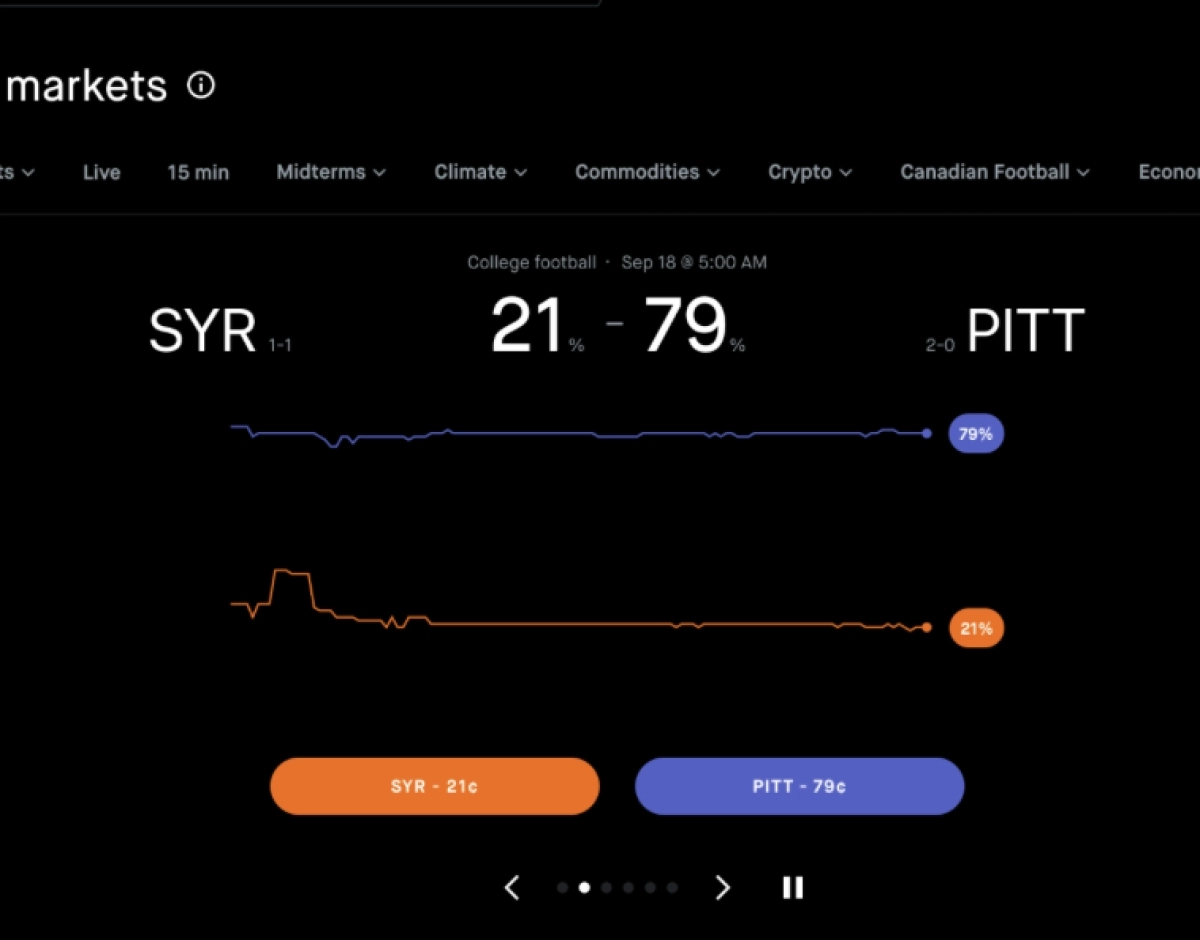
A displayed percentage is a quoted price rather than a clean probability, because the two sides of a market usually sum to slightly more than 100%. Treat that gap as part of the cost of getting in and out.
It is also worth knowing how the unit is displayed. Published fee tables price contracts from $0.001 to $0.999 each and run a parallel column for 100-contract lots, while consumer screens often show a percentage next to the payout on a $100 position.
Check which one a screen is showing before sizing anything, and cross-check any move against team news and the league's official tiebreaker procedures. Treat a price as one input rather than a prediction.
Availability and Access
The CFTC describes event contracts as federally regulated products that can operate in all 50 states under federal law. That is a statement about the products themselves, not a promise that any given account can be opened wherever you live.
Platforms set their own eligibility terms and minimum ages, and some restrict access further. Check the platform's own notes before assuming access.
The balance between federal and state authority in this area is being contested in the courts, so terms can change during the season.
Guardrails Worth Setting
Trading event contracts involves a real risk of loss and is not appropriate for everyone. You can lose the full amount committed, trading can be halted and settlement depends on the designated result source rather than on what the standings appear to show.
Season-long positions can stay committed for months and there is no assurance a buyer will be available when you want to exit. If you do participate, set a firm limit using only money you can afford to lose and do not borrow or increase spending to recover losses.
FAQ
How many teams make the NFL playoffs?
Seven from each conference: the four division winners plus three wild card teams, which are the best remaining records.
What decides whether a season-long contract pays out?
The result source named in the contract rules, read exactly as written. Check how ties and unusual outcomes are handled before assuming an outcome is covered.
Can I sell a season-long position before the season ends?
Only if trading is open and a buyer accepts your price. On a long-dated market that is not assured, and you may receive less than you paid.
Does federal regulation mean a platform is available where I live?
Not on its own. Federal regulation applies to the contracts and the registered entities behind them, while individual platforms still set their own eligibility terms.

