


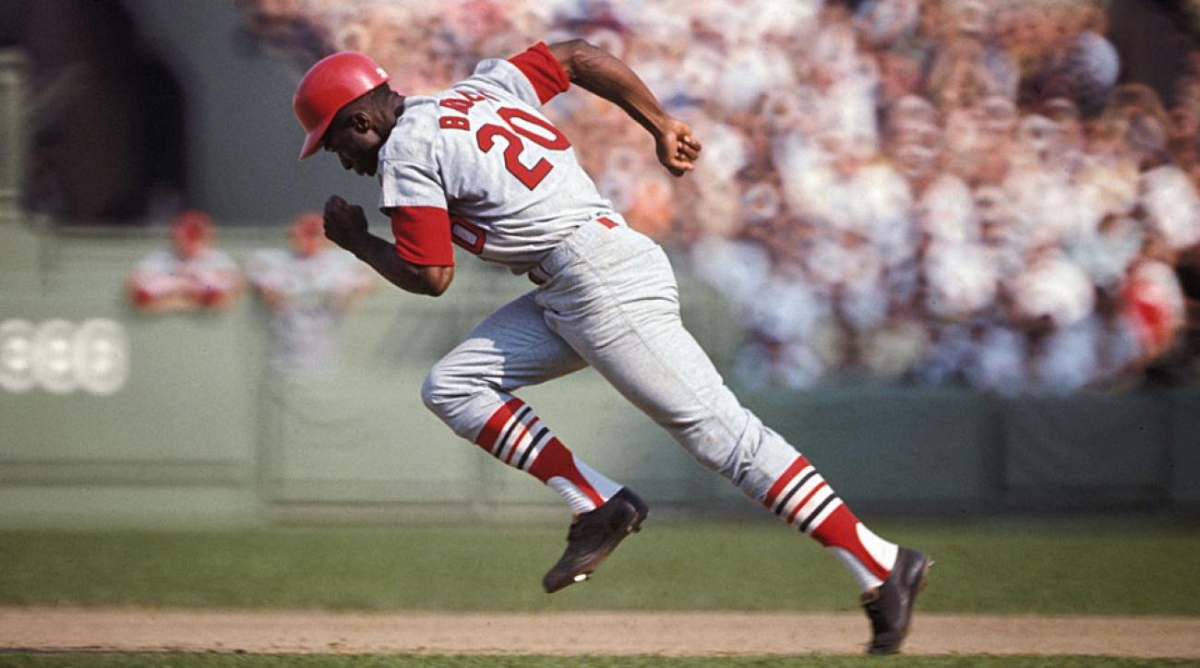






When a franchise executes a trade that is profoundly imbalanced, altering the entire course of its modern history, the transaction swiftly becomes a quintessential example of executive ill-gotten gains. In June 1964, the St. Louis Cardinals obtained an underperforming and structurally mismanaged outfielder from their longstanding adversaries, the Chicago Cubs, in a notorious multi-player deal centered on pitcher Ernie Broglio. Lou Brock did not merely experience a change of scenery in Missouri; he became an unstoppable force of high-velocity offense. By infusing the roster with a formidable combination of exceptional speed and aggressive contact hitting, the exceptionally swift left fielder embarked on a legendary 16-season tenure that revolutionized the batting order for an entire generation.
His mid-season arrival in 1964 served as an immediate catalyst, resulting in a significant increase in his performance virtually overnight. Brock transformed getting on base into a nightly demonstration, batting an impressive .348 over 103 games during the latter part of the season, thereby contributing to the Redbirds' historic National League pennant victory and ultimately securing the world championship title against the New York Yankees.
Once fully integrated into the local culture, he methodically redefined the art of base running. He achieved his first career stolen base title during an impressive 1966 season, an accomplishment that sparked a remarkable sequence of dominance, whereby he led the National League in stolen bases in eight of nine summers from 1966 through 1974. The pinnacle of his individual base-stealing mastery was exemplified during the exceptional 1974 regular season. At the age of 35, Brock demonstrated an exemplary display of timing and tactical foresight, breaking the modern single-season record by stealing an extraordinary 118 bases and securing a distinguished runner-up position for the National League Most Valuable Player award.
Nevertheless, characterizing Brock exclusively as a baserunning specialist significantly understates the extensive nature of his offensive contributions. He was a distinguished high-volume hitter during his tenure under the Arch, achieving four seasons with 200 hits, in addition to seven seasons in which he exceeded 180 hits.
His big-game DNA was entirely unrivaled when the ultimate prize was on the line. Across three separate World Series appearances (1964, 1967, and 1968), Brock systematically dismantled opposing pitching to forge a mind-bending .391/.424/.655 postseason slash line with 14 doubles, seven triples, four home runs, and a modern Fall Classic-record 14 stolen bases across 21 games.
Where Brock experiences substantial decline under contemporary analytical scrutiny is in his markedly volatile and unidimensional profile. He was widely recognized as a notably aggressive hitter who consistently ranked high on league strikeout leaderboards, recording at least 100 strikeouts in nine separate summers with St. Louis.
Defensively, his metrics were even more problematic; he possessed a highly erratic glove and a limited throwing arm, posting eight separate seasons with a negative defensive bWAR of -1.0 or worse while retiring with the third-most errors recorded by any left fielder in the history of the sport. These massive defensive leaks heavily drag down his advanced efficiency metrics, explaining why his localized value anchors lower in a comprehensive algorithmic review than his traditional status might indicate.
Nevertheless, his historic longevity ultimately earned him inner-circle baseball immortality. During his final 1979 swan song in a Cardinals uniform, the veteran icon joined the sport's most exclusive fraternity, collecting his 3,000th career hit to draw a definitive, storybook curtain on his playing days.
In St. Louis, Brock accumulated 2,713 hits, 434 doubles, 121 triples, and 888 stolen bases, which formed the bulk of his 938 career swiped bags—a historical record that stood until Rickey Henderson eventually redefined the category. He would be inducted into the Baseball Hall of Fame in 1985 on the first ballot, and was also part of the first class inducted into the Cardinals Hall of Fame in 2014. His number 20 was also retired by the team after he retired in 1979.

Comments powered by CComment