


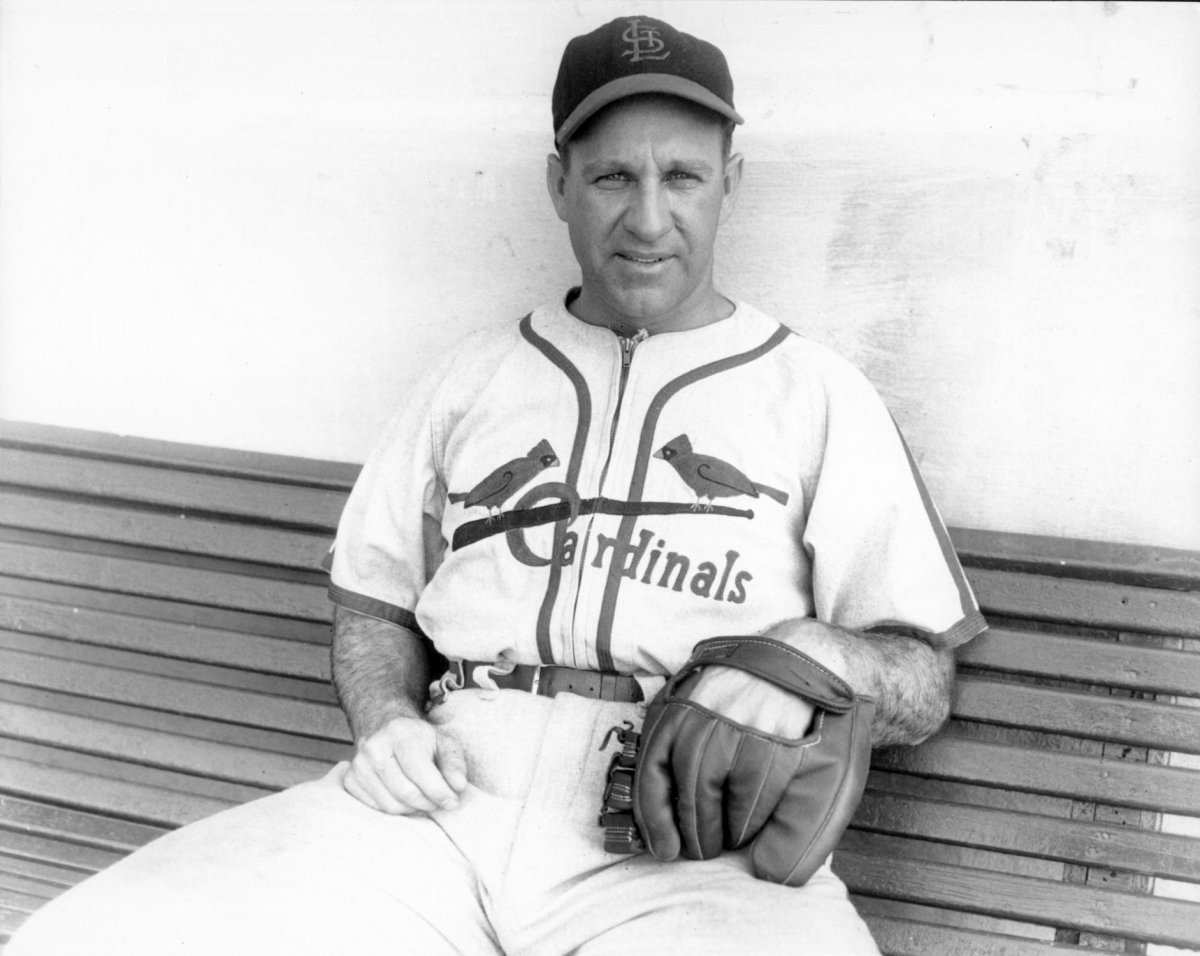




If you are a regular reader of Notinhalloffame.com, you know that the editorial staff is an absolute sucker for great sports names. Enos Slaughter is a fantastic identifier all on its own, but when you inject his timeless, rustic moniker, you get Enos “Country” Slaughter—a combination of words so beautifully evocative of a bygone era that the temptation to artificially elevate him in the historical ledger was immense. We didn't do that, of course, but his performance on the grass didn't require any favoritism anyway.
Emerging from the Redbirds' minor league talent pipeline, the broad-shouldered, highly aggressive right fielder was known for his unwavering refusal to walk, sprinting to first base even after taking a walk. Throughout his notable yet interrupted career in Missouri, he served as the competitive spark and high-energy driver for three pennant-winning teams, consistently delivering solid line-drive production that cemented his legendary status in local lore.
His 1938 debut season served as an impressive introduction, as he posted a .276 batting average over 112 games. Interestingly, this would remain his lowest single-season batting average during his main years with the Cardinals, highlighting his remarkable consistency over the next decade and a half. In 1939, he became a key player, regularly dismantling National League pitching and leading the league with 52 doubles while maintaining a .320 batting average. He sustained that upward trajectory directly into the 1940s, capturing a well-deserved runner-up finish in the 1942 National League Most Valuable Player balloting after pacing the circuit in hits (188) and triples (177) to propel St. Louis to a world championship.
Then, at the absolute evolutionary zenith of his physical peak, the broader geopolitical realities of World War II engineered a sudden, three-year competitive blackout. Slaughter completely stepped away from the sport from 1943 through 1945 to serve his country in the Army Air Forces. Had those three prime summers not been sacrificed, he would have easily compiled eleven individual .300 campaigns for the organization rather than eight.
Demonstrating the legendary grit that defined his entire identity, his 1946 return to civilian life marked a remarkable moment of athletic redemption. Slaughter dominated the Senior Circuit leaderboards by hitting 18 home runs and driving in a league-high 130 runs, finishing just behind in the NL MVP voting. The peak of his baseball achievements occurred in October during Game 7 of the 1946 World Series against the Boston Red Sox. With the game tied at 3–3 in the eighth inning, Slaughter sparked a memorable hit-and-run from first base on a line drive to left-center field by Harry Walker. Bypassing standard strategic caution and charging through a visible stop sign from his third-base coach, he executed "Slaughter's Mad Dash"—a relentless, full-throttle sprint from first base all the way to home plate. Catching the Boston defense entirely off guard and sliding across the plate to score the world-championship-winning run, the iconic play remains one of the most celebrated, high-leverage moments in the history of global sports.
Slaughter remained a frontline fixture through the turn of the decade, recording another spectacular third-place MVP finish in 1949 by leading the league with 13 triples while batting a brilliant .336.
The inevitable business exit materialized in April 1954 when management initiated a youth movement, shocking the local community by trading the aging icon to the New York Yankees, where he would secure two more championship rings as a highly effective utility hand. Over his 1,751 games representing St. Louis, he accumulated exactly 2,064 hits, 366 doubles, 135 triples, 146 home runs, and 1,148 runs batted in, completely validated by an exceptional .305/.384/.463 franchise slash line.
He entered the Baseball Hall of Fame via the Veterans Committee in 1985. Eleven years later, Slaughter's number 9 was retired by the team, and in 2014, he was part of the Cardinals’ inaugural Hall of Fame class.

Comments powered by CComment