


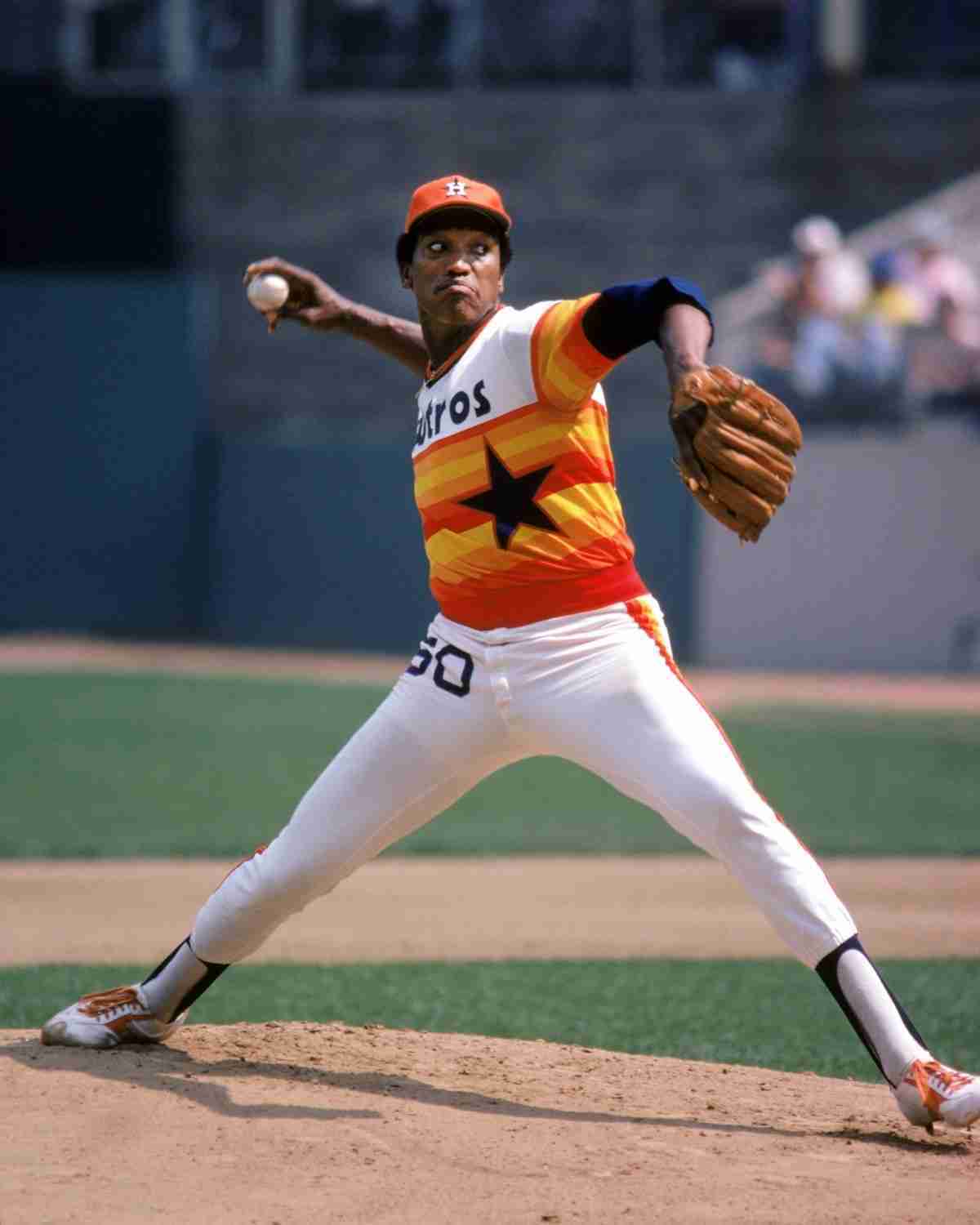


J.R. Richard was a force of nature on the mound, a 6' 8" titan who possessed a velocity that felt like a localized atmospheric event. In an era where the radar gun was just becoming a standard part of the game’s lexicon, Richard was the gold standard for raw, unadulterated power. For a decade in Houston, he wasn't just a starter; he was a phenomenon who terrified hitters with a 100-mph heater and a slider that moved like a ghost.
Richard’s arrival in Houston in the early 1970s was a slow-burning evolution, as he worked to harness a lightning-bolt arm that often lacked direction. He reached a pivotal breakthrough in 1976, his first 20-win season, where he finally combined his massive frame with a repeatable delivery. That summer, he struck out 225 batters and threw 291 innings, signaling a transition from a wild prospect to the most feared arm in the National League. He possessed a focused intensity that allowed him to thrive in the high-pressure environment of the Astrodome, where his speed seemed even more lethal against the backdrop of the "Eighth Wonder of the World."
The middle of his tenure saw him reach an unrivaled gear of dominance. In 1978 and 1979, Richard became the first right-hander in National League history to record back-to-back 300-strikeout seasons. He led the league in punchouts both years, and in 1979, he reached a career-high mark for efficiency, leading the NL in both ERA (2.71) and FIP (2.21). He was a model of physical resilience, routinely pitching deep into games and finishing in the top five of the Cy Young voting. He showed the organization that a pitcher could become a franchise pillar by simply being too fast for the modern hitter to comprehend.
Everything seemed to be building toward a historic 1980 campaign. Richard started the All-Star Game and looked poised to lead the Astros to their first-ever postseason berth, carrying a 10-4 record and a microscopic 1.90 ERA into late July. However, the trajectory of his career reached a tragic and sudden final punctuation when he suffered a stroke during a warm-up session at the Astrodome. The medical emergency effectively ended his time on the mound at just 30 years old, leaving the baseball world to wonder what a full career of his "flamethrowing" ability might have looked like.
He left the game with 107 wins and 1,493 strikeouts, a statistical footprint that felt incomplete yet remained legendary. The story in Houston reached its rightful conclusion in 2019 when the Astros inducted him into the inaugural class of their Hall of Fame.

Comments powered by CComment