


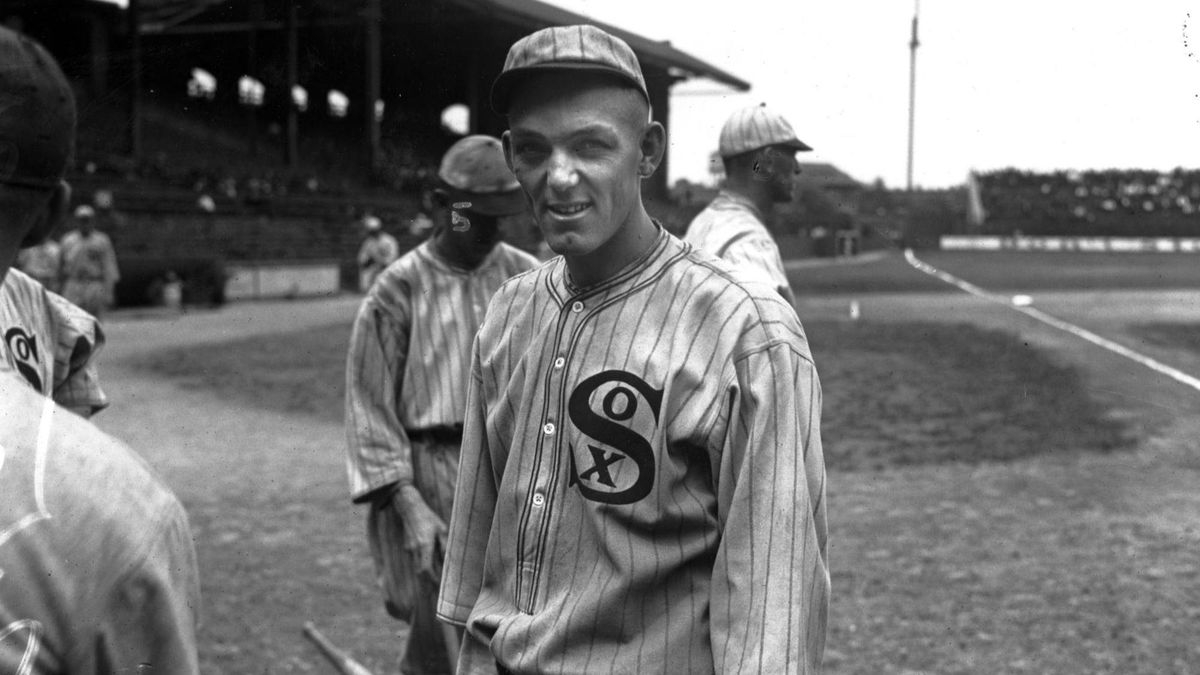


Arriving in the Chicago lineup in 1912, Buck Weaver rapidly established himself as a fixture of the infield. He arrived with a reputation for a relentless, aggressive style of play, transitioning from shortstop to third base, where his range and arm strength became a cornerstone of the club’s run prevention. He was a model of defensive reliability, never posting a negative defensive bWAR throughout his nine seasons and consistently shrinking the field for opposing hitters. He was the rare talent who understood the nuances of the "deadball" era, twice leading the American League in sacrifice hits and swiping 173 bases during his tenure.
The true magnitude of his value was on full display during the franchise's most successful stretch. Weaver was a primary catalyst for the 1917 World Series champions, providing the veteran poise and defensive stability that allowed the Pale Hose to capture the crown. His game reached a new level of sophistication by 1919; he had matured into a dangerous high-frequency hitter, and during the infamous World Series of that year, he was arguably the best player on the field. He recorded 11 hits and played flawless defense, a performance that remains the central piece of evidence for those who argue he never participated in the fix.
His presence was defined by a jovial, competitive nature that made him a favorite among both fans and peers. Weaver remained a standout through the 1920 campaign, authoring a career-high .331 batting average and accumulating over 1,300 hits before the legal and administrative storm broke over the club. Whether he was charging a bunt to cut down a runner or lacing a line drive into the gap, he competed with a visible joy that made his sudden exile all the more tragic. He proved that a player could anchor a championship team through a rare combination of grit, speed, and tactical intelligence.
His playing career reached a sudden, forced conclusion after the 1920 season. Despite his stellar play and his insistence that he had no part in the conspiracy, Commissioner Kenesaw Mountain Landis banned him for life for his "guilty knowledge" of the scandal. He left the organization as a statistical titan of the era, a man who spent his entire professional life in a White Sox uniform only to be cast out in his athletic prime.
With the White Sox, Weaver compiled 1,308 hits, 173 stolen bases, and 563 runs scored with a .272 batting average.

Comments powered by CComment