


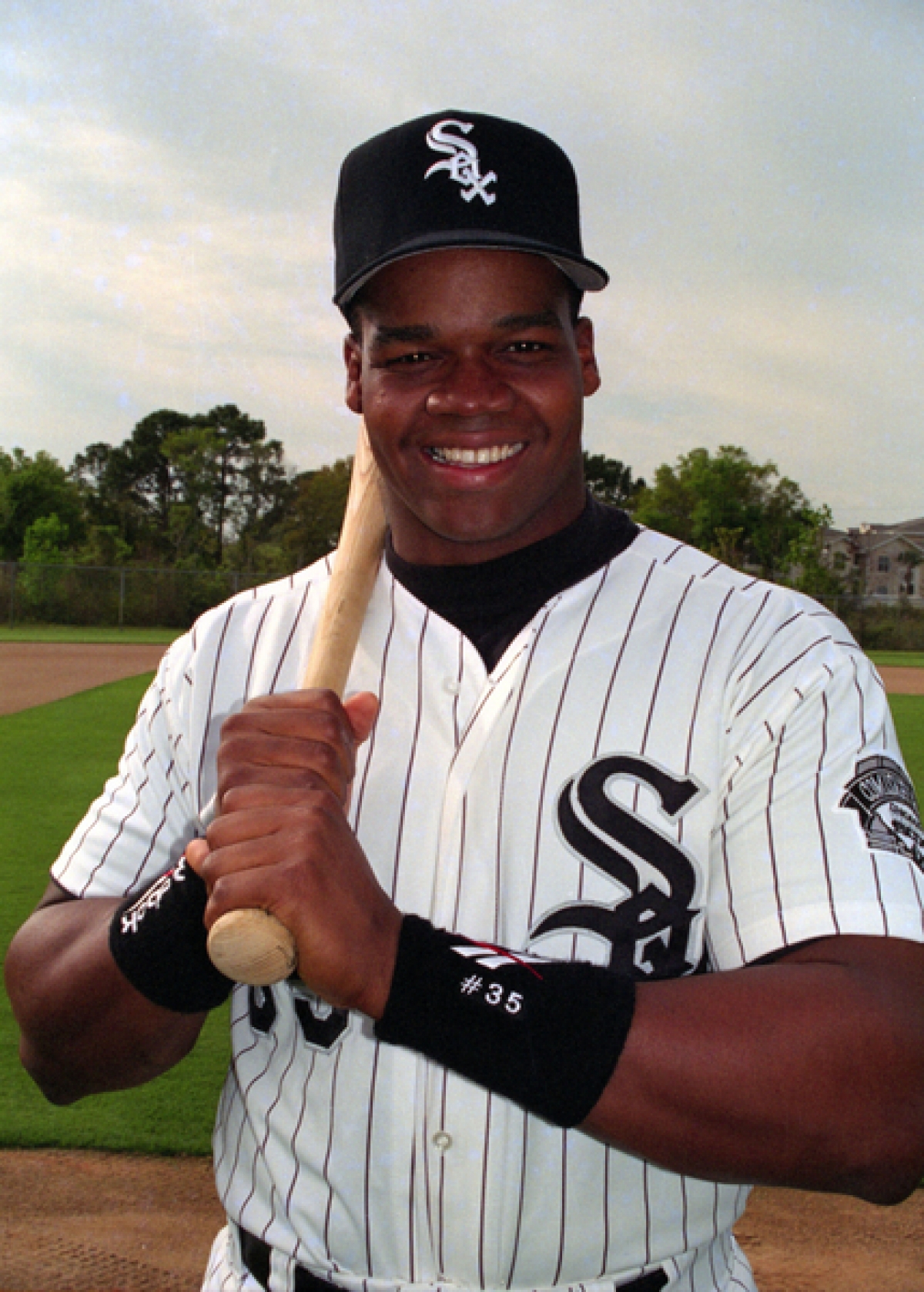


When Frank Thomas took his first hacks at Comiskey Park in 1990, the baseball world wasn't quite prepared for the paradox he represented. He was a 6'5", 240-pound mountain of a man who looked like he belonged on a football field, and indeed, he had played tight end at Auburn. But unlike Oakland’s Bash Brothers (Jose Canseco and Mark McGwire) of the era, who relied on raw, unrefined strength, Thomas arrived with the most sophisticated hitting eye in the American League. He didn't just want to hit the ball over the wall; he wanted to dominate the pitcher intellectually. For the fans on the South Side, the 60-game debut in 1990 wasn't just a preview; it was a warning shot.
The ensuing seven-year run from 1991 to 1997 is a stretch of offensive geography that has few neighbors in the history of the sport. Thomas turned the batter's box into a personal laboratory, conducting a relentless experiment in elite production. In every single one of those years, he hit at least .300, maintained an on-base percentage of .425 or higher, and slugged at a minimum of .530. He became the only player in the history of the game to put up seven consecutive seasons with 20-plus homers, 100 RBIs, 100 walks, and 100 runs scored while hitting .300. It wasn't just a "hot streak"; it was a decade of perfection. During this apex, he claimed back-to-back MVP awards in 1993 and 1994, and truthfully, he could have made a compelling case for a third or fourth.
As the 90s transitioned into the new millennium, the narrative around Thomas began to shift toward his role as a Designated Hitter. Traditionalists grumbled about his lack of a glove, but the reality was that his bat was so vital it would have been a crime to risk his health in the field. Even as his batting average began its natural, age-related dip, the power remained terrifying. In 2000, he staged a massive "second act," crushing 43 home runs and driving in a career-high 143 runs to finish as the MVP runner-up. He proved that even as his game evolved, his presence in the heart of the order remained the gravity that held the White Sox together.
The sunset of his tenure in Chicago was tinged with the bittersweet reality of professional sports. By 2004 and 2005, the "Big Hurt" was finally feeling the hurt himself, as foot injuries began to rob him of the stability that powered his legendary swing. When the White Sox finally broke their 88-year championship drought in 2005, Thomas was a veteran mentor in the dugout, but his injury kept him off the postseason roster. It was a difficult way to see a legend's run conclude, watching from the sidelines as the team he had carried for fifteen years finally reached the summit. When the front office chose not to re-sign him following that World Series win, it marked the end of the greatest individual era in franchise history.
Frank Thomas left the South Side as the undisputed king of the record books. He remains the all-time leader in runs scored (1,327), doubles (447), home runs (448), RBIs (1,468), and walks (1,466). His career Sox slash line is .307/.427/.568, which serves as a statistical masterpiece that may never be touched. He was a first-ballot Hall of Famer who didn't just hurt the opposition; he dismantled them with a blend of discipline and power that redefined the modern hitter. When his number 35 was retired in 2010, it was a formal acknowledgement of what every pitcher from that era already knew: there was only one Big Hurt, and there will never be another.

Comments powered by CComment