

37. Livan Hernandez
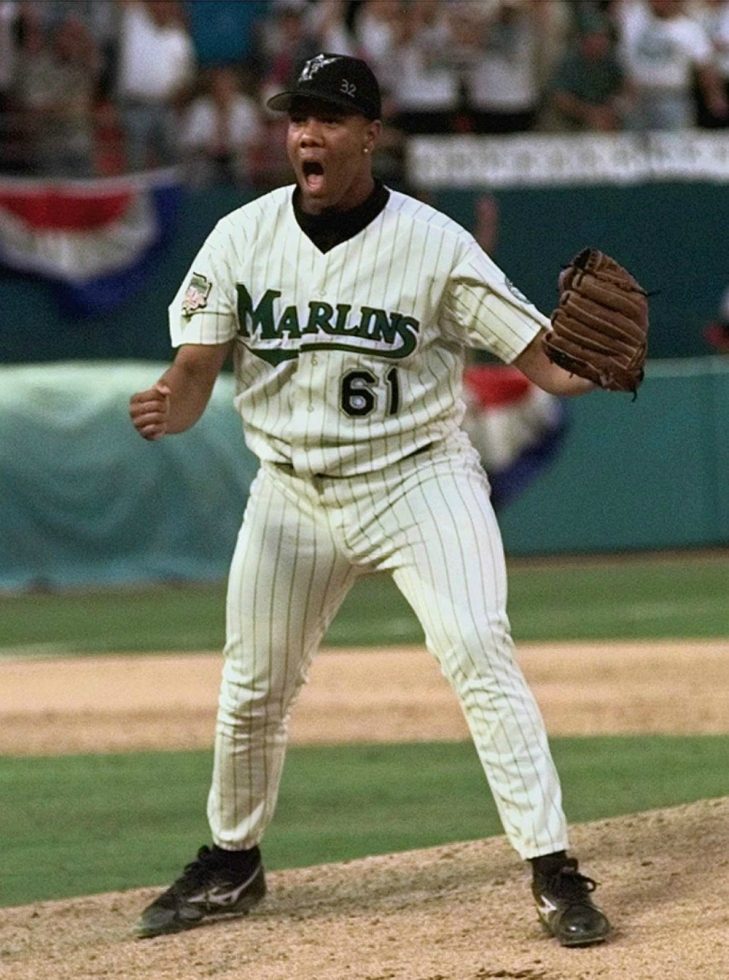
One of the most fascinating people to rank on a list of all-time Marlins is Liván Hernández, the star of the 1997 Playoffs.
Liván Hernández arrived in South Florida in 1996 as a figure of immense political and athletic intrigue, having defected from Cuba just a year earlier. While he possessed a high-velocity arm and a signature "slow" curveball, his residency in Miami was ultimately defined by a singular, lightning-strike October that transformed him from a rookie prospect into a postseason immortal.
After a solid 1997 regular season with a 9-3 record and a 3.18 ERA, Hernández reached a career highlight in the playoffs. He delivered one of the franchise's most memorable performances in Game 5 of the NLCS, striking out a record 15 Atlanta Braves in a complete-game performance. This achievement earned him the NLCS MVP award, but he continued to excel. Hernández demonstrated complete command during the Fall Classic, winning two additional games against Cleveland to secure the World Series MVP, becoming only the fourth player to earn both honors in the same season.
Following a grueling 1998 campaign in which he logged a career-high 234.1 innings, Hernández’s efficiency began to waver, and the organization finalized a trade sending him to the San Francisco Giants in July of 1999. Hernandez would have greater individual success with the Expos/Nationals, representing them in the All-Star Game twice. As a Marlin, Hernandez had a record of 24-24, with a 4.39 ERA and 333 Strikeouts. Notably, he was also an excellent defensive player and an above-average hitting Pitcher, accumulating 35 Hits with a .222 Batting Average for the team.
If I Had a Vote in the 2018 Baseball Hall of Fame Election
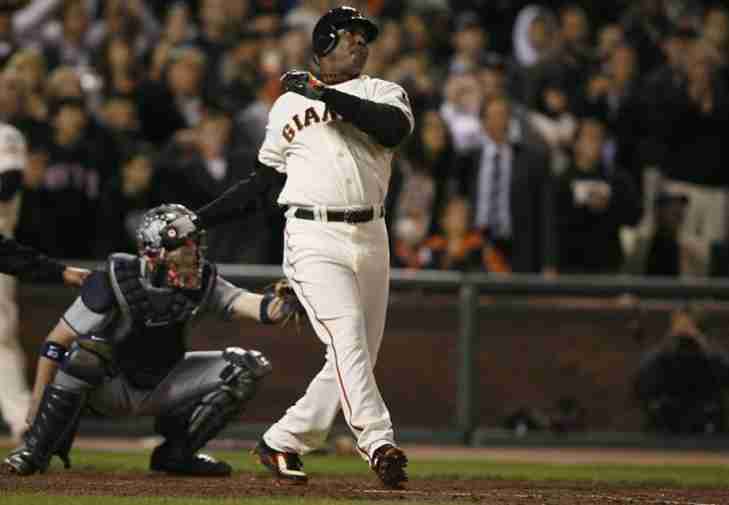
Sounds like voting for the Baseball Hall of Fame for the last few years, doesn't it?
The good news is that since the Shutout of 2013, when the eligible members of the Baseball Writers' Association of America (BBWAA) could not muster the 75 percent of the vote necessary to elect any one ballot candidate to the Hall of Fame despite a wealth of candidates from whom to choose (I counted 14), the BBWAA has sent a dozen players to Cooperstown. Based on that trend, and barring any unusual or unforeseen wrinkle, the writers are certain to elect at least one player for 2018.
20. Livan Hernandez

Livan Hernandez was already renowned as a Cuban defector who earned both the NLCS and World Series MVP awards as a 22-year-old rookie with the 1997 Florida Marlins. He joined Montreal before the 2003 season following a trade from San Francisco. While many saw the move as a salary dump, Hernández viewed it as an opportunity for a remarkable, career-changing resurgence. Over the next four years, he became both literally and metaphorically the bridge that helped the franchise transition from Montreal to Washington.
His 2003 campaign for the Expos was a standout example of old-school volume pitching. During a time when modern baseball was quickly pulling starters earlier, Hernández ignored the trend and relied solely on his stamina. He overwhelmed opposing lineups by leading the National League with 233.0 innings pitched and eight complete games, finishing with a 15–10 record and a 3.21 ERA. In 2004, during the Expos' final summer in Quebec, he elevated his durability by pitching 255.0 innings, leading the league in nine complete games and 35 starts. This remarkable workload earned him his first All-Star selection and a Silver Slugger Award at the plate.
When the franchise officially relocated to the nation's capital ahead of the 2005 schedule, it was entirely fitting that the deathless right-hander threw the historic first pitch in Washington Nationals history. Hernández served as the face of the inaugural District squad, putting together a brilliant 15-win tour and leading the major leagues yet again with 246.1 grueling innings across 35 starts, securing a consecutive All-Star nod.
After a 2006 trade to Arizona and a short stint across multiple teams, Hernández made a notable return to Washington in late 2009 for a dramatic, late-stage career homecoming. He pitched with seasoned, soft-tossing accuracy, relying heavily on a nearly untouchable, changing-speed looping curveball and a low-80s sinking fastball, effectively defying aging norms. In 2010, he pitched 211 innings with a solid 3.67 ERA, serving as the main high-pressure reliever for the rebuilding Nationals before ending his storied chapter with the franchise in late 2011.
With Montreal/Washington, Hernandez compiled a 70–72 record, a 4.01 ERA, and a 1.35 WHIP. He threw 1,177.1 innings, recording 27 complete games, 5 shutouts, and 840 strikeouts.
Livan Hernandez


Livan Hernandez had a long and productive career in Major League Baseball, and though he was never really among the elite Pitchers in the game, he was a valuable innings eater, a more than above average hitting Pitcher and finished off his career with a respectable 178 and 177, 1,976 Strikeouts and a 25.2 bWAR. Overall, it is not a Hall of Fame resume, but anyone who can pitch seventeen seasons in the Majors had a career of value; especially when you consider that he was the World Series and NLCS MVP for the Marlins in their shocking championship in 1997.
The Bullet Points:
Country of Origin:
Villa Clara, Cuba
Eligible In:
The 2018 Vote
Position:
Pitcher
Played For:
Florida Marlins
San Francisco Giants
Montreal Expos/Washington Nationals
Arizona Diamondbacks
Minnesota Twins
Colorado Rockies
New York Mets
Atlanta Braves
Milwaukee Brewers
Major Accolades and Awards:
World Series MVP (1) (2007)
NLCS MVP (1) (2007)
2 Time All Star (2004 & 2005)
Silver Slugger (1) (NL) (2004)
Most Innings Pitched (3) (NL) (2003, 2004 & 2005)
Most Complete Games (2) (NL) (2003 & 2004)
World Series Rings (1) (Florida Marlins, 1997)
Other Points of Note:
Top Ten Cy Young Finishes:
(AL: 2003, 7th), (AL: 2005,3rd), (AL: 2007, 5th) & (NL: 2009, 3rd)
1 Top Ten Finish (Earned Run Average)
3 Top Ten Finishes (Wins)
1 Top Ten Finish (WHIP)
7 Top Ten Finishes (Innings Pitched)
2 Top Ten Finishes (Strikeouts)
7 Top Ten Finishes (Complete Games)
2 Top Ten Finishes (WAR for Pitchers)
Notable All Time Rankings:
63. Games Started: 474
76. Strikeouts: 1,976
