

146. Sam McDowell
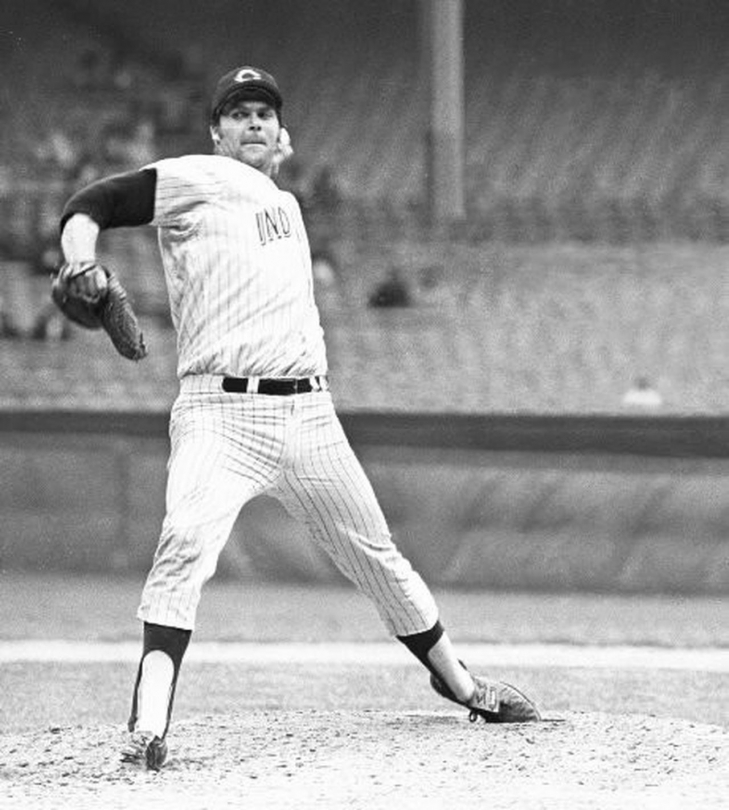
Sam McDowell had one of the most unimposing yet correct nicknames. When you hear the name "Sudden" Sam, you aren't sure what to think, but what does a "sudden" Pitcher mean? For McDowell, it is in reference to his rapid delivery and the strong odds that he would strike you out.
McDowell broke in with the Cleveland Indians as a teenager in 1961, and he was a fixture in the starting rotation in 1964. While Sandy Koufax and Bob Gibson would have more Strikeouts than McDowell in the 1960s, McDowell had the most in the American League. The southpaw led the AL in Ks five times as an Indian, with two years eclipsing the 300 mark. Six times an All-Star, McDowell won the ERA Title in 1965, and he was twice the league-leader in bWAR for Pitchers. McDowell was able to hold opponents to a lack of Hits, but he was wild, and he walked far too many batters, as he gave free passes the most in the AL in five different seasons.
He would finish his career with runs in San Francisco, New York (AL), and Pittsburgh.
While McDowell’s overall record of 141-134 was not great, he is 25th all-time in SO/9 and 10th all-time in H/9. Those ranks place him around a plethora of Hall of Famers.
As for the Hall, McDowell was eligible in 1981, but he never received a vote, making him one of the best flamethrowers with that dubious distinction.
10. Sam McDowell

The Cleveland rotation found a true outlier in 1961 when Sam McDowell debuted as a teenager, but it was the 1964 campaign where he matured into a full-time force. He possessed a rare, high-ceiling talent that enabled him to lead the American League in strikeouts five times during his tenure with the club. While legends like Koufax and Gibson were grabbing headlines in the Senior Circuit, "Sudden" Sam was the undisputed king of the whiff in the AL, twice eclipsing the 300-strikeout mark in a single season. He arrived as a raw prodigy and quickly became the pitcher that every hitter in the league dreaded facing on a Tuesday night.
The peak of his efficiency was a sight to behold, particularly during the 1965 season when he captured the American League ERA title with a microscopic 2.18 mark. His impact was further validated by his status as a six-time All-Star and a two-time league leader in bWAR for pitchers, proving that his value was rooted in much more than just a high radar gun reading. He was an efficiency machine when he found the zone, holding opponents to incredibly low hit totals and dominating the high-leverage moments of the mid-60s.
However, his dominance was often a double-edged sword. McDowell played with a wildness that was as legendary as his velocity, leading the league in walks five times during his Cleveland tenure. This tug-of-war between elite stuff and erratic control meant that while his 122-109 record with the club was solid, it rarely reflected the true terror he struck into the hearts of opposing lineups. He was a high-volume workhorse who frequently led the league in batters faced and innings pitched, serving as the most durable and dangerous southpaw of his generation.
The chapter eventually closed on his time in Cleveland following the 1971 season, leading to later stops in San Francisco, New York, and Pittsburgh. He left the organization as a statistical titan, having amassed 2,159 strikeouts in an Indians uniform, a total that remains a benchmark for every left-hander who has followed him. He proved that even with a lack of pinpoint command, a pitcher with enough "sudden" life on his heater could rule the league for a decade.
Recognition for his cornerstone status in the franchise finally arrived in 2010, when the organization inducted him into the Cleveland Indians Hall of Fame.
