

39. Larry Jackson
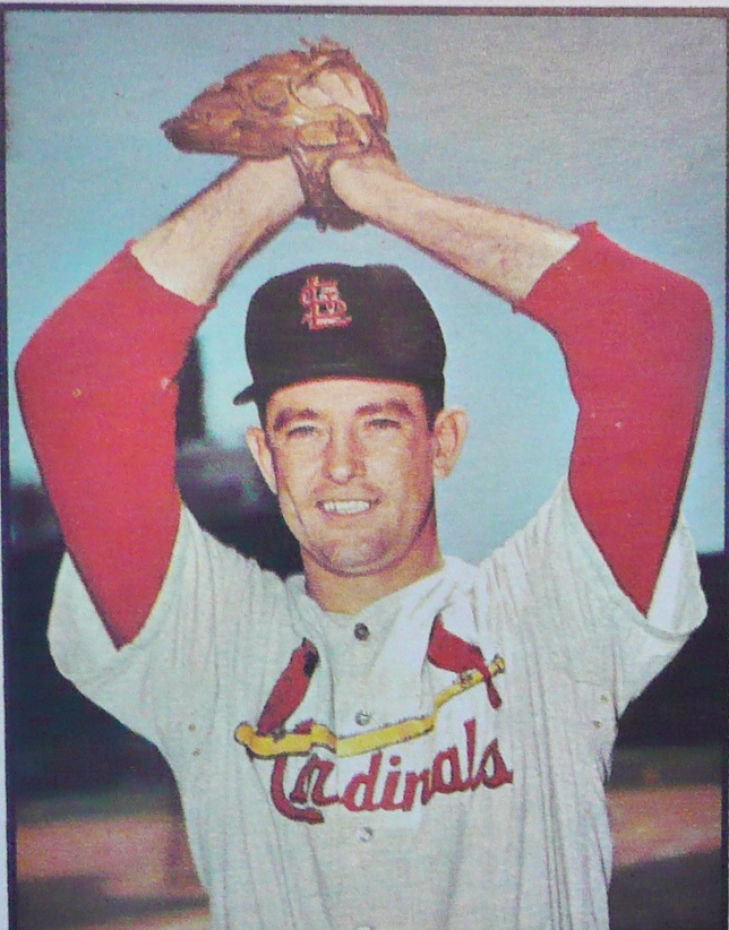
When Mr. Larry Jackson debuted in Major League Baseball with the St. Louis team in 1955, the organization was experiencing ongoing instability. Engulfed in a continual cycle of managerial and executive turnover, the team spent several years attempting to ascertain the true capabilities of this durable right-hander, fluctuating him between the starting rotation and high-leverage bullpen roles. Nonetheless, despite the organizational disorder surrounding him, Jackson maintained focus and established himself as a pillar of dependability for a franchise undergoing a transitional period.
Once he permanently secured his place in the rotation in 1957, Jackson blossomed into the quiet workhorse of the staff. Over his eight seasons in St. Louis, he secured three All-Star selections, including a memorable nod in 1957 when he got to pitch in front of the home crowd at Sportsman's Park. He was a model of steady, volume-heavy production, rolling up a 101–86 record and tossing 70 complete games as a Cardinal.
Paradoxically, his finest hour in a Redbird uniform was completely ignored by the All-Star voters. In 1959, pitching for a seventh-place club that finished twelve games under .500, Jackson turned in a masterpiece that only modern sabermetrics could fully appreciate. On the surface, his 14–13 record and 3.30 ERA looked standard. Under the hood, he was the most dominant pitcher in the National League. Jackson led all senior circuit arms with a whopping 7.3 Baseball-Reference WAR, anchored by league-best marks in both Fielding Independent Pitching (2.87) and home run prevention (0.50). He took the ball for 256 innings and simply refused to let opposing hitters clear the fences.
The outstanding 1959 campaign launched a three-year period during which he pitched an average of 250 innings annually, culminating in a 16-win season in 1962. However, by that time, a new generation of top young pitchers, headed by a rising star named Bob Gibson, was prepared to take over the rotation. To find a power hitter to replace the aging Stan Musial, the front office traded Jackson to Chicago that winter.
Jackson compiled a 101–86 record with a 3.52 ERA over 315 appearances (198 starts). He threw 1,601 innings, racked up 828 strikeouts, recorded 70 complete games, and tossed 14 shutouts while accumulating 23.5 bWAR as a Cardinal.
161. Larry Jackson
Larry Jackson played for some good teams, but never any great ones (he never played in the postseason). As such, Jackson never made the 200 Win club, but his value as an innings eater was essential to the success of many of his teams.
Once Larry Jackson worked his way permanently into the Cardinals’ rotation, he seemingly never left. Jackson would become the ace of many average teams and would go on to set the modern record for right-handers in Wins without winning a pennant. Still, he parlayed his famous slider to a Cy Young runner-up in 1964, and though this was the closest he would come to a big award, he was one of the most respected starting pitchers in the National League. Larry Jackson never received a vote for the Hall of Fame, but a look at his career sabremetrics has given us cause to wonder why.
