Menu
A+ A A-
Site Admin

Site Admin

Bill DeWitt III Claims London Games Are To Thank For Baseball’s Global Popularity

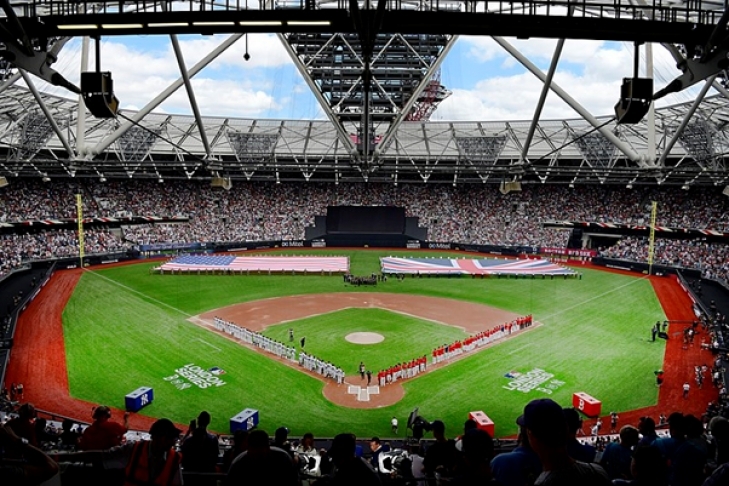
Following on from a successful Major League Baseball two-game series in June this year, Bill DeWitt III, president of the St Louis Cardinals, has expressed his optimism about the future of the league in London. When asked about the future of the games on November 11th, DeWitt commented that “I think the first step is games over there. This is the second year back. I think if you see significant enthusiasm again, which you should, MLB might extend [the London Series] into a regular thing.”

12. Tom Nalen

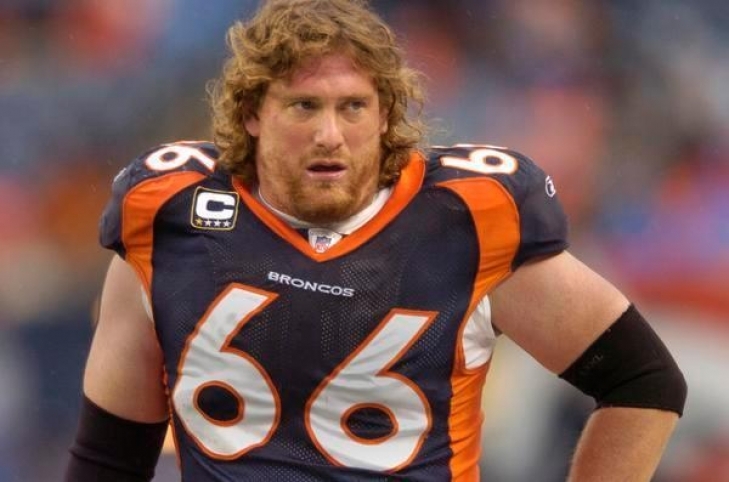
Drafted in the seventh round (218th overall) of the 1994 NFL Draft from Boston College, Tom Nalen arrived in Denver with modest expectations. He earned the starting center job early in his second season and went on to anchor Alex Gibbs’ famous zone-blocking scheme for more than a decade. Slightly undersized at 286 pounds, Nalen relied on textbook leverage, rare foot speed, and an ironclad grasp of defensive fronts to call the line of scrimmage, cementing his status as the cerebral heartbeat of the offense.

Nalen's arrival coincided with Denver's transformation into an offensive juggernaut. While John Elway's arm and Terrell Davis' running generated headlines, Nalen was the indispensable engine up front that made the system go. During his 14 seasons with Big Blue, Nalen blocked for six different 1,000-yard rushers across 11 seasons—including Davis’ iconic 2,008-yard MVP campaign in 1998, alongside Olandis Gary, Mike Anderson, Clinton Portis, Reuben Droughns, and Tatum Bell. His ability to reach linebackers on stretch plays allowed running backs to cut back into open grass consistently.

That trench dominance produced consecutive Lombardi Trophies in Super Bowl XXXII and XXXIII, as the front five imposed its will in back-to-back playoff runs. Individual accolades quickly followed: Nalen earned four consecutive Pro Bowl trips from 1997 through 2000, adding a second-team All-Pro nod in 1999 and a first-team selection in 2000. After rebounding from a knee injury that cut his 2002 campaign short, Nalen delivered a masterclass year in 2003—earning his fifth Pro Bowl nod, a second first-team All-Pro honor, and recognition as the NFL Alumni Offensive Lineman of the Year.

Nalen, known for his stoic demeanor and silent media policy, let his play speak until a torn bicep in 2007 ended his career. His long tenure set the franchise standard. He played 194 games with 188 starts—second only to John Elway—and had 13 postseason starts and two Super Bowl rings. A five-time Pro Bowler, two-time First-Team All-Pro, and part of the Broncos 50th Anniversary Team, he was inducted into the Broncos Ring of Fame in 2013.

10. Karl Mecklenberg

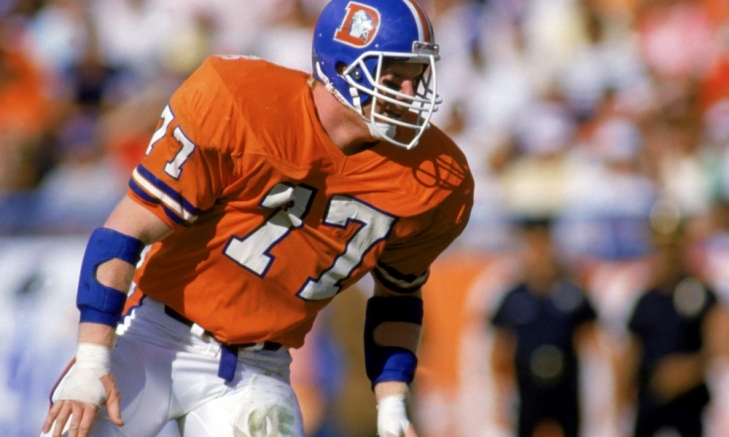
Drafted in the long-forgotten 12th round (310th overall) of the 1983 NFL Draft out of Minnesota, Karl Mecklenburg began his professional career as a longshot defensive end before evolving into one of the most uniquely versatile front-seven weapons in football history. Nicknamed the "Albino Rhino," he earned the ultimate reputation as a defensive "Swiss-Army Knife," lining up at all seven front-seven positions—inside linebacker, outside linebacker, nose tackle, and both defensive end spots—often shifting between multiple alignment roles over the course of a single game to attack opposing offenses.

Mecklenburg's career took a major step forward when Denver moved him to inside linebacker, while still utilizing him as an interior pass rusher on third downs. His breakthrough season was in 1985, when he achieved a career-high 13.0 sacks, setting a franchise record at the time, which earned him his first Pro Bowl selection and First-Team All-Pro honors. He confirmed this was no accident in 1986, earning AFC Player of the Year from Football News after recording 9.5 sacks and leading Denver's defense to a Super Bowl XXI appearance.

During his peak from 1985 to 1989, Mecklenburg was the crucial tactical force in Joe Collier's defense. He earned four First-Team All-Pro honors (1985, 1986, 1987, 1989) within five seasons. His 1989 campaign was a showcase of dominance, as he led the Broncos with a personal best of 143 tackles, along with 7.5 sacks and four forced fumbles. He topped the NFL in Approximate Value and helped Denver reach Super Bowl XXIV for the third time in his career.

Despite aging and injuries, Mecklenburg's keen instincts and diagnose-and-attack skills kept him among the league's top linebackers into the early 1990s. He received Pro Bowl nominations again in 1991 and 1993, leading the linebacking unit through scheme changes and remaining one of the most hard-hitting interior defenders. Notably, he is the only player in Denver history to achieve four sacks in a single game twice, showcasing his rare talent for disrupting pass protections from the inside.

Across 12 seasons in Denver (1983–1994), Mecklenburg played 180 games, with 1,145 tackles, 79.0 sacks, 16 forced fumbles, and five interceptions. The Broncos inducted their six-time Pro Bowler into the Ring of Fame in 2001.

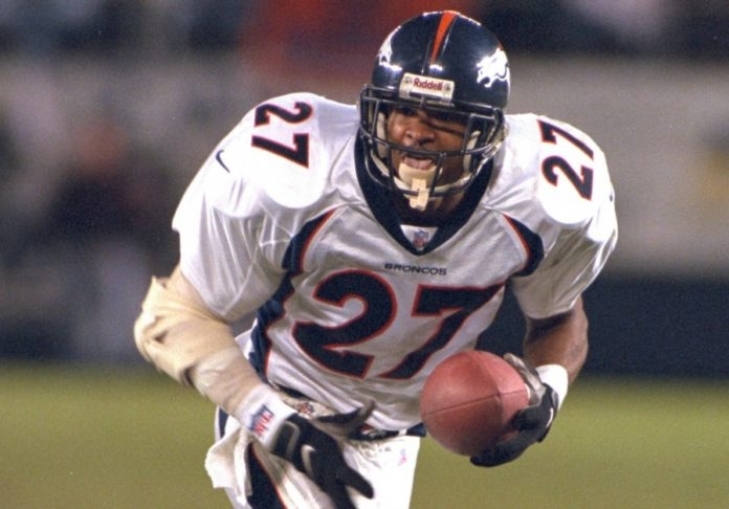
8. Steve Atwater

Arriving in Denver as the 20th overall pick in the 1989 NFL Draft, the imposing safety out of Arkansas immediately redefined physical play in the Broncos' secondary. Standing 6-foot-3 and weighing 218 pounds, Steve Atwater brought a linebacker's size and a sprinter's range to the free safety position, earning runner-up honors for NFL Defensive Rookie of the Year while helping propel Denver to an appearance in Super Bowl XXIV.

Nicknamed "The Smiling Assassin" for his cheerful personality off the field and fierce tackling on it, Atwater quickly became one of the league's most formidable enforcers. From 1990 to 1996, he enjoyed a period of dominance, earning seven straight Pro Bowl selections. During his prime, he received First-Team All-Pro honors in 1991 and 1992, and a Second-Team award in 1996. He was a consistent leader in tackles and expertly shut down deep passing routes.

His 1991 First-Team All-Pro season saw him achieve a career-high 150 tackles and five interceptions, showcasing his rare ability to play as an extra linebacker in the box against the run without compromising pass coverage. In 1992, he earned his second First-Team honors with 121 tackles and two interceptions, cementing his status as the AFC's top all-around safety. During this period, he made his most famous play—a legendary, bone-jarring collision on Monday Night Football in 1990 that stopped 260-pound Chiefs fullback Christian Okoye in his tracks.

Atwater's elite instincts and physical presence were the heartbeat of the defense as Denver evolved into a championship powerhouse late in the decade. He logged 126 tackles in 1995 and another 117 in 1996, consistently setting a ruthless physical tone for the entire unit. Opposing receivers routinely dropped passes over the middle in anticipation of Atwater's arrival, allowing Denver's defensive coordinators to run aggressive, opportunistic schemes up front.

As his tenure with the Denver Broncos and the Miami Dolphins reached its zenith, Atwater served as a pivotal figure in the defensive backfield for the Broncos' consecutive championship-winning teams. His most notable postseason performance occurred in Super Bowl XXXII against Green Bay, where he delivered an outstanding display with six tackles, a sack, a forced fumble, and a decisive pass breakup in the late stages of the game, which involved a mid-air collision knocking out three players, thereby securing Denver's inaugural Lombardi Trophy. He subsequently earned a second championship ring in Super Bowl XXXIII before concluding his professional career with a single season with the New York Jets in 1999.

Over his career, Atwater appeared in 155 regular-season games, compiling 24 interceptions, 1,074 tackles, and 5.0 sacks, while earning a spot on the NFL 1990s All-Decade Team. The Broncos inducted him into the Ring of Fame in 2007, culminating in his enshrinement into the Pro Football Hall of Fame in 2020.