
- Published in Top 50 St. Louis Cardinals
4. Bob Gibson
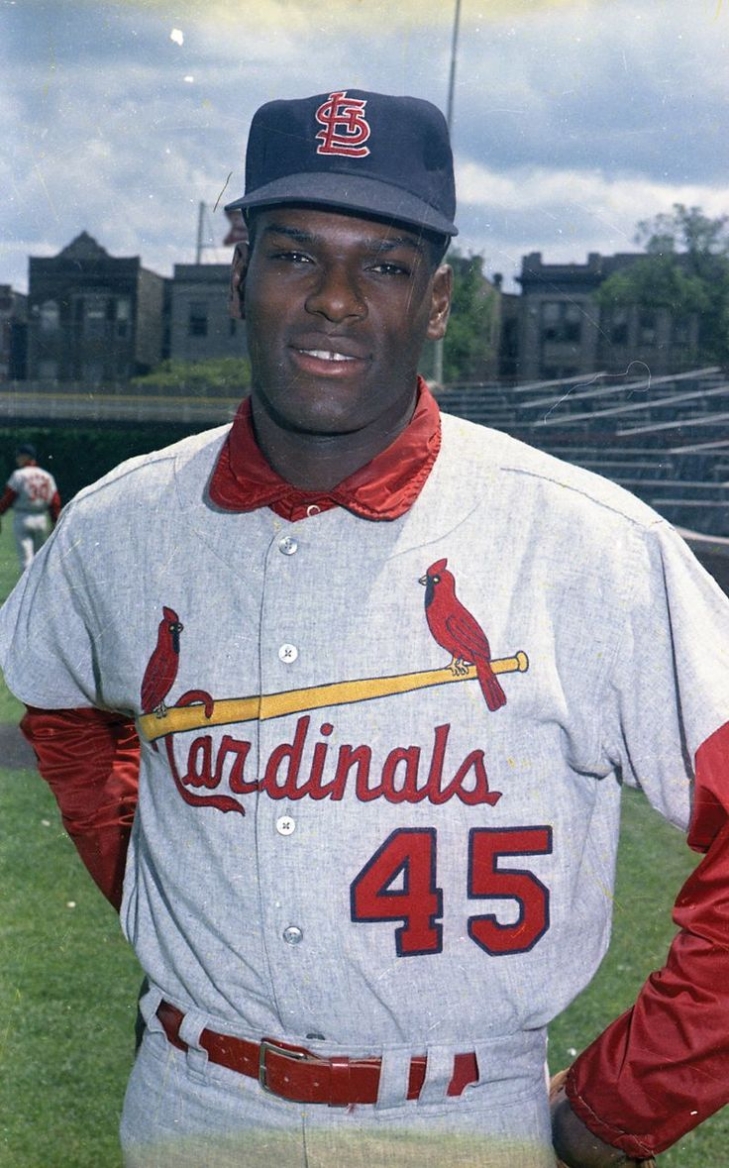
When evaluating a franchise that has spent more than a century accumulating championship banners, debates over the greatest players to ever wear the uniform can linger for decades. Yet when the conversation turns to the mound, it begins and ends with a singular, fiercely competitive presence from Omaha, Nebraska. Bob Gibson did not merely pitch for the St. Louis Cardinals; he commanded the entire diamond through sheer intimidation and unparalleled physical execution. Signed as an amateur free agent ahead of the 1957 season—following a brief, legendary stint showcasing his athleticism with the Harlem Globetrotters—the muscular right-hander became a permanent fixture in the starting rotation by 1961, embarking on a legendary run that remains the gold standard for pitching excellence in Midwestern baseball history.
Calling Gibson the greatest hurler in the club's long history is not a stretch; it is a mathematical certainty. He is the franchise's all-time leader in pitching bWAR (81.7), total wins (251), strikeouts (3,117), and total innings pitched (3,884.1).
While he established himself as a reliable front-line starter during the opening years of the 1960s, his legendary status as a big-game performer was forged in a historic breakthrough during the 1964 World Series against the New York Yankees.
Gibson hoisted the entire team onto his back, enduring a grueling workload of three complete-game starts. He won two of them—including a heroic, nine-inning masterpiece in Game 7 on just two days of rest—to capture the world championship and set a Fall Classic record with 31 strikeouts.
That legendary postseason performance launched a spectacular six-year reign of terror that reshaped the competitive landscape of the Senior Circuit. Gibson earned six consecutive All-Star selections from 1965 to 1970, pairing his blazing fastball with a slider that left hitters helpless.
In October 1967, he recaptured his October magic, guiding St. Louis to another World Series crown with a flawless 3–0 record over 27 complete innings, a microscopic 1.00 ERA, and a 0.704 WHIP against Boston, earning his second World Series MVP trophy.
The pinnacle of his career on the mound occurred during an incredible 1968 regular season. During the famous ‘Year of the Pitcher," Gibson delivered an outstanding performance, showcasing exceptional defensive skill. He skillfully overwhelmed National League lineups, finishing with a 22–9 record and setting a modern major league record with a remarkable 1.12 ERA.
His advanced efficiency filters were unrivaled; he tossed an unbelievable 13 shutouts, paced the circuit with a 1.77 FIP, and posted a 0.853 WHIP over 304.2 innings, culminating in a well-deserved sweep of both the National League Cy Young Award and the league's Most Valuable Player trophy.
That historic summer set the stage for a legendary heavyweight showdown in the 1968 World Series, where Gibson faced American League MVP and Cy Young Award winner Denny McLain of the Detroit Tigers. While the Cardinals ultimately fell short in a grueling seven-game battle, Gibson’s individual performance remained staggering. He authored three more complete-game starts, posting a 1.67 ERA and a 0.815 WHIP, and set an untouchable single-game World Series record by racking up 17 strikeouts in a dominant Game 1 victory.
His absolute dominance, alongside the general supremacy of pitchers across both leagues that summer, sparked localized panic among baseball executives. Fearing that offense was being permanently choked out of the sport, Major League Baseball took the unprecedented step ahead of the 1969 season to lower the pitching rubber by five inches and reduce the strike zone.
Despite structural rule changes designed to curb his effectiveness, Gibson’s elite spatial awareness and deep competitive drive enabled him to make immediate, masterclass adjustments. He maintained his frontline authority into the next decade, capturing a spectacular second career Cy Young Award in 1970 by winning 23 games with a 3.12 ERA and 274 strikeouts.
Furthermore, focusing solely on his legendary pitching tells only part of the story of his incredible, multidimensional legacy. Gibson was a premier, complete athlete who heavily influenced games with his bat and glove. He hit 24 career home runs as a dangerous threat at the bottom of the lineup and revolutionized defensive expectations at his position, using his lightning-fast reflexes to capture nine consecutive National League Gold Glove Awards from 1965 to 1973, providing a steady hand for the entire St. Louis defense.
The 1975 schedule marked his career end, as the physical toll of thousands of high-intensity innings forced his retirement.
Bob Gibson would be chosen for the Baseball Hall of Fame in 1981, which was his first year of eligibility. As for the Cardinals, they retired his number 45 after Gibson retired, and he was inducted into the first class of St. Louis' Hall of Fame in 2014.