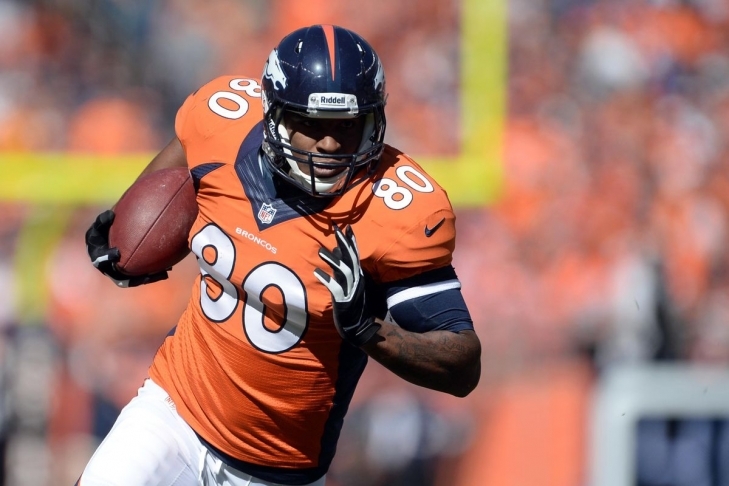
Selected in the seventh round (192nd overall) of the 1990 NFL Draft out of Division II Savannah State, Shannon Sharpe arrived in Denver as a converted wide receiver with long odds of making an impact. Instead, he completely redefined the tight end position, blending wide receiver athleticism with unmatched verbal swagger to become the premier pass-catching tight end of the 1990s and a centerpiece of Denver's back-to-back championship teams.
Prior to Sharpe's emergence, the National Football League regarded tight ends chiefly as supplementary offensive linemen with occasional infiltration into the flat. Sharpe disrupted this traditional perception. By flexing into the slot or enlarging his role as a receiver, he compelled defensive coordinators to confront complex schematic challenges. Should a defense maintain base personnel, Sharpe evaded coverage by isolating a slow-footed linebacker; conversely, if they employed nickel or dime defensive backs, Denver responded with audible shifts to facilitate a handoff to Terrell Davis into a less crowded box. His capacity to divert coverage away from the perimeter facilitated the entire offensive operation, acting as both a primary vertical target and an auxiliary catalyst for Denver's renowned zone-blocking running scheme.
Sharpe demonstrated exceptional speed that outpaced linebackers when covering downfield, and physicality that proved challenging for safeties attempting tackles in open space. Head coach Mike Shanahan strategically utilized Sharpe’s unique movement abilities by positioning him in the slot, in the flex, or isolated on the boundary. Possessing elite run-after-catch acceleration, Sharpe effectively employed strong hands to secure passes amid traffic and subsequently accelerate past defensive backs, resulting in explosive gains.
Sharpe’s illustrious career commenced during his breakout year of 1992, when he led the Denver Broncos in receiving with 53 receptions for 640 yards, thereby earning his inaugural Pro Bowl selection. In 1993, he cemented his status as a premier offensive asset by receiving his first First-Team All-Pro accolade after securing 81 receptions for 995 yards and nine touchdowns, including a historic 13-reception playoff game against the Los Angeles Raiders. He further demonstrated his continued excellence in 1994 with a career-high 87 receptions for 1,010 yards, evidencing that defensive game-planning could not effectively limit his downfield volume.
When Mike Shanahan assumed coaching responsibilities in 1995, Sharpe adapted seamlessly, recording 63 receptions across 13 games despite contending with injuries. From 1996 to 1998, Sharpe attained the pinnacle of his career, securing three consecutive First-Team All-Pro honors. He achieved 80 receptions for 1,062 yards and 10 touchdowns in 1996, followed by a personal-best 1,107 receiving yards in 1997. During the 1997 postseason, his critical third-and-5 reception against Pittsburgh in the AFC Championship Game secured Denver’s qualification for the Super Bowl, ultimately leading to victory in Super Bowl XXXII. He concluded his seven-year Pro Bowl streak in 1998 with 768 yards and 10 touchdowns, aiding Denver in achieving a 14-2 record and clinching consecutive championships in Super Bowl XXXIII.
Following a two-year stint with the Baltimore Ravens, during which he secured his third Super Bowl ring (XXXV) and an eighth Pro Bowl selection, Sharpe returned to Denver in 2002 to complete his career. At the time of his retirement following the 2003 season, Sharpe held the all-time NFL records for tight ends in receptions (815), receiving yards (10,060), and receiving touchdowns (62), becoming the first tight end in league history to cross the 10,000-yard threshold.
In 2009, he was inducted into the Denver Broncos Ring of Fame. In 2011, he entered the Pro Football Hall of Fame. Playing for the Broncos (1990–1999, 2002–2003), Sharpe appeared in 172 games (139 starts), with 675 receptions, 8,439 yards, and 55 touchdowns.