
- Published in Awards = HOF / Hockey
The Ted Lindsay Award
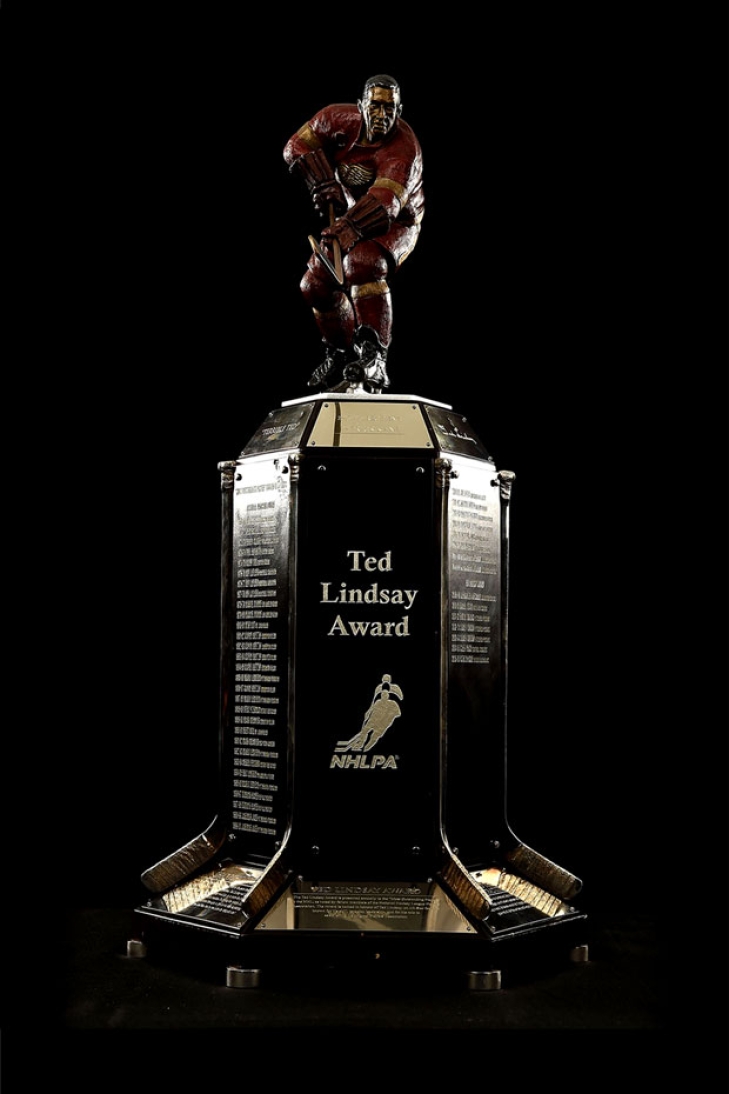
The Hart is not the only award considered the MVP in Hockey, as in the 1971-72 Season, the Lester B. Pearson Award was created, which is where the players vote on who they feel is the league MVP. In 2010, it was renamed the Ted Lindsay Award, in honor of the Hall of Famer who spearheaded the creation of the NHLPA.
The results are as follows:
There are currently 20 former Ted Lindsay Award winners who are Hockey Hall of Fame eligible with 18 entering, yielding a percentage of 90.0.
This covers 33 years of Hall-eligible winners, of which 31 of them saw a Conn Smythe winner enter the Hall. This yields a percentage of 93.9.
The following are the past players who have won the Ted Lindsay Award who are eligible for the Hockey Hall of Fame and have been enshrined.
1971: Phil Esposito, Boston Bruins, Center: 76 Goals, 76 Assists, 152 Points, +69, 18.5 Point Shares.
A year after he led the Bruins to a Stanley Cup, Phil Esposito won the first ever Lester B. Pearson Award on the strength of hockey’s first ever 76 Goal Season, a number he matched in Assists. His 152 Points landed him another Art Ross Trophy, and he was a First Team All-Star for the third straight season. Esposito was not the Hart Trophy winner, as despite his incredible accomplishments, the honor went to Bobby Orr, who had 139 Points and 22.8 Point Shares.
Inducted into the Hall of Fame in 1984.
1972: Jean Ratelle, New York Rangers, Center: 46 Goals, 63 Assists, 109 Points, +61, 13.6 Point Shares.
Jean Ratelle had his best season in hockey where he had career-highs in the big three offensive stats (46 Goals, 63 Assists and 109 Points). Ratelle was the league-leader in Even Strength Goals (40) and Shot Percentage (25.1%) and with only four Penalty Minutes, he was an easy choice for the Lady Byng. Ratelle was only fourth for the Hart this year (Bobby Orr won it), and he was a Second Team All-Star at Center behind Phil Esposito. Ratelle scored 1,267 Points over his career
Inducted into the Hall of Fame in 1985.
1973: Bobby Clarke, Philadelphia Flyers, Center: 37 Goals, 67 Assists, 104 Points, +32, 10.3 Point Shares.
For the first time, an expansion team had a player win the Hart when Bobby Clarke took it for the first of three times. The Center, who had won the Bill Masterton Award the year before, was the Second Team All-Star behind Phil Esposito, but bested the Bruin for the Lester B. Pearson and also the Hart Trophy, as much of Philadelphia’s success this season was led by Clarke, but the best was coming for Philadelphia and the “Broad Street Bullies”. Clarke would lead the Flyers to the next two Stanley Cups, and he also won a second and third Hart. Clarke played the entirety of his career with Philadelphia, retiring in 1984 with 1,210 career Points.
Inducted into the Hall of Fame in 1987.
1974 (2): Phil Esposito, Boston Bruins, Center. 68 Goals, 77 Assists, 145 Points, +51, 17.0 Point Shares.
This was Esposito’s second Lester B. Pearson Trophy and making him the first to become a multi-time winner. In between his two Pearson wins, Esposito won his second Stanley Cup, and two Art Ross Trophies. This season, Esposito won his fifth Art Ross Trophy, was a First Team All-Star for the sixth time, and was also the winner of the Lester B. Pearson. Esposito was also the NHL’s Goal leader for the sixth consecutive season, and this was also the fifth straight year a Bruin won the Hart. The charismatic Center was a Second Team All-Star the year after, and he was then traded to the New York Rangers where he played until he retired in 1981. Esposito accumulated 717 Goals and 1,590 Points over his career.
Inducted into the Hall of Fame in 1984.
1975: Bobby Orr, Boston Bruins, Defense. 46 Goals, 89 Assists, 135 Points, +80, 21.5 Point Shares.
You could argue that Bobby Orr’s Lester B. Pearson Trophy 1975 was a surprise. It was not that he wasn’t worthy, but the shock was that he had never won it before despite the hardware being only five years old. Previously, Orr won three Hart Trophies, two Stanley Cups, seven Norris Trophies, a Conn Smythe and an Art Ross. This season, he would win his second Art Ross trophy in 1974-75, and to date he was the first, last and only blueliner to win that honor. Orr was also the first Defenseman to win the Pearson. A knee injury derailed his career, and he only scored 55 Points over his final three years in hockey, the latter two being in a Blackhawks uniform. He was fast-tracked into the Hall, and there will never be another Defenseman like him again.
Inducted into the Hall of Fame in 1979.
1976: Guy Lafleur, Montreal Canadiens, Right Wing. 56 Goals, 69 Assists, 125 Points, +67, 13.8 Point Shares.
The Montreal Canadiens have had many dynasties over their existence, and in the 1970s, their offensive leader was Guy Lafleur. A First Team All-Star the Year before, Lafleur was so again this year and he won his first Art Ross. The Right Wing was third this year for the Hart and Lady Byng, but more importantly, he led the Habs to a Stanley Cup win, and his second overall.
Inducted into the Hall of Fame in 1987.
1977 (2): Guy Lafleur, Montreal Canadiens, Right Wing. 56 Goals, 80 Assists, 136 Points, +89, 15.7 Point Shares.
Guy Lafleur took them to their second straight Stanley Cup and he also won the Hart Trophy. The Habs star won his second Art Ross and earned his third First Team All-Star Selection. This would be the only season where he won the Conn Smythe as well as leading the league in Assists (80). Notably, LaFleur became the first back-to-back Pearson/Lindsay winner.
Inducted into the Hall of Fame in 1988.
1978 (3): Guy Lafleur, Montreal Canadiens, Right Wing. 60 Goals, 72 Assists, 132 Points, +73, 15.8 Point Shares.
Lafleur was named a First Team All-Star for the fourth of what would be six straight selections, and would also mark his second Hart and third and final Art Ross Trophy. The Right Wing played with Montreal until he was forced to retire in the 1984-85 Season. After being inducted into the Hockey Hall of Fame, he came out of retirement for three seasons, one with the New York Rangers and two with Quebec. He would retire for good in 1991, leaving the NHL with 1,353 Points, and was the first ever three-time Ted Lindsay Award winner.
Inducted into the Hall of Fame in 1988.
1979: Marcel Dionne, Los Angeles Kings, Center. 59 Goals, 71 Assists, 130 Points, +22, 13.3 Point Shares.
Dionne was a First Team All-Star two years before, and this season he was a Second Team All-Star behind Bryan Trottier of the New York Islanders, who also won the Hart Trophy. Dionne was third for the Hart this season, and was the first King to win the Pearson.
Inducted into the Hall of Fame in 1992.
1980 (2): Marcel Dionne, Los Angeles Kings, Center. 53 Goals, 84 Assists, 137 Points, +34, 13.5 Point Shares
Dionne went back-to-back with his second Pearson, and he was a First Team All-Star, besting Wayne Gretzky, who beat him for the Hart. This makes Dionne the only multiple Pearson winner never to win a Hart. This might be true, but Dionne won the Art Ross Trophy this year and he had three more 100 Point years. Dionne, who originally played with Detroit, finished his career with the New York Rangers in 1989 and retired with 1,307 Points.
Inducted into the Hall of Fame in 1992.
1982: Wayne Gretzky, Edmonton Oilers, Center. 92 Goals, 120 Assists, 212 Points, +80, 19.7 Point Shares.
92 Goals. When Phil Esposito lit the lamp 76 times, that record seemed unbreakable, but this year, Gretzky had 92 Goals and hit the 50 Goal mark after only 39 Games! Not only the Gretzky set new records in Goal scoring, he broke his own Assists mark (120), and broke the 200 Point plain with his personal best 212. Gretzky also for the first time was the NHL leader in Plus/Minus (+80). This was Gretzky’s second Art Ross and First Team All-Star, but for the first time he won the Lester B. Pearson Award, meaning his peers could no longer deny his talent.
Inducted into the Hall of Fame in 1999.
1983 (2): Wayne Gretzky, Edmonton Oilers, Center. 71 Goals, 125 Assists, 196 Points, +61, 18.0 Point Shares.
Gretzky was again an offensive juggernaut, and for the third year in a row, he broke the single-season Assists mark. He repeated the awards he won last year, with an Art Ross, Hart and First Team All-Star, but this year he led the Oilers to their first Stanley Cup appearance. They lost to the New York Islanders, but we knew was set to come. Notably, Gretzky became the first player to win the Hart four years in a row.
Inducted into the Hall of Fame in 1999.
1984 (3): Wayne Gretzky, Edmonton Oilers, Center. 87 Goals, 118 Assists, 205 Points, +78, 19.6 Point Shares.
Imagine having a season where you score 87 Goals, 118 Assists and 205 Points, and none of those are personal highs. Gretzky was just that good. This was Gretzky’s fifth straight Hart (becoming the first to do have five straight), and he also won his fourth Art Ross and First Team All-Star, and he captured his fifth Hart Trophy. The coup de gras for Gretzky was leading Edmonton to their first Stanley Cup win.
Inducted into the Hall of Fame in 1999.
1985 (4): Wayne Gretzky, Edmonton Oilers, Center. 73 Goals, 135 Assists, 208 Points, +100, 19.6 Point Shares.
Gretzky matched his idol’s (Gordie Howe) mark in Hart wins, but unlike Howe, Gretzky did it in six consecutive years. This would be the fourth straight year the Gretzky led the NHL in Goals, and he also set a career-high in Plus/Minus with +100. In regards to his trophy case, Gretzky repeated as the Art Ross winner, Lester B. Pearson winner and First Team All-Star, but this time he added a new award, the Conn Smythe Trophy, as the Oilers won their second Stanley Cup.
Inducted into the Hall of Fame in 1999.
1986: Mario Lemieux, Pittsburgh Penguins, Center. 48 Goals, 93 Assists, 131 Points, -8, 10.9 Point Shares.
Mario Lemieux was only in his second season in the NHL, but he already saved the Pittsburgh Penguins from relocating. Lemieux was a Second Team All-Star behind Gretzky, and he was second to him for the Hart too. He was the first Pearson winner for the Penguins.
Inducted into the Hall of Fame in 1997.
1987 (5): Wayne Gretzky, Edmonton Oilers, Center. 62 Goals, 121 Assists, 183 Points, +69, 17.6 Point Shares.
Gretzky did it again with an unprecedented eighth Hart Trophy, and he did so while collecting yet another First Team All-Star and Art Ross while leading the NHL in Goals for the fifth and final time. This would also be Gretzky’s fifth and final Lester B. Pearson Award. Gretzky took the Oilers to their third Stanley Cup win, and did so again the year after. He was traded to the Los Angeles Kings, and won his ninth Hart there. After a brief stint with St. Louis in 1996 and three final years with the Rangers, Gretzky retired as the all-time leader in Goals (894), Assists (1,963) and Points (2,857).
Inducted into the Hall of Fame in 1999.
1988 (2): Mario Lemieux, Pittsburgh Penguins, Center. 70 Goals, 98 Assists, 168 Points, +23, 16.2 Point Shares.
This year, Mario Lemieux brought the Pittsburgh Penguins their first Hart Trophy winner, and playing at Center, he did the unthinkable by unseating Gretzky as the First Team All-Star. Lemieux led the NHL in Goals for the first time, and this year he also notched his first Art Ross Trophy. His peers already knew how magnificent he was, as this was Lemieux’s second Pearson Award.
Inducted into the Hall of Fame in 1997.
1989: Steve Yzerman, Detroit Red Wings, Center. 65 Goals, 90 Assists, 155 Points, +17, 14.4 Point Shares.
Steve Yzerman never won the Hart, but this season he won the Lindsay on the year he had career-highs in Goals (60), Assists (90) and Points (155). This was the year that returned the Red Wings to prominence, and Yzerman was the first Red Wing to win the Pearson. Yzerman led the Red Wings to three Stanley Cups, won a Conn Smythe and had 1,755 career Points.
Inducted into the Hall of Fame in 2011.
1990: Mark Messier, Edmonton Oilers, Center. 45 Goals, 84 Assists, 129 Points, +19, 11.3 Point Shares.
The Edmonton Oilers traded Wayne Gretzky to the Los Angeles Kings, which meant that Mark Messier would become the Oilers’ leader. Messier did what Gretzky couldn’t without the other…win the Stanley Cup. Messier’s 129 Points were a career-high, and he was named a First Team All-Star this year. What Messier this season should be celebrated a lot more than it is, and we say that even though Messier won the Hart that year!
1991: Brett Hull, St. Louis Blues, Right Wing. 86 Goals, 45 Assists, 131 Points, +23, 15.4 Point Shares.
Brett Hull led the NHL in Goals for three seasons in a row, and in all three of them, he had at least 70. This was Hull’s highwater mark, and he would also secure the Hart Trophy. A three-time First Team All-Star, Hull later won a Stanley Cup as a Dallas Star in 1999 and a Detroit Red Wing in 2002. Retiring in 2006, Hull had 527 career Goals.
Inducted into the Hall of Fame in 2009.
1992 (2): Mark Messier, New York Rangers, Center. 35 Goals, 72 Assists, 107 Points, +31, 9.9 Point Shares.
Messier became the first player to win the Pearson with two different teams. The Center was now the leader of the Rangers, and he was also the winner of the Hart Trophy and a First Team All-Star. Messier’s leadership would take the Rangers to a 1994 Stanley Cup, and he was so good at that role, that the National Hockey League would create a “Mark Messier Leadership Award”. When he retired, Messier scored 1,887 career Points.
Inducted into the Hall of Fame in 2007.
1993 (3): Mario Lemieux, Pittsburgh Penguins, Center. 69 Goals, 91 Assists, 160 Points, +55, 16.2 Point Shares.
Since his second Lester B. Pearson Award, Lemieux went on to win the 1991 and 1992 Stanley Cup, and injuries prevented him from full seasons, which kept the Hart from his grabs. This year, he only played 60 Games, but he won the Art Ross with 160 Points and led the NHL in Plus/Minus (+55). Lemieux would also win the Hart, was a First Team All-Star and he was the Bill Masterton Award winner. Why did he only play 60 Games? Lemieux was diagnosed with Hodgkin’s lymphoma, yet came back to finish the season.
Inducted into the Hall of Fame in 1997.
1994: Sergei Fedorov, Detroit Red Wings, Center. 56 Goals, 64 Assists, 120 Points, +48, 13.8 Point Shares.
Making history as the first non-Canadian and first European to win the Pearson, Sergei Fedorov was in his fourth NHL season and this was best statistical season by far. Fedorov was a First Team All-Star, Hart Trophy winner and Frank J. Selke winner this year, and he would later win three Stanley Cups for Detroit. The Russian later won another Selke Trophy and he would later play for Anaheim, Columbus and Washington. Fedorov scored 1,179 career Points.
Inducted into the Hall of Fame in 2015.
1995: Eric Lindros, Philadelphia Flyers, Center. 29 Goals, 41 Assists, 70 Points, +27, 8.8 Point Shares.
The Philadelphia Flyers gave an awful lot to get Eric Lindros, and while it might not have been worth it, it was still a Pearson winner. Lindros was a First Team All-Star this year as well as the coveted Hart Trophy winner in this strike-shortened year. Lindros also won his only Art Ross this year, and he was a 1.14 PPG player over his 13 NHL Seasons.
Inducted into the Hall of Fame in 2016.
1996 (4): Mario Lemieux, Pittsburgh Penguins, Center. 69 Goals, 92 Assists, 161 Points, +10, 17.4 Point Shares.
Lemieux also won his third Hart and fifth Art Ross trophy this season, while also earning First Team All-Star honors. The Center was a First Team All-Star and Art Ross winner the next year, and he retired after that. He came back in 2000, now as a player/owner albeit on the ice on a reduced role due to his past injuries and fatigue. He played his last game in 2006, accumulating 1,723 career Points.
Inducted into the Hall of Fame in 1997.
1997: Dominik Hasek, Buffalo Sabres, Goalie. 37 Wins, 20 Losses, 10 Ties, 2.27 GAA, .930 Save Percentage, 17.2 Point Shares.
Dominik Hasek was already considered one of the best Goalies in Hockey, but this year he was elevated to the best player in the world. This season, Hasek won his third Vezina Trophy and earned his third First Team All-Star, and he was also won the Hart. Hasek was also first in Save Percentage for the fourth year in the row. He also made history as the first Czech player to win the Pearson.
Inducted into the Hall of Fame in 2014.
1998 (2): Dominik Hasek, Buffalo Sabres, Goalie. 33 Wins, 23 Losses, 13 Ties, 2.09 GAA, .932 Save Percentage, 18.6 Point Shares.
In terms of accolades, Hasek repeated his efforts of 1997 with a Hart, Lester B. Pearson, a Vezina and a First Team All-Star, and he again led the NHL in Save Percentage. Hasek would later win two more Vezina Trophies. In 1999, Hasek took Buffalo on his back and carried them to a Stanley Cup Final. The Czech Goalie grew frustrated and asked for a trade, which he got when he was sent to Detroit. He would win two Stanley Cups with Detroit and then played in Europe, retiring in 2011.
Inducted into the Hall of Fame in 2014.
2001: Joe Sakic, Colorado Avalanche, Center. 54 Goals, 64 Assists, 118 Points, +45, 15.9 Point Shares.
Sakic was the first Nordiques/Avalanche player to win the Lester B. Pearson, which he did in his 13thseason. Sakic had a career-high 54 Goals, was the NHL leader in Plus/Minus (+45) and he was also the winner of the Lady Byng and the Hart Trophy. This year, Sakic and the Avs won the Stanley Cup, which was their second, having won it in 1996. The Center was also named a First Team All-Star, and would be again in two of the next three years. Sakic played his entire career with Quebec/Colorado, retiring in 2009 with 1,641 Points.
Inducted into the Hall of Fame in 2015.
2002: Jarome Iginla, Calgary Flames, Right Wing. 52 Goals, 44 Assists, 96 Points, +27, 14.4 Point Shares.
Iginla was a First Team All-Star for the first of what would be three times, and he was also the Maurice Richard and Art Ross Trophy winner this year. Iginla did not win the Hart as he was the runner-up to the Montreal Goalie, Jose Theodore. He played with the Flames until 2013, and would later play for Pittsburgh, Boston, Colorado and Los Angeles, and had an even 1,300 career Points.
Inducted into the Hall of Fame in 2020.
2004: Martin St. Louis, Tampa Bay Lightning, Right Wing. 38 Goals, 56 Assists, 94 Points, +35, 13.2 Point Shares.
It was a breakout campaign for St. Louis who was in his sixth season, and fourth in Tampa Bay after playing for Calgary in seasons one and two. St. Louis became the first Lightning player to win the Pearson, and he also won the Hart, Art Ross, was a First Team All-Star and was the NHL leader in Plus/Minus (+35). St. Louis led Tampa to the Stanley Cup that year. After this year, St. Louis was a Second Team All-Star four times, won another Art Ross and would also win three Lady Byng Trophies. He played until 2015, after a year and a half with the Rangers.
Inducted into the Hall of Fame in 2018.
2011: Daniel Sedin, Vancouver Canucks, Left Wing. 41 Goals, 63 Assists, 104 Points +30, 14.3 Point Shares
Along with his twin brother, Henrik, Daniel Sedin played his entire 17-year career with the Vancouver Canucks, with his best season coming right in the middle of it. Sedin was a First Team All-Star this year, and he would also win the Art Ross, the only time in his career he accomplished either of those. Sedin was second in Hart voting, finishing behind Corey Perry of Anaheim. Sedin retired with 1,041 career Points.
Inducted into the Hall of Fame in 2021.
The following are the players who have won the Ted Lindsay Award who are eligible for the Hockey Hall of Fame and have not been selected:
1981: Mike Liut, St. Louis Blues, Goalie. 33 Wins, 14 Losses, 13 Ties, 3.35 GAA, .894 Save Percentage, 11.6 Point Shares.
Mike Liut was named a First Team All-Star and he was the runner-up for the Hart, finishing behind Wayne Gretzky. Gretzky won his second Hart this year, but his peers named Liut the Pearson winner, making Liut the first Goalie to win the award. Playing until 1992, Liut was a Second Team All-Star in 1986-87 when he was playing with the Hartford Whalers. Liut finished his career with two and a half seasons in Washington, and he had an overall record of 293-271-74.
Eligible since 1995. Ranked #85 on Notinhalloffame.com.
2003: Markus Naslund, Vancouver Canucks, Left Wing. 48 Goals, 56 Assists, 104 Points, +6, 13.5 Point Shares.
Naslund was not only the first Vancouver Canuck to win the Pearson, he was also the first from Sweden to capture the trophy. Naslund was in year two of his three-year run as a First Team All-Star, and he was the runner-up for the Hart to Peter Forsberg of the Colorado Avalanche. Naslund played in the NHL until 2009, with his last year being as a New York Ranger. The Swedish Wing had 869 NHL Points.
Eligible since 2012. Ranked #45 on Notinhalloffame.com.
The following are the players who have won the Ted Lindsay Award in the NHL who have retired but have not met the mandatory years out of the game to qualify for the Hockey Hall of Fame:
?
The following are the players who have won the Ted Lindsay Award Trophy who are still active.
1999: Jaromir Jagr, Pittsburgh Penguins, Right Wing. 44 Goals, 83 Assists, 127 Points, +17, 14.6 Point Shares.
This was Jagr’s ninth season in the NHL, and they were all spent with the Pittsburgh Penguins. Winning his third Art Ross Trophy, Jagr had career highs in Assists (83) and Points (127), and he was also the Hart Trophy winner, and he previously helped Pittsburgh win two Stanley Cups.
50 Years Old, Playing in Europe.
2000 (2): Jaromir Jagr, Pittsburgh Penguins, Right Wing. 42 Goals, 54 Assists, 96 Points, +25, 12.2 Point Shares.
Jagr went back-to-back for the Pearson, and this was the third straight year he led the NHL in Assists and it was also his third straight Art Ross and First Team All-Star. Jagr was second for the Hart this year, and the year after he had his fourth consecutive Art Ross and First Team All-Star.
50 Years Old, Playing in Europe.
2006 (3): Jaromir Jagr, New York Rangers, Right Wing. 54 Goals, 69 Assists, 123 Points, +34, 15.5 Point Shares.
This was a comeback year of sorts for Jagr, who had his first three-digit year in scoring since 2000-01. This was his last season where he hit at least 100, but he remained a scorer, playing for Philadelphia, Boston, New Jersey, Florida and Calgary. He won the Bill Masterton in 2016-17 and accumulated a colossal 1,921 career Points.
50 Years Old, Playing in Europe.
2007: Sidney Crosby, Pittsburgh Penguins, Center. 36 Goals, 84 Assists, 120 Points, +10, 13.3 Point Shares.
“Sid the Kid” did not win the Calder, as that went to his long-time rival, Alex Ovechkin. Crosby would however beat him to a Lester B. Pearson win, which he collected in his sophomore season. Crosby would also win his first Art Ross, was named a First Team All-Star, he also won the prestigious Hart Trophy. There was a lot more to come for Crosby.
35 Years Old, Playing for the Pittsburgh Penguins.
2008: Alex Ovechkin, Washington Capitals, Left Wing. 65 Goals, 47 Assists, 112 Points, +28, 17.2 Point Shares.
Ovechkin won his first Lester B. Pearson in his third season, which was also the first by a Washington Capital. A First Team All-Star in all of his seasons to date, Ovechkin also won the Hart Trophy, the Art Ross Trophy, and the Rocket Richard Award for his 65 Goals.
37 Years Old, Playing for the Washington Capitals.
2009 (2): Alex Ovechkin, Washington Capitals, Left Wing. 56 Goals, 54 Assists, 110 Points, +8, 14.5 Point Shares.
The Russian Center repeated most of his honors in his back-to-back Pearson win. Ovechkin repeated as the Rocket Richard winner, and was a First Team All-Star for his fourth consecutive season. He would also win his second straight Hart.
37 Years Old, Playing for the Washington Capitals.
2010 (3): Alex Ovechkin, Washington Capitals, Left Wing. 50 Goals, 59 Assists, 109 Points, +45, 15.6 Point Shares.
Ovechkin remained in hickey elite, capturing his third consecutive Lester B. Pearson, which was now renamed the Ted Lindsay Award. Again, a First Team All-Star, Ovechkin missed out on the Hart, losing to Henrik Sedin of the Vancouver Canucks.
37 Years Old, Playing for the Washington Capitals.
2012: Evgeni Malkin, Pittsburgh Penguins, Center. 50 Goals, 59 Assists, 109 Points, +18, 13.4 Point Shares.
The first three seasons for Evgeni Malkin was nothing short of stunning. Malkin won the Calder in 2006-07, was a First Team All-Star in all three years, and was the Art Ross Winner in 2008-09, while winning the Stanley Cup and the Conn Smythe. Malkin’s two years after was riddled with injuries, but he made up for it in 2011-12 with a second Art Ross, and his first Hart. Malkin was a First Team All-Star for the fourth time, and he also won the Hart Trophy. He would go on to win two more Cups with Pittsburgh.
34 Years Old, Playing for the Pittsburgh Penguins.
2013 (2): Sidney Crosby, Pittsburgh Penguins, Center. 15 Goals, 41 Assists, 56 Points, +26, 7.5 Point Shares.
In between his first and second Ted Lindsay Award, Crosby won a Stanley Cup in 2009, was a Second Team All-Star (2010), won a Rocket Richard Trophy (2009) and a Mark Messier Leadership Award (2010). A First Team All-Star this year, Crosby was second for the Hart to Ovechkin.
35 Years Old, Playing for the Pittsburgh Penguins.
2014 (3): Sidney Crosby, Pittsburgh Penguins, Center. 36 Goals, 84 Assists, 120 Points, +18, 13.3 Point Shares.
Crosby went back-to-back in Ted Lindsay wins, and this season he collected another Art Ross, a Hart, and a First Team All-Star Selection. Crosby later won two more Stanley Cups with the Pens in 2016 and 2017.
35 Years Old, Playing for the Pittsburgh Penguins.
2015: Carey Price, Montreal Canadiens, Goalie. 44 Wins, 16 Losses, 5 Ties, 1.96 GAA, .933 Save Percentage, 16.2 Point Shares.
This was the eighth NHL season for Price, who as of this writing has only played for the Montreal Canadiens. Price led the NHL in Wins (44), Save Percentage (.933) and Goals Against Average (1.96), and he not only won the Hart, he also captured the Vezina, William M. Jennings, Hart Trophy, and he was also a First Team All-Star. This is the only year that Price was a post-season All-Star.
35 Years Old, Playing for the Montreal Canadiens.
2016: Patrick Kane, Chicago Blackhawks, Right Wing. 46 Goals, 60 Assists, 106 Points, +17, 15.0 Point Shares.
This was Kane’s ninth season in the NHL and the Chicago Blackhawk had already accomplished so much before his Ted Lindsay win. Kane won the Calder, and was already a two-time First Team All-Star, and a three-time Stanley Cup winner. This season, Kane was a First Team All-Star for a third time, and also won his first Art Ross and Hart Trophy. Kane has been a First Team All-Star for a fourth time and earned a Second Team All-Star. He is already a member of the 1,000 Point club.
34 Years Old, Playing for the Chicago Blackhawks.
2017: Connor McDavid, Edmonton Oilers, Center. 30 Goals, 70 Assists, 100 Points, +27, 12.8 Point Shares.
McDavid was in his second season, where he not only won the Ted Lindsay, but was the winner of the Art Ross and the Hart. This season also brought in the first of three straight First Team All-Stars.
26 Years Old, Playing for the Edmonton Oilers.
2018 (2): Connor McDavid, Edmonton Oilers, Center. 41 Goals, 67 Assists, 108 Points, +20, 13.1 Points Shares.
McDavid won his second straight Ted Lindsay Award, and it coincided with his second Art Ross and First Team All-Star Selection. The Oiler was only fifth in Hart voting, finishing behind Taylor Hall (winner, New Jersey), Nathan McKinnon (Colorado), Anze Kopitar (Los Angeles) and Claude Giroux (Philadelphia).
26 Years Old. Playing for the Edmonton Oilers.
2019: Nikita Kucherov, Tampa Bay Lightning, Right Wing. 41 Goals, 87 Assists, 128 Points, +24, 14.6 Point Shares.
Kucherov was in his sixth NHL season (all with Tampa) and he would win not only the Hart but his first Art Ross and Hart Trophy. Kucherov was a First Team All-Star for the Second straight time and the year after he was a Second Team All-Star and led the Lightning win the Stanley Cup in 2020.
29 Years Old, Playing for the Tampa Bay Lightning.
2020: Leon Draisaitl, Edmonton Oilers, Center. 43 Goals, 67 Assists, 110 Points, -7, 12.8 Point Shares.
Draisaitl’s Ted Lindsay Award win marked the first time that a German player won the most coveted individual award in Hockey. Draisaitl was in his sixth season in hockey (all with Edmonton) and this year he also won the Hart, Art Ross, and was a First Team All-Star.
27 Years Old, Playing for the Edmonton Oilers.
2021 (3): Connor McDavid, Edmonton Oilers, Center. 44 Goals, 79 Assists, 123 Points, +28, 13.0 Points Shares.
McDavid captured his third Ted Lindsay, while adding a second Hart and fourth Art Ross. There are only a handful of players who accomplished as many awards as McDavid did in such a short period of time.
26 Years Old. Playing for the Edmonton Oilers.
2022: Auston Matthews, Toronto Maple Leafs, Center. 60 Goals, 46 Assists, 106 Points, +20, 13.2 Points Shares.
It took over 40 years before the Maple Leafs had their first Ted Lindsay Award winner, and it took a 60 Goal winner to it. Matthews also won the Hart Trophy, his first, and beat out Connor McDavid as this year’s First Team All-Star at Center.
25 Years Old. Playing for the Toronto Maple Leafs.
As expected, the Ted Lindsay Award is like the Hart Trophy as an excellent indicator for Hall of Fame induction.