Menu
A+ A A-
Site Admin

Site Admin

9. Boog Powell

In the golden era of the Baltimore Orioles, few figures loomed as large—physically or culturally—as John Wesley "Boog" Powell. A massive, 6-foot-4 presence at first base, Boog was the primary power engine for the great championship teams of the late 1960s and early 70s. With a nickname born of childhood mischief and a swing that could launch mammoth home runs into the far reaches of Memorial Stadium, he was the definitive fan favorite of a generation.

Signed as an amateur free agent in 1959, Powell debuted for Baltimore just two seasons later and quickly established himself as a premier run-producer. Over the next 14 years, he would record eight seasons with at least 20 home runs, including three campaigns where he cleared the 100-RBI plateau. His peak coincided with the franchise’s most dominant stretch; from 1968 to 1971, Boog reeled off four consecutive All-Star selections. During this run, he authored his finest season in 1969—batting a career-high .304—before following it up with a masterful 1970 campaign that earned him the American League MVP.

Powell’s left-handed bat was the cornerstone of the Orioles' "Big Three" alongside the two Robinsons. He was instrumental in securing the 1966 and 1970 World Series titles, often saving his most clutch performances for October. Over his postseason career, Boog tallied six home runs and 18 RBIs, homering in the first two games of the 1970 Fall Classic to set the tone for the championship.

By the time he was dealt to Cleveland in 1975, Boog had compiled a legendary Orioles resume: 303 home runs, 1,063 RBIs, and a .465 slugging percentage. Inducted into the Baltimore Orioles Hall of Fame in 1979, he remains one of the most beloved icons in franchise history—a "gentle giant" whose power put the Orioles on top of the world

8. Urban Shocker

The greatest pitcher in the history of the St. Louis Browns, and arguably the owner of the most memorable name in the sport, is Urban Shocker. Though his career began and ended with the New York Yankees, his seven-year peak in St. Louis (1918–1924) cemented his status as the premier arm of the franchise’s Midwestern era.

After a quiet debut following a 1918 trade from New York, Shocker exploded into the regular rotation in 1919. What followed was a stretch of durability and dominance rarely seen in the "Live-Ball" transition. From 1920 to 1923, Shocker reeled off four consecutive 20-win seasons, headlined by a league-leading 27 victories in 1921.

A master of the "grandfathered" spitball, Shocker was much more than a junk-baller; he was a surgical control artist. He famously prioritized location over velocity, leading the American League in both BB/9 and Strikeout-to-Walk ratio (SO/BB) in 1922 and 1923. His efficiency was so respected by his contemporaries that he received MVP votes in both of those seasons—a rarity for pitchers in that era.

The "Yankee bookend" of his career was completed in December 1924 when he was traded back to New York. He left St. Louis with a 126–80 record and 704 strikeouts, departing as the franchise’s all-time leader in wins and shutouts. While the Browns relocated to Baltimore decades later, Shocker’s four-year run of 20-win excellence remains the gold standard for any pitcher to ever wear the St. Louis uniform.


7. Frank Robinson

Prior to the 1966 season, the Baltimore Orioles pulled off what remains arguably the most lopsided trade in baseball history. Frank Robinson, a former Rookie of the Year and MVP with Cincinnati, was sent to Baltimore in exchange for Jack Baldschun, Milt Pappas, and Dick Simpson. Defending the move, Reds owner Bill DeWitt infamously labeled Robinson an "old 30." The legendary outfielder responded by authoring the greatest season of his career, instantly transforming the Orioles into a global baseball powerhouse.

In that 1966 debut, Robinson delivered a season for the ages, capturing the American League Triple Crown and becoming the first player to win the MVP award in both leagues. He led the AL in runs (122), home runs (49), and RBIs (122), while posting a devastating slash line of .316/.410/.637. Most importantly, he led Baltimore to its first World Series title, punctuated by his own World Series MVP performance.

Robinson’s arrival signaled the dawn of a dynasty. A five-time All-Star in Baltimore, he proceeded to record three more .300+ seasons and twice more eclipsed the 30-home run mark. He was the veteran heartbeat of the squad that secured the 1970 World Series championship before departing for the Dodgers in 1971. In just six seasons in Baltimore, Robinson maintained a remarkable .300/.401/.543 slash line, accumulating 882 hits and 179 home runs.

His legacy was cemented in 1982 with a first-ballot induction into the National Baseball Hall of Fame. The Orioles retired his iconic #20 and made him—alongside Brooks Robinson—a charter member of the Baltimore Orioles Hall of Fame. To this day, Robinson remains the standard-bearer for peak performance in the history of the franchise.

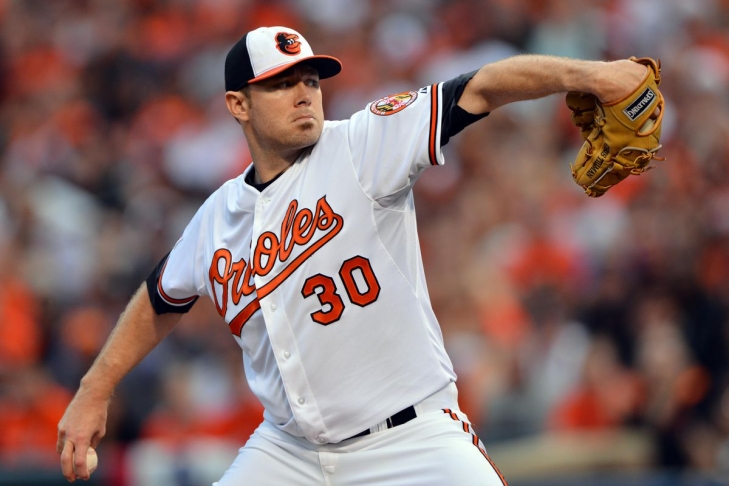
6. Mike Mussina

Mike Mussina anchored the Baltimore rotation for a decade (1991–2000), evolving almost instantly from a standout USC Trojan into one of the most sophisticated arms in the American League. By just his second season, "Moose" had established himself as an elite top-of-the-rotation force, combining a lethal knuckle-curve with a cerebral approach that made him a master of the in-game adjustment.

Selected to five All-Star Games during his Baltimore tenure, Mussina was the definitive model of consistent efficiency. From 1992 through 2000—every season he served as a full-time starter for the Orioles—he ranked among the top eight in the league for walks per nine innings (BB/9), even leading the AL in that category in 1995. His command was matched only by his ability to suppress base runners; he finished as the AL runner-up in WHIP three times and placed in the top five for ERA on five separate occasions in Baltimore. While the Cy Young Award proved elusive, Mussina was a perennial finalist, securing six top-six finishes as an Oriole, highlighted by a runner-up performance in 1999.

Mussina was equally dominant with his glove, securing four consecutive Gold Gloves (1996–1999) and reinforcing his reputation as one of the finest-fielding pitchers to ever play the game. Though he eventually departed for New York, he left Charm City with a towering legacy: a 147–81 record and 1,535 strikeouts in an Orioles uniform.

His journey culminated in a 2019 induction into the National Baseball Hall of Fame. In a characteristic display of poise, Mussina elected to have no logo on his plaque’s cap, honoring both franchises that defined his 18-year career. The Orioles, however, had long since claimed him as their own, inducting the right-hander into the Baltimore Orioles Hall of Fame in 2012.