Menu
A+ A A-
Site Admin

Site Admin

3. Zach Thomas

When the Miami Dolphins selected Zach Thomas in the fifth round (154th overall) of the 1996 NFL Draft, scouts brushed him off as an undersized middle linebacker out of Texas Tech who lacked the raw length and physical measurables to withstand professional blocking schemes. Standing 5-foot-11, Thomas quickly silenced every skeptic by unleashing an uncanny diagnostic instinct, relentless sideline-to-sideline pursuit, and an instinctual nose for the football that transformed him into one of the most prolific tackling artists in gridiron history.

Thomas exploded onto the scene as an immediate defensive catalyst during his 1996 debut campaign, racking up 154 combined tackles, three interceptions, and two sacks while claiming PFWA All-Rookie Team honors. That explosive entry was merely the foundation for a masterclass in elite consistency. Operating at the heart of Jimmy Johnson’s defense, Thomas established a decade-long siege on ball-carriers, consistently ranking among the NFL's elite in total tackles while anchoring a premier defensive unit alongside brother-in-law Jason Taylor.

From his 1996 rookie year through the 2006 season, Thomas was an immovable tackling machine, posting at least 128 combined tackles in every campaign in which he played more than 11 games. He topped the entire league in tackles twice—racking up 156 tackles in 2002 and a career-high 165 in 2006—and finished runner-up on two separate occasions. His extraordinary anticipation enabled him to diagnose plays before the ball was snapped, erasing running lanes and consistently driving offensive schemes into dead ends.

Accolades quickly followed for the Texas Tech product. Across his twelve years in South Florida, Thomas earned seven Pro Bowl invitations and was named a First-Team AP All-Pro five times (1998, 1999, 2002, 2003, and 2006), along with two Second-Team AP All-Pro honors (2001, 2005). Honored as a two-time NFL Alumni Linebacker of the Year, his sustained dominance at the peak of his career earned him selection to the official NFL 2000s All-Decade Team.

Beyond his staggering tackle volume, Thomas possessed a knack for swinging momentum with timely turnovers. A nightmare in pass coverage, he logged 17 interceptions in a Dolphins uniform, returning four of them for touchdowns—a franchise record for interceptions returned for scores by a defensive player. His football IQ and vocal leadership earned him the team's Leadership Award three separate times, making him the undisputed heartbeat of the locker room.

Thomas’s memorable South Florida chapter ended after the 2007 season when he was released during a roster rebuild. He played one last season in 2008 with the Dallas Cowboys, starting 14 games and making 94 tackles. Although he signed with the Kansas City Chiefs in 2009, a severe concussion in training camp sidelined him, ending his career early before he could play in Missouri.

With the Dolphins, he compiled 1,640 combined tackles (1,042 solo, 598 assists), 19.5 sacks, 17 interceptions (170 return yards, four returned for touchdowns), 17 forced fumbles, and seven fumble recoveries. The Dolphins organization honored his contributions by inducting him into the Miami Dolphins Honor Roll in 2012, and in 2023, the Pro Football Hall of Fame called him.
2. Jason Taylor

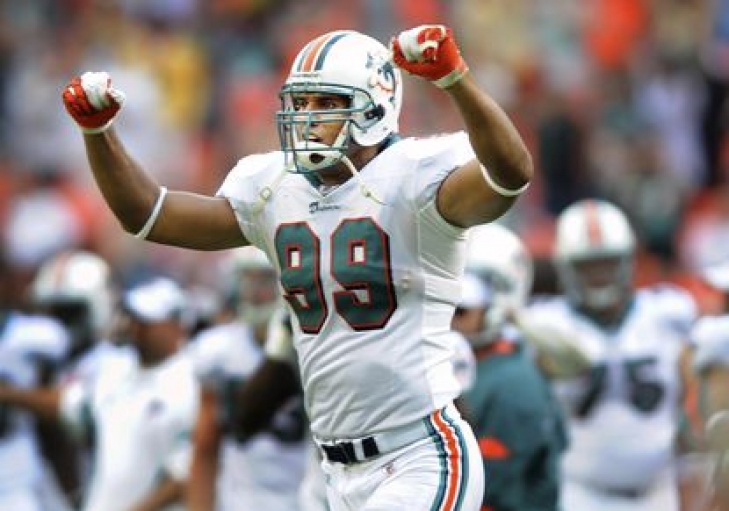
Selected in the third round (73rd overall) of the 1997 NFL Draft out of the University of Akron, Jason Taylor entered the professional ranks after earning two First-Team All-MAC selections as a Zip. The Dolphins saw immense raw potential in the 6-foot-6, 244-pound pass-rushing specialist, and he immediately validated their trust. Taylor recorded 5.0 sacks and two forced fumbles as a rookie, earning PFWA All-Rookie Team honors and laying the foundation for a legendary career in South Florida.

Over his first three professional seasons, Taylor established himself as a reliable, high-motor edge defender, posting 9.0 sacks in 1998 before breaking through to stardom. His signature breakout came in the 2000 campaign, when he recorded 14.5 sacks, four fumble recoveries, and a career-high 20 Approximate Value. That performance earned him his first of six Pro Bowl selections and his first First-Team AP All-Pro nod, signaling the arrival of an elite game-changer on Miami's defensive front.

Taylor built on that momentum with astonishing consistency, recording double-digit sack totals in six different seasons for the Dolphins. His explosive first step, long reach, and relentless strip-sacking technique made him a nightmare for opposing offensive tackles. In 2002, Taylor reached the peak of pass-rushing efficiency, leading the entire NFL with 18.5 sacks and forcing seven fumbles to capture his second First-Team All-Pro honor.

His finest individual campaign arrived in 2006, producing one of the most dominant single-season performances by a defensive lineman in league history. Taylor was a turnover-generating machine, causing a whopping nine forced fumbles while adding 13.5 sacks and returning two interceptions for touchdowns. His unmatched ability to turn defensive disruptions into instant points earned him the 2006 AP NFL Defensive Player of the Year Award.

Beyond his terrifying pass-rushing arsenal, Taylor was equally celebrated for his leadership and humanitarian efforts off the field. Following another standout 11.0-sack campaign in 2007 that earned him his sixth Pro Bowl invitation, he was named the 2007 Walter Payton NFL Man of the Year—a testament to his extensive charitable contributions through the Jason Taylor Foundation, supporting South Florida's vulnerable youth.

After 11 brilliant seasons anchoring Miami's defense, Taylor was traded to Washington in 2008, where he played one season before returning to South Florida. He signed back with the Dolphins as a free agent in 2009 for his second stint in aqua and orange, bringing veteran leadership and posting 7.0 sacks, a forced fumble, and a fumble recovery returned for a touchdown across 16 games.

Following that single-year homecoming, Taylor spent the 2010 season with the division-rival New York Jets, appearing in 16 games and helping drive New York to the AFC Championship Game. But his professional football story was destined to end where it began. In 2011, Taylor signed with Miami for a third and final stint, putting on the Dolphins helmet one last time to complete a storied 15-year career in front of the South Florida faithful.

Across his three stints with Miami, Taylor was the ultimate defensive disrupter. He generated a franchise-record 131.0 sacks in aqua and orange, while amassing 45 forced fumbles and 27 fumble recoveries. His career tally of nine defensive touchdowns—including six fumble returns for scores—stands as an NFL record for defensive linemen, cementing his legacy as one of the most lethal big-play defenders in gridiron history.

The Dolphins enshrined his legacy in 2012 by inducting him into the Miami Dolphins Honor Roll. In 2017, Taylor received top national recognition, being elected to the Pro Football Hall of Fame in his first year of eligibility and earning a spot on the NFL 2000s All-Decade Team.

1. Dan Marino

The 1983 NFL Draft lives in football lore as the legendary "Year of the Quarterback," a frantic first-round frenzy where five passers—John Elway, Todd Blackledge, Jim Kelly, Tony Eason, and Division II product Ken O'Brien—were swept off the board early. Sitting near the bottom of the round after coming off a Super Bowl appearance, the Miami Dolphins watched in absolute disbelief as Dan Marino, a consensus collegiate phenom out of Pittsburgh, unexpectedly plummeted down draft boards due to unproven rumors and pre-draft paranoia. When Miami snatched Marino with the 27th overall pick, they didn't just capitalize on one of the greatest draft-day steals in sports history; they reshaped the parameters of professional passing forever.

Marino made the teams that passed on him pay almost immediately. Taking over the starting quarterback role midway through his 1983 rookie campaign, he took the league by storm with a 7–2 starting record, 20 touchdown passes, a Pro Bowl selection, and PFWA All-Rookie Team honors. But that stellar introductory run was merely a prelude to the most explosive three-year passing stretch the gridiron had ever witnessed.

From 1984 to 1986, Marino accomplished a feat unmatched in NFL history, leading the league in completions, passing yards, and passing touchdowns in three consecutive seasons while earning First-Team AP All-Pro honors each year. His legendary 1984 sophomore campaign fundamentally altered the sport: Marino shattered existing aerial records by becoming the first quarterback to cross the 5,000-yard threshold (5,084) while throwing an unheard-of 48 touchdown passes. Named the NFL MVP and Offensive Player of the Year, he powered Miami to a 14–2 record and an AFC Championship title, driving the Dolphins to Super Bowl XIX.

Though Miami fell to San Francisco in the championship game, Marino established himself as the premier, undisputed passing force of his era. He followed up his historic MVP year by throwing for 4,137 yards and 30 touchdowns in 1985—handing the eventual champion 1985 Chicago Bears their lone defeat of the season—and backed that up with 4,746 yards and 44 touchdown passes in 1986.

Marino led the NFL in passing yards five separate times throughout his career and earned nine total Pro Bowl selections. Lacking mobility in the pocket, he never needed to run. Armed with the fastest, smoothest release in football history and unmatched downfield accuracy, Marino turned solid receivers like Mark Duper and Mark Clayton into lethal, perennial All-Pro weapons.

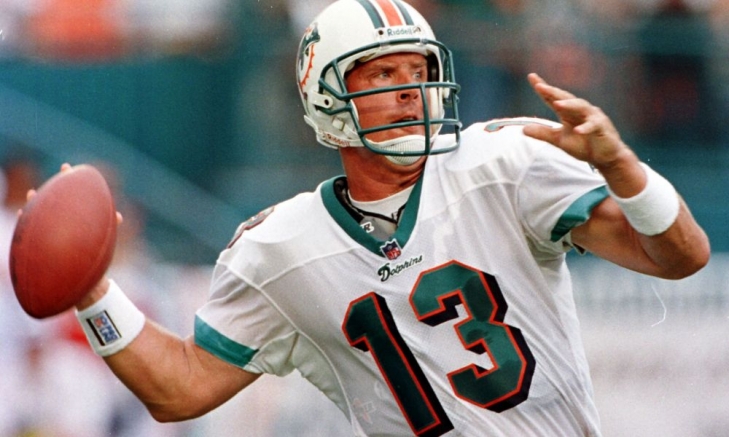
Throughout his 17-year run in South Florida, a consistent running game and elite defensive support rarely materialized around him. Yet despite those perpetual roster deficiencies, as long as No. 13 was behind center, the Dolphins were an immediate Super Bowl threat. His supernatural pocket instincts and quick release allowed him to neutralize pass rushes effortlessly, leading the NFL in lowest sack percentage in ten different seasons.

What Marino achieved in the 1980s and 1990s was entirely unprecedented, operating in a far more physical era for pass defenses before modern rules protected quarterbacks and receivers. While eventual rule changes allowed modern passers to challenge his single-season marks decades later, the sheer distance between Marino and his contemporaries during his prime remains utterly staggering.

When he finally hung up his cleats following the 1999 season, Marino stood alone at the summit of gridiron history as the all-time leading passer, holding every major cumulative throwing record, including completions (4,967), passing yards (61,361), and passing touchdowns (420).  Marino never did win the Super Bowl, but nobody, and we mean nobody, ever placed the blame on the legendary quarterback.

Marino was inducted into the Pro Football Hall of Fame in 2005 during his first eligibility, and was later named to the NFL 100th Anniversary All-Time Team. The Dolphins retired his No. 13 jersey and added him to the Miami Dolphins Honor Roll in 2000.

43. Bryce Paup

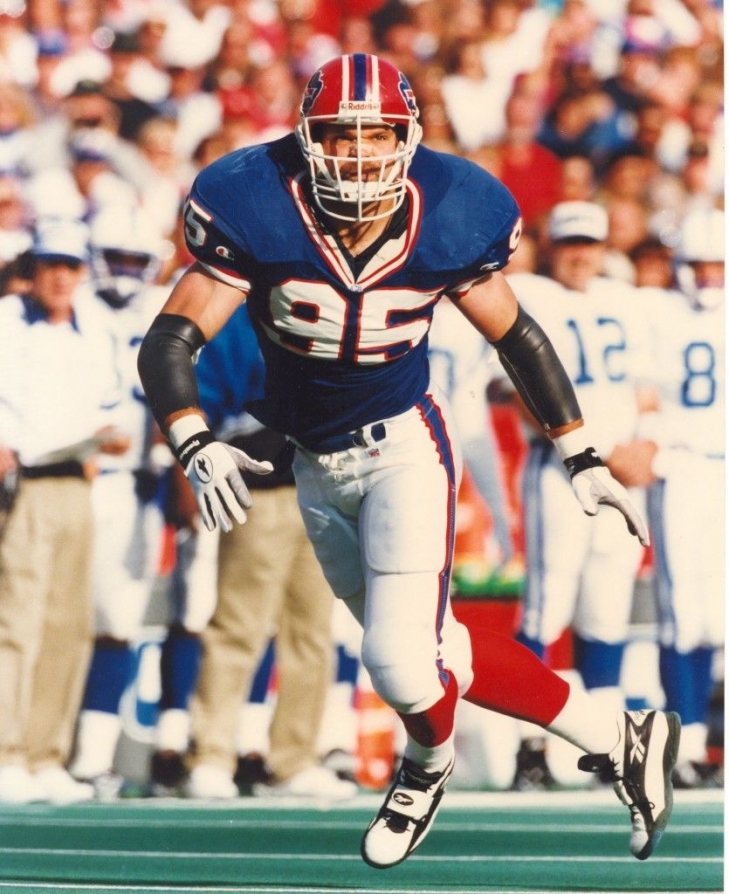
Signed by the Buffalo Bills in 1995 after five productive seasons in Green Bay, Bryce Paup arrived in Western New York as one of the most transformative free-agent additions in franchise history. Stepping onto Wade Phillips' defense opposite Hall of Fame defensive end Bruce Smith, Paup provided an unstoppable pass-rushing dynamic that ignited Buffalo's front seven.

Paup showcased a great blend of length, initial burst, and relentless hand technique. Playing mainly as a 3-4 left outside linebacker, his strength on film was turning speed into power; he often won one-on-one battles on the edge by dipping his shoulder under offensive tackles or using an explosive bull-rush to pressure the quarterback, making things difficult for the offense.

Paup had a memorable debut season in 1995, showcasing one of the most impressive single-season pass-rushing feats in NFL history. Exploiting situations where offenses focused extra blockers on Bruce Smith, Paup dominated backfields, leading the NFL with a career-best 17.5 sacks. He also tallied 89 tackles, three forced fumbles, and two interceptions. Paup made history as the first Bills player to receive the AP NFL Defensive Player of the Year Award, also earning First-Team All-Pro honors and his second Pro Bowl selection.

Paup remained a force on the edge over the next two seasons, anchoring Buffalo's linebacker corps. He logged 6.0 sacks and 11 tackles for loss in 1996, earning another Pro Bowl selection. He backed that up in 1997 with 9.5 sacks, three forced fumbles, and an interception in 15 starts, securing his third consecutive Pro Bowl nod as a Bill.

After the 1997 season, Paup joined the Jacksonville Jaguars as a free agent. Although his time with Buffalo was short, it represented the pinnacle of his career. During his three seasons with the Bills (1995–1997), he started all 45 regular-season games he played, recording 33.0 sacks, 215 tackles, six forced fumbles, two recoveries, and three interceptions.