Menu
A+ A A-
Site Admin

Site Admin

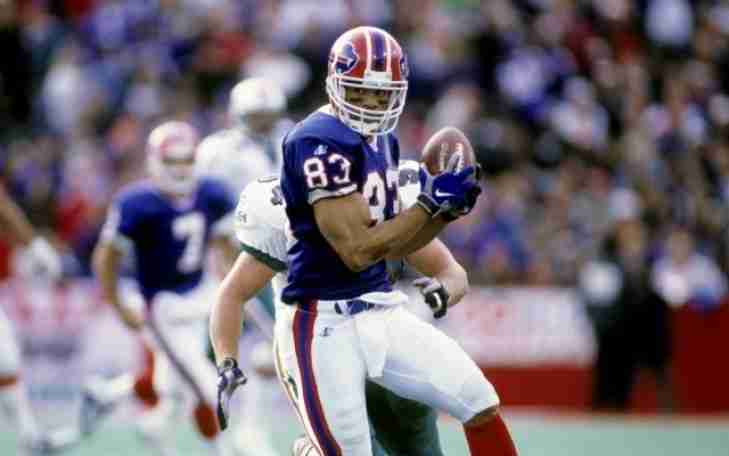
6. Andre Reed

Selected in the fourth round (86th overall) of the 1985 NFL Draft out of Division II Kutztown University, Andre Reed arrived in Buffalo as a small-school prospect with raw athletic upside. He quickly shattered expectations, spending 15 seasons as Jim Kelly's most dependable target and establishing himself as one of the most prolific wide receivers in NFL history.

Reed revolutionized slot and intermediate receiver roles within Marv Levy's fast-paced "K-Gun" offense. Known for his fearless approach to the middle of the field, he specialized in running slants, shallow crosses, and seam routes through dense secondary coverage. Once he caught the ball, Reed became a strong runner, leveraging his powerful lower body and quick bursts of speed to make significant yardage after the catch (YAC).

Reed made an impressive rookie debut in 1985 with 48 catches, 637 yards, and four touchdowns. In 1986, he became Buffalo's top receiver, leading in both receptions and yards. His rise to elite status aligned with Buffalo's no-huddle offense. Reed received his first of seven straight Pro Bowl selections (1988–1994) in 1988, with 71 catches for 968 yards. He hit his career high in receiving yards in 1989, with 88 catches, 1,312 yards, and nine touchdowns, earning Second-Team All-Pro honors.

During Buffalo's four straight AFC championship runs, Reed was the offense's key player in crucial moments. In 1991, he made 81 catches for 1,113 yards and scored 10 touchdowns, setting a personal best, with another impressive season in 1992. His postseason performance in 1992 solidified his reputation in big games, especially during "The Comeback" against the Houston Oilers, where he caught eight passes for 136 yards and scored three second-half touchdowns, helping set the NFL record for the biggest playoff comeback.

Reed enjoyed another prolific season in 1994, setting a single-season career high with 90 receptions for 1,303 yards. Despite a hamstring injury in 1995, he bounced back in 1996 with 66 catches for 1,036 yards—his fourth 1,000-yard campaign. He remained a steady starter through his final year in Buffalo in 1999, then concluded his career with Washington in 2000.

Over 15 seasons with Buffalo, Reed established franchise records that remain unbroken: 941 receptions, 13,095 receiving yards, and 86 receiving touchdowns in 221 regular-season games. Upon retiring, he ranked just behind Jerry Rice in career postseason receptions (85) and Super Bowl catches (27). The franchise enshrined Reed on the Buffalo Bills Wall of Fame in 2006. Eight years later, he took his place in the Pro Football Hall of Fame in 2014.
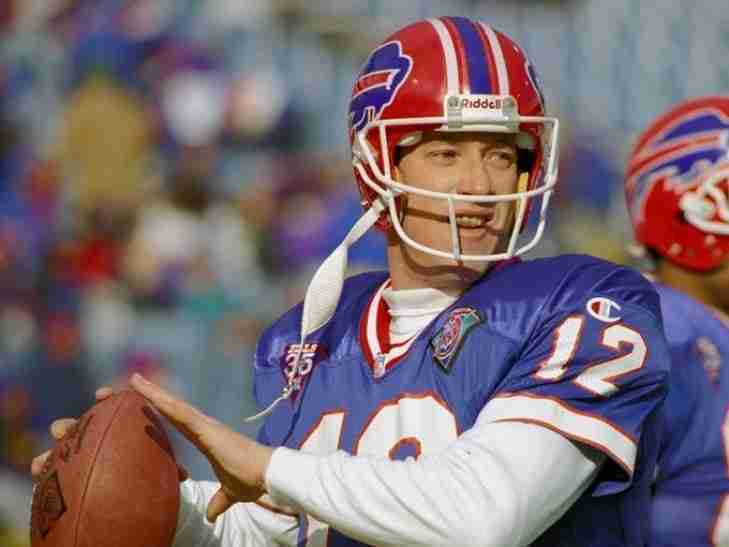
4. Jim Kelly

Drafted 14th overall in the renowned 1983 NFL Draft class originating from Miami, Jim Kelly initially expressed reluctance regarding the prospect of playing in Western New York, choosing instead to sign with the Houston Gamblers of the USFL. After two outstanding seasons within the spring league, the USFL ceased operations, prompting Kelly to relocate northward and join Buffalo in 1986. What commenced as a hesitant arrival ultimately evolved into one of the most celebrated bonds between a player and a city in sports history, as Kelly wholeheartedly adopted the blue-collar ethos of the region and became the cherished face of the franchise.

Kelly epitomized a formidable, physically robust pocket passer, embodying a linebacker’s mentality in the quarterback role. Serving as the field general for the innovative "K-Gun" offense, he exercised comprehensive control at the line of scrimmage, calling plays without a huddle to prevent opposing defenses from mounting effective countermeasures. Kelly demonstrated a rapid release, superior intermediate ball placement, and exceptional composure under pressure, consistently remaining upright in the pocket to deliver accurate throws just prior to receiving substantial hits.

Kelly made an immediate impact when he debuted with the Bills in 1986, passing for 3,593 yards and 22 touchdowns. He earned his first Pro Bowl in 1987 after guiding Buffalo to a .500 record, and secured another in 1988 as he led the team to a 12–4 record and an AFC East championship.

His prime years aligned with Buffalo's remarkable streak of four straight AFC championships from 1990 to 1993. In 1990, Kelly topped the NFL in passer rating (101.2) and completion percentage (63.3%) while leading the team to Super Bowl XXV. The following year, he delivered an outstanding 1991 season, earning First-Team All-Pro honors, leading the league with 33 touchdown passes, and setting a personal best with 3,844 passing yards. He earned Pro Bowl selections in 1990, 1991, and 1992, and was among the top five in MVP voting in 1990 and 1991.

Over his 11 seasons in Buffalo, Kelly led the team to six AFC East division titles and eight playoff appearances. He retired following the 1996 season holding every major franchise passing record, finishing his career with 35,467 passing yards and 237 touchdown passes across 160 regular-season starts.

In November 2001, the organization honored his legacy by inducting him into the Buffalo Bills Wall of Fame and retiring his No. 12 jersey, the first in team history to do so. The next year, Kelly was elected to the Pro Football Hall of Fame in his first year of eligibility.

2. Thurman Thomas

Thurman Thomas was drafted 40th overall in the second round of the 1988 NFL Draft from Oklahoma State, after falling past the first round due to knee concerns, but he arrived in Buffalo determined to prove himself. Teaming up with Jim Kelly, Andre Reed, and coach Marv Levy, Thomas became central to the iconic "K-Gun" fast-paced offense, transforming the running back role into a formidable dual-threat weapon both rushing and receiving.

Thomas had outstanding open-field vision, quick lateral movements, and exceptional pass-catching ability. When working in no-huddle formations, he took advantage of light defensive boxes meant to defend against Buffalo's passing attack. He pushed defensive edges, made sharp acceleration cuts to weave through second-level gaps, and absorbed hits without slowing down. As a backfield receiver, he ran diverse routes—such as slants, wheels, and angles—creating tough single-coverage challenges for linebackers.

Thomas quickly established himself as a rookie in 1988, gaining 881 yards, and then exploded in 1989 with 1,244 rushing yards and 60 receptions. This marked the start of an exceptional period where Thomas led the NFL in total yards from scrimmage for four straight seasons (1989–1992), showcasing durability and versatility comparable to Buffalo's four consecutive AFC championships.

His outstanding season came during the 1991 AP NFL MVP and Offensive Player of the Year campaign. Thomas propelled Buffalo to a 13–3 record, rushing for 1,407 yards and seven touchdowns, while also making 62 receptions for 631 yards and five touchdowns through the air. His 2,038 total yards from scrimmage topped the league, earning him his second First-Team All-Pro honor as Buffalo secured its second straight conference title.

Thomas demonstrated exceptional durability by achieving eight straight 1,000-yard rushing seasons from 1989 to 1996. During Buffalo's four Super Bowl appearances, he was the team's key postseason performer, setting NFL postseason records for total points (126) and touchdowns (21) at retirement.

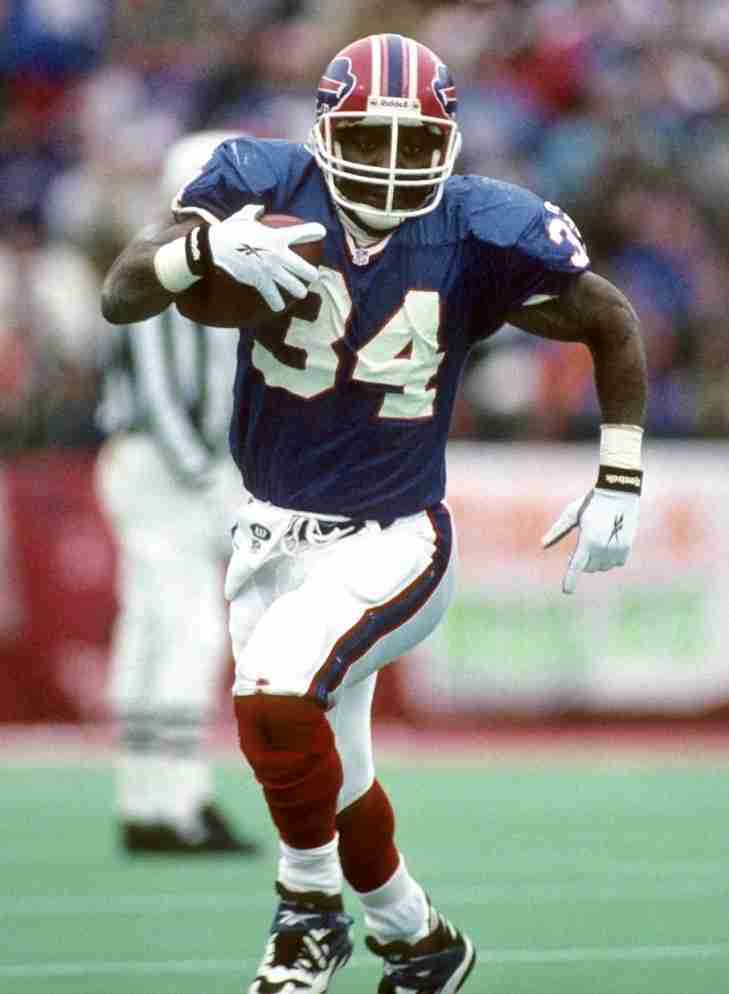
Following a 12-year tenure with Buffalo and a final season with Miami in 2000, Thomas retired holding franchise records of 11,938 rushing yards and 65 rushing touchdowns. He also recorded 4,458 receiving yards and 22 receiving touchdowns. Thomas was named to the NFL 1990s All-Decade Team. Buffalo honored him by adding him to the Wall of Fame in 2005. He was inducted into the Pro Football Hall of Fame in 2007, and in October 2018, the franchise officially retired his No. 34 jersey.

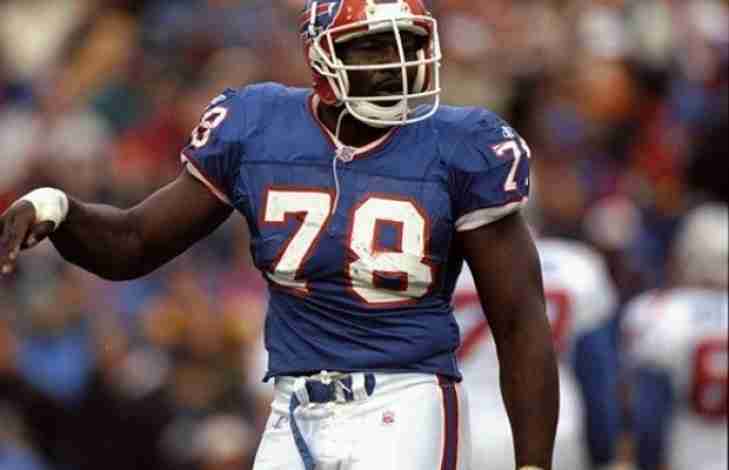
1. Bruce Smith

Drafted first overall in the 1985 NFL Draft from Virginia Tech, Bruce Smith came to Western New York with high expectations and quickly proved himself. Although Buffalo's explosive K-Gun offense frequently made headlines nationally, Smith was the true driving force of the team, dominating opposing backfields for 15 seasons and becoming the all-time leading sack artist in football history.

Smith combined explosive quickness, lateral agility, and raw power with an exceptional skill set. Usually playing as a 3-4 defensive end—an role mainly focused on absorbing double-teams rather than racking up individual stats—he defied traditional positional roles. Smith utilized his signature dip-and-rip move, leveraging his flexibility to bend around corners at sharp angles without losing speed. When offensive linemen over-kicked to contain the outside, he responded with a powerful swim move or a fierce bull rush that pushed the pocket into the quarterback. Additionally, Smith showed impressive stamina and sharp game awareness, often disengaging from blocks to tackle running plays behind the line of scrimmage.

Smith made an immediate impact as a rookie in 1985 with 6.5 sacks, then truly established himself in 1986 with 15 sacks, marking his rise. In 1987, he achieved his first Pro Bowl and First-Team All-Pro honors after recording 12.0 sacks in only 12 games, beginning a streak of double-digit sacks in 12 of his 13 full seasons in Buffalo. He continued with 11.0 sacks in 1988 and 13.0 in 1989, leading a swiftly improving defense that propelled Buffalo into serious playoff contention.

His standout season was 1990, when he earned the Defensive Player of the Year award. Smith led the league throughout the season, setting a franchise record with 19.0 sacks and making 101 tackles—an impressive feat for a defensive lineman. His dominance was especially clear in Week 14, when he sacked Indianapolis quarterback Jeff George four times in the first 20 minutes. He finished the year by helping Buffalo reach its first AFC championship, highlighted by a safety in Super Bowl XXV.

After missing most of the 1991 regular season due to knee surgery, Smith made a strong comeback in 1992, recording 14.0 sacks and helping the defense secure a third consecutive AFC title. He replicated that 14.0-sack achievement in 1993, adding 108 tackles and earning another First-Team All-Pro honor as Buffalo secured its fourth straight conference championship. Smith continued to perform at an elite level into the mid-1990s, with 10.0 sacks in 1994 and 10.5 in 1995.

Smith captured his second AP Defensive Player of the Year award in 1996 at age 33. Racking up 13.5 sacks, 90 tackles, and five forced fumbles, he proved virtually unblockable even as offenses geared their entire blocking schemes toward stopping him. He backed that up with 14.0 sacks in 1997 and 10.0 sacks in 1998, turning in his final double-digit sack year in Western New York. He completed his Buffalo tenure in 1999 with a 7.0-sack campaign, taking the team to its final postseason appearance of the decade.

Smith played his final four seasons in Washington, surpassing Reggie White's all-time record in 2003 to finish with 200.0 sacks, a mark that remains the benchmark for pass rushers. During his 15 seasons with Buffalo, he appeared in 217 regular-season games, set franchise records with 171.0 sacks, and earned 11 Pro Bowl selections. He was named to the NFL 1980s All-Decade Team, the 1990s All-Decade Team, and the NFL 100th Anniversary All-Time Team.

His impact in Western New York is unparalleled. The Buffalo Bills added him to their Wall of Fame in 2008. A year afterward, he was inducted into the Pro Football Hall of Fame in 2009 on his first ballot. In 2016, the team honored him with a jersey retirement ceremony for No. 78, the first in franchise history.