Menu
A+ A A-
Site Admin

Site Admin

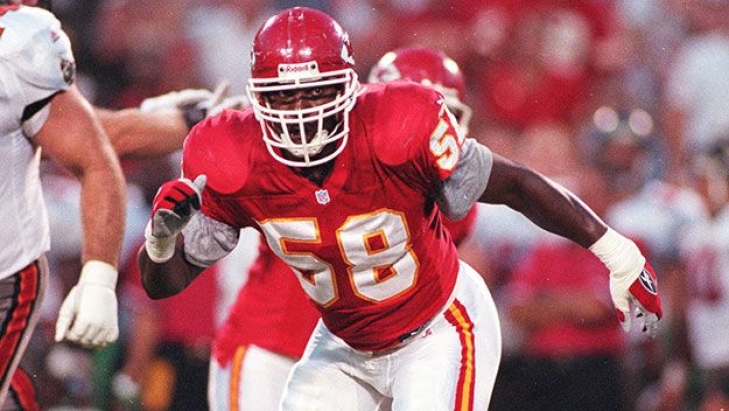
6. Derrick Thomas

Selected fourth overall out of Alabama in 1989 after capturing the Butkus Award as the nation’s top collegiate linebacker, Derrick Thomas arrived in Kansas City with a first-step acceleration off the edge that instantly altered NFL passing offenses. His twitchy, lightning-fast snap anticipation transformed him into the premier edge rusher of his generation, making him an immediate cornerstone for Marty Schottenheimer's rebuilding Chiefs defense.

Thomas exploded onto the professional scene in 1989, racking up 10.0 sacks and forcing three fumbles to capture NFL Defensive Rookie of the Year honors alongside his first of nine consecutive Pro Bowl selections. Opposing offensive tackles simply could not match his elite dip-and-bend movement along the perimeter. He followed up his rookie campaign with an extraordinary 1990 season, leading the entire NFL with a franchise-record 20.0 sacks to earn First-Team All-Pro honors.

The crown jewel of that 1990 campaign unfolded on Veterans Day against the Seattle Seahawks, when Thomas set an NFL single-game record by sacking quarterback Dave Krieg seven times. He perfected a signature "sack-and-strip" technique, actively chopping at the ball rather than just taking down the passer. That technique yielded 45 career forced fumbles and 19 fumble recoveries, consistently converting defensive pressure into instant turnover points for Kansas City.

Throughout the 1990s, Thomas served as the heartbeat of a feared Chiefs defense alongside Neil Smith and Dan Saleaumua. He earned three First-Team All-Pro selections (1990, 1992, 1996) and topped double-digit sacks in seven different seasons, including a 1998 opener where he dropped Raiders quarterback Jeff Gruden's squad six times in a single afternoon. His presence turned Arrowhead Stadium into a nightmare environment for visiting quarterbacks, establishing an electric atmosphere that defined an era.

Off the field, Thomas was equally impactful, cementing his legacy as a true community hero through his extensive philanthropic work. In 1990, he founded the Third and Long Foundation to help inner-city children learn to read, devoting countless hours to youth literacy programs across the metropolitan area. His unselfish community service earned him the prestigious NFL Man of the Year Award in 1993, making him deeply beloved across the region.  By decade’s end, he was an easy pick for the 1990s All-Decade Team.

Tragedy struck the organization and the football world in January 2000. Following a motor vehicle accident on an icy highway while en route to Kansas City International Airport, Thomas suffered chest trauma that left him paralyzed below the chest. Less than a month later, on February 8, 2000, he passed away suddenly at age 33 from a pulmonary embolism, leaving behind a heartbroken fan base and an irreplaceable void in the sport.

His memory remains deeply woven into the fabric of the franchise. The Chiefs inducted Thomas into the Chiefs Hall of Honor in 2001 and officially retired his iconic No. 58 jersey in 2009. That same year, he received ultimate national immortality with his posthumous election into the Pro Football Hall of Fame in Canton.  Thomas played in 169 regular-season games with 157 starts. He compiled 126.5 official sacks, 45 forced fumbles, 19 fumble recoveries, 641 tackles, and four defensive touchdowns in red and gold—departing as the franchise’s all-time leader in sacks.
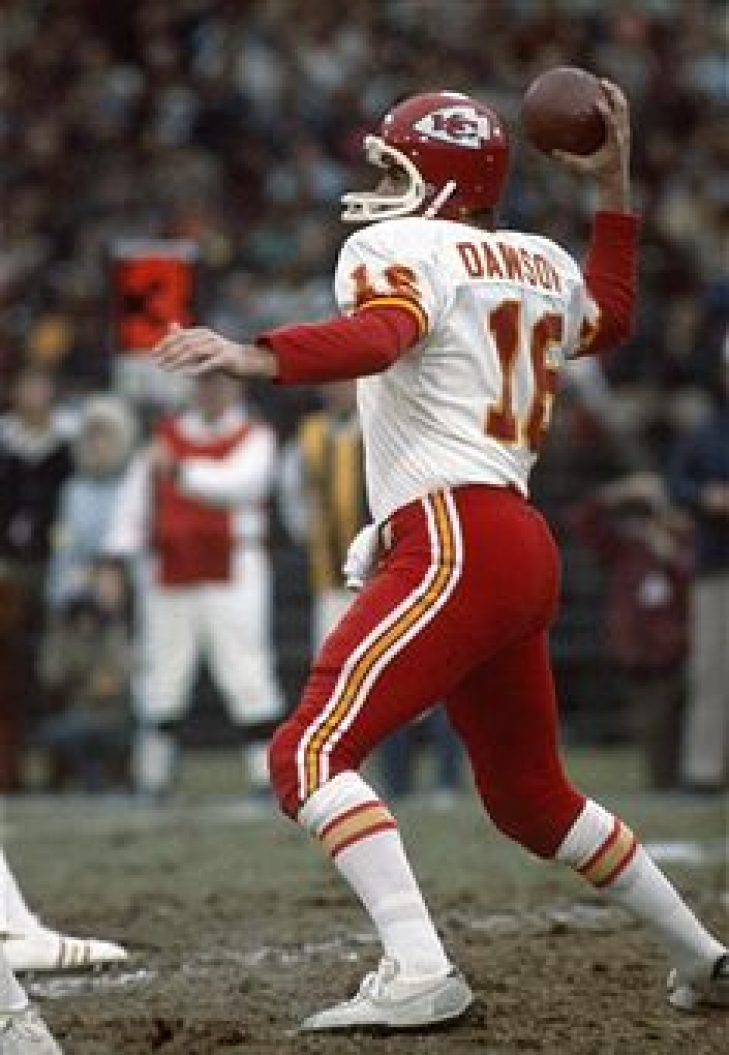
5. Len Dawson

Before he became the undisputed royalty of Kansas City football, Len Dawson looked like a first-round draft bust buried on NFL sidelines. Selected fifth overall by Pittsburgh out of Purdue in 1957, Dawson spent three anonymous seasons underutilized by the Steelers before being shipped to Cleveland, where he languished behind Milt Plum. Released after five NFL seasons with just two career touchdown passes to his name, Dawson’s professional career seemed dead on arrival until former Purdue assistant Hank Stram threw him a lifeline with the AFL’s Dallas Texans in 1962.

Reunited with Stram, Dawson immediately unspooled one of the most remarkable career turnarounds in pro football history. Taking the reins of Stram’s innovative "moving pocket" offense, Dawson brought clinical precision and icy composure to a fledgling league often criticized for chaotic play. Nicknamed "Lenny the Cool" for his unflappable demeanor under pressure, he transformed the Texans into an instant juggernaut, leading the AFL with 29 touchdown passes and a 98.3 passer rating in his very first season as a full-time starter.

The memorable 1962 campaign ended with a double-overtime win against the Houston Oilers in the AFL Championship, earning the franchise its first league title. When Lamar Hunt moved the team north to Missouri to form the Kansas City Chiefs the next year, the team’s location shifted, but Dawson's consistent brilliance did not change. He became the standard for efficiency throughout the decade, consistently leading the AFL in passing.

Dawson’s mastery of Stram’s scheme was unmatched in his era. He won six AFL passer rating titles (1962, 1964–1968)—including five straight seasons on top—and led the league in touchdown passes four times (1962, 1963, 1965, 1966). Unlike opponents who focused on deep vertical throws, Dawson dissected defenses with pinpoint accuracy, leading the league in completion percentage in eight seasons and consistently achieving touchdown-to-interception ratios that were far ahead of his time.

In 1966, Dawson led Kansas City to an 11–2–1 record and a decisive victory over Buffalo in the AFL title game, securing their place in the first AFL-NFL World Championship Game (Super Bowl I). Although the Chiefs ultimately lost to Vince Lombardi’s Green Bay Packers, Dawson impressed many by completing 16 of 27 passes against a renowned NFL defense, demonstrating to skeptical fans across the country that the AFL’s top quarterback had exceptional, world-class skills.

Three years later, Dawson created his career's defining masterpiece in 1969. Although he missed five games due to a knee injury and faced false, sensationalized gambling accusations before Super Bowl IV against the favored Minnesota Vikings, Dawson stayed resilient. His steady leadership kept Kansas City focused as they dominated Minnesota's renowned "Purple People Eaters" defense, winning 23–7. Dawson received Super Bowl MVP honors, confirming the AFL's strength just months prior to the official merger.

Dawson was more than just a champion with his awards; he was a tough physical player who took harsh hits during an era with almost no protective rules for quarterbacks. He led the Chiefs through their integration into the unified NFL, starting until he retired after the 1975 season at age 40. By retirement, he had played 14 seasons in Chiefs red, setting statistical records that stood for nearly 50 years until Patrick Mahomes came along.

His post-playing career further cemented his reputation as a local legend. Dawson smoothly shifted into a popular broadcaster, leading local sports coverage in Kansas City and working for decades as the color commentator for the Chiefs Radio Network, while also hosting HBO's Inside the NFL. His unique ability to earn trust both on the field and at home made him the enduring elder figure in Kansas City sports culture.

With the Chiefs, Dawson compiled 28,507 passing yards, 237 passing touchdowns, and 178 interceptions in red and gold, along with 1,241 rushing yards and nine rushing touchdowns. A Super Bowl IV champion and MVP, three-time AFL Champion (1962, 1966, 1969), six-time AFL All-Star, 1968 Pro Bowler, and 1962 First-Team All-AFL selection, Dawson had his No. 16 jersey retired by the Chiefs and remains a universally revered pillar of football history; he was inducted into the Pro Football Hall of Fame in 2009.

7. Will Shields

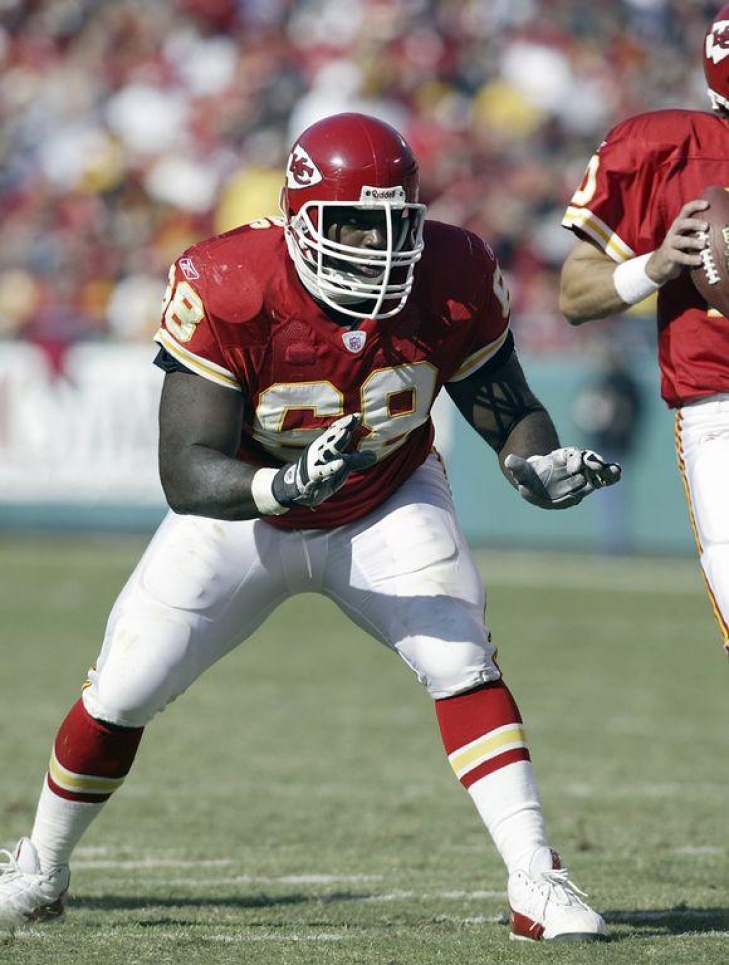
The Kansas City Chiefs boast a rich history of legendary interior linemen, but none ever matched the absolute durability, technical precision, and sustained excellence of Will Shields. Selected in the third round (74th overall) out of Nebraska in the 1993 NFL Draft—where he won the Outland Trophy as the nation's top interior lineman—Shields stepped into the starting lineup in Week 2 of his rookie season and never stepped back out for the next 14 years.

Serving as the unwavering anchor at right guard, Shields constructed one of the most astonishing iron-man streaks in professional sports history. He played in all 224 regular-season games of his NFL career—starting 223 of them—and added another eight postseason starts without ever missing a single game due to injury. That legendary reliability provided the foundation for multiple eras of Chiefs football, bridging the physical offense of Marty Schottenheimer with the explosive high-scoring units of Dick Vermeil.

Mechanically, Shields was an absolute technician whose elite leverage and vice-like hands made him virtually unshakeable in pass protection. Though he had the brute, raw power to root out defensive tackles in tight quarters, his exceptional lateral quickness and football IQ let him pull out in space seamlessly on traps and sweeps.

During the early 2000s, Shields served as the centerpiece of an offensive line widely regarded as one of the greatest ever assembled. Flanked by Willie Roaf, Casey Wiegmann, and Brian Waters, Shields paved the way for tailbacks Marcus Allen, Priest Holmes, and Larry Johnson. His rare combination of explosive power at the point of attack and mobility in space enabled Holmes to set the then-NFL record with 27 rushing touchdowns in 2003, while the offense consistently ranked at the top of the league in total yardage and scoring.

Individual accolades naturally followed his dominant play. Shields earned 12 consecutive Pro Bowl selections from 1995 through 2006, setting a Chiefs franchise record that stands to this day. He earned two First-Team AP All-Pro selections (2002, 2003) and five Second-Team selections, eventually securing a coveted spot on the NFL 2000s All-Decade Team. Off the field, his active commitment to the Kansas City community through his "Will to Succeed" Foundation earned him the prestigious Walter Payton NFL Man of the Year Award in 2003.

Shields retired after 2006, leaving a legacy of durability and leadership. He was inducted into the Kansas City Chiefs Hall of Fame in 2012 and the Pro Football Hall of Fame in 2015. He started all but one of his games.

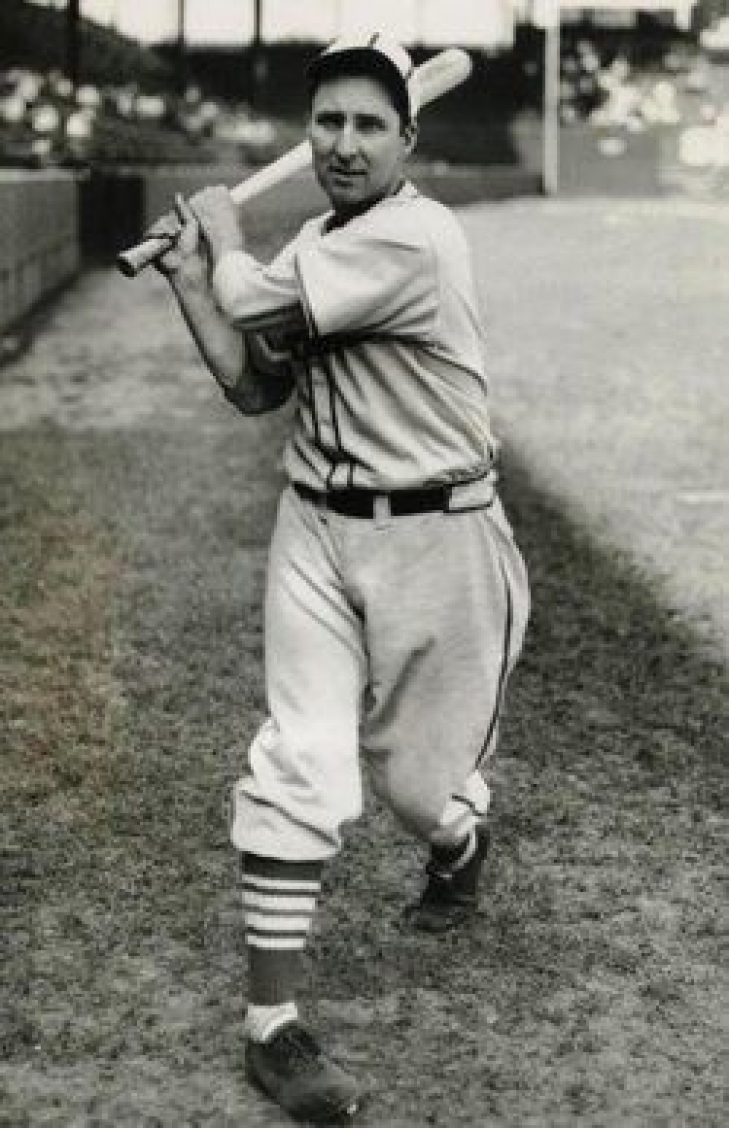
48. Ripper Collins

Ripper Collins gained his intimidating nickname as a minor leaguer when a line drive from his bat tore the cover off a baseball. However, when he stepped into the major leagues full-time, fans were taken aback to learn that the powerful hitter was actually a modest 5-foot-9, 165-pound player. Despite his average size, this switch-hitting first baseman compensated with lightning-quick wrist movements and a fierce style of play that perfectly suited the rough and unpolished culture of the 1930s "Gashouse Gang."

His journey to the big leagues officially started with a supporting role, as he appeared in 89 games as a rookie during the Cardinals' 1931 World Series victory. Recognizing his potential, St. Louis management traded veteran Jim Bottomley to make way for Collins. By 1932, he had become the regular first baseman, winning over fans at Sportsman's Park with his energetic play and playful clubhouse antics.

Everything came into a historic alignment during the remarkable 1934 season. Collins assembled an exceptional offensive performance, dominating National League pitching with a .333 batting average, a league-leading .615 slugging percentage, and an OPS of 1.008. He hit 35 home runs, tying Mel Ott for the league lead—making Collins the inaugural switch-hitter in Major League history to surpass 30 home runs in a single season. This extraordinary achievement earned him sixth place in the National League Most Valuable Player voting and propelled the Cardinals to another World Series appearance. In the 1934 World Series against Detroit, he demonstrated unwavering determination, batting .367 and achieving four hits in the decisive Game 7 victory, thereby securing his second world championship ring.

The intensive production persisted throughout the subsequent two summers, resulting in Collins securing a pair of All-Star selections in 1935 and 1936 as he upheld his reputation as a premium run producer. Nevertheless, as Branch Rickey's renowned developmental pipeline began to overflow with younger talent, the management seized the opportunity to leverage Collins' high trade value by trading him to the rival Chicago Cubs prior to the 1937 season. Given that his peak period in St. Louis lasted only six seasons before transferring to Chicago and Pittsburgh, his cumulative totals are somewhat modest compared to those of players with careers spanning multiple decades. Nonetheless, the exceptional and historic peak of his 1934 performance remains one of the most dynamic single-season displays in the extensive history of the franchise.

Across six seasons in St. Louis (1931–1936), Collins played 777 games, with 852 hits, 106 home runs, and 516 RBIs. He posted a .307/.370/517 slash line, with a 134 OPS+.