Menu
A+ A A-
Site Admin

Site Admin

9. Willie Lanier

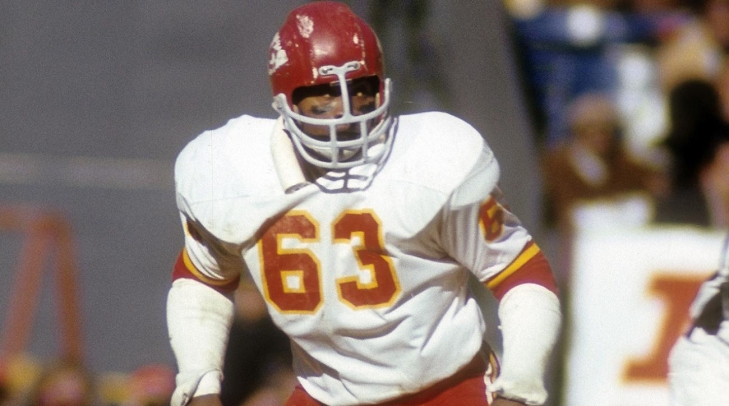
When football historians examine the legendary Kansas City defense of the late 1960s and early 1970s, one man stands squarely at the center of that brutal, championship-caliber unit: Willie Lanier. Selected in the second round (50th overall) out of Morgan State in the 1967 AFL Draft, Lanier made immediate history by becoming the first Black athlete to start at middle linebacker in professional football.

Operating alongside Bobby Bell and Jim Lynch, Lanier formed one-third of arguably the NFL’s most fearsome linebacker trio. Nicknamed "Contact," Lanier played with a ferocious, intimidating style that pushed the physical limits of the era. He attacked ball-carriers headfirst with such staggering, violent force that the Chiefs added extra padding to the outside of his helmet to absorb the impact—a modification meant as much to protect opposing players as to cushion Lanier himself. Beyond his hitting power, Lanier possessed elite instincts and range, diagnosing plays instantly and shutting down opponents’ run games from sideline to sideline.

Lanier's leadership and authority in the middle of the field powered the Chiefs to their crowning achievement in Super Bowl IV. In that iconic 23–7 upset over the Minnesota Vikings, Lanier anchored a defense that stifled Minnesota's offense, recording seven tackles and intercepting a pass from Joe Kapp. His clutch playmaking made him the unquestioned emotional heartbeat of Hank Stram's "Triple-Stack" defense.

The accolades poured in continuously throughout his stellar career. Lanier earned AFL All-Star honors in 1968 and 1969, and once the AFL-NFL merger was finalized, he reeled off six consecutive Pro Bowl selections from 1970 to 1975. A three-time First-Team AP All-Pro (and eight-time total All-Pro choice across both leagues), Lanier was widely regarded as the premier middle linebacker of his generation. Off the field, his character and civic contributions earned him the NFL Walter Payton Man of the Year Award in 1972.

Lanier spent his entire 11-year career in Kansas City, playing in 149 regular-season games before retiring after the 1977 season.  He compiled 27 sacks and recovered 18 fumbles. The franchise inducted him into the Chiefs Hall of Fame in 1985 and retired his iconic No. 63 jersey. Enshrined in the Pro Football Hall of Fame in Canton as part of the Class of 1986, Lanier was later selected to both the NFL 75th Anniversary All-Time Team and the NFL 100th Anniversary All-Time Team.
8. Buck Buchanan

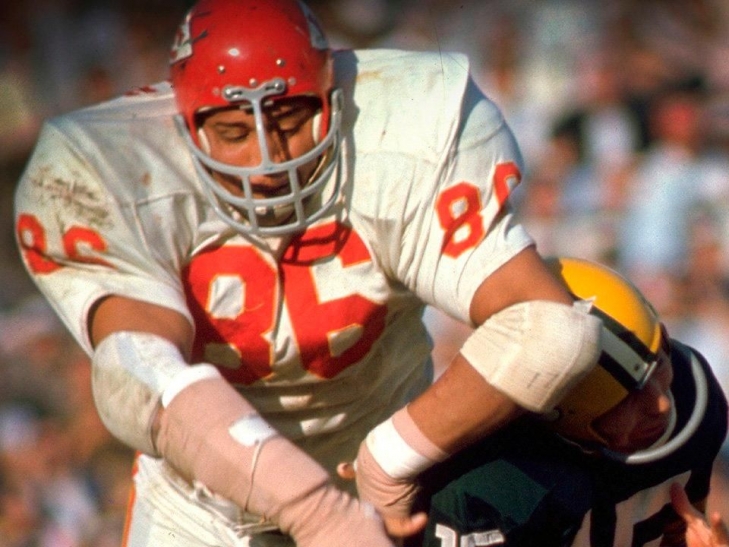
Chosen first overall by the Kansas City Chiefs in the 1963 AFL Draft, Grambling State icon Junious "Buck" Buchanan made history as the first Black player selected with the top overall pick in professional football. While head coach Hank Stram and legendary scout Lloyd Wells recognized Buchanan's exceptional talent, he surpassed all expectations, revolutionizing line play and becoming the formidable force driving Kansas City's defense for more than ten years.

Standing 6-foot-7 and weighing 287 pounds, Buchanan possessed a terrifying blend of size, power, and sprinter-like speed that was unprecedented for a defensive tackle in the 1960s. He used his explosive first step to overwhelm opposing guards and centers, routinely firing into the backfield to blow up plays before they developed. Beyond collapsing pockets, Buchanan used his massive wingspan and leaping ability to swat down passes at the line of scrimmage, highlighted by a staggering 16 batted balls in the 1967 campaign.

Buchanan served as the emotional and physical anchor of Kansas City's famous "Triple-Stack" defense, lining up alongside fellow Hall of Famers Willie Lanier, Bobby Bell, and Emmitt Thomas. His peak performance elevated the franchise onto the game's biggest stages, leading the Chiefs to two AFL Championships and appearances in Super Bowls I and IV. In Super Bowl IV against the heavily favored Minnesota Vikings, Buchanan and the Chiefs’ defense suffocated Minnesota's offense, limiting it to just 67 rushing yards in a decisive 23–7 victory.

His dominance was recognized year in and year out across both leagues. Buchanan was named an AFL All-Star six consecutive times from 1964 through 1969, and following the AFL-NFL merger, he seamlessly continued his elite play by earning Pro Bowl selections in 1970 and 1971. A four-time First-Team All-AFL selection, he was an undeniable selection for the AFL All-Time Team.

In total, Buchanan played 182 regular-season games in red and gold—including a streak of 166 consecutive games—before retiring following the 1975 season.   Statistically, Buchanan had 70.5 sacks in his career. His legacy in professional football includes induction into the Kansas City Chiefs Hall of Fame in 1981, the retirement of his No. 86 jersey, enshrinement in the Pro Football Hall of Fame in 1990, and selection to the NFL 100th Anniversary All-Time Team in 2019.

2. Bobby Bell

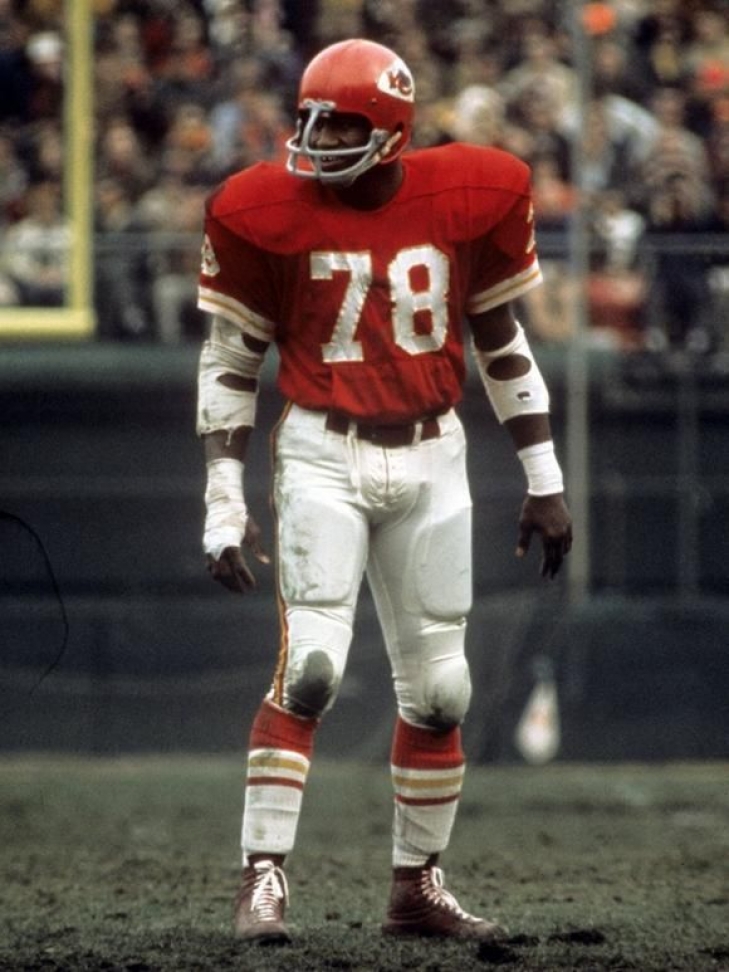
Before modern NFL scouting built templates for hybrid defender archetypes, Bobby Bell was already breaking the mold. Standing 6-foot-4 and 228 pounds with 4.5 track speed, Bell had a freakish athletic profile decades ahead of its time. A high school quarterback and a national champion tackle at the University of Minnesota, he captured the 1962 Outland Trophy as the nation's premier interior college lineman. When the Chiefs scooped him up in the seventh round of the 1963 AFL draft, they secured the ultimate chess piece for head coach Hank Stram.

Stram famously stated that Bell was so talented he could master all 22 positions on a successful football team and perform excellently in each one. Bell initially spent two seasons playing at defensive end, setting the edge, before switching permanently to outside linebacker in Stram's innovative "stack defense." His extraordinary range enabled him to disrupt running plays behind the line of scrimmage, drop back into coverage like a safety, and even take care of long-snapping duties on special teams seamlessly.

His versatility from the start set the stage for a remarkable series of individual awards. After an impressive rookie year, Bell was recognized as an AFL All-Star or NFL Pro Bowler for nine straight seasons from 1964 to 1972, including six consecutive First-Team All-AFL/NFL selections. Acting as the key athletic threat on a star-studded defense with middle linebacker Willie Lanier and tackle Buck Buchanan, Bell provided Kansas City with a solution for every offensive strategy in professional football.

Bell was a defensive force capable of controlling any situation on any down. He was an aggressive, top-tier open-field tackler who almost always completed wraps, tackling ball-carriers in space before they could break to the outside. His constant effort and quick closing speed made him a formidable blitzing option off the edge, enabling him to consistently pressure opposing quarterbacks during his twelve years in Missouri.

Although sacks did not become an official NFL statistic until 1982, internal Chiefs tracking shows Bell amassed 40.0 career quarterback sacks. Combined with his 26 career interceptions, Bell is an unofficial charter member of pro football's elite 20-20 club. More impressively, he converted those turnovers into points, scoring nine career defensive touchdowns—including six pick-sixes, which tied the all-time NFL record for linebackers.

Without Bell anchoring the defense, imagining Kansas City creating the legendary legacy of the 1960s franchise is difficult. His coverage ability and playmaking skills led the Chiefs to three AFL Championships and appearances in Super Bowls I and IV. In Super Bowl IV, where they defeated the Minnesota Vikings, Bell's defense limited Minnesota to just 67 rushing yards, marking one of the most dominant championship performances in professional football history.

Bell spent 12 seasons with the Kansas City Chiefs (1963–1974), playing in 168 games with 159 starts. He recorded 26 interceptions for 479 yards, six interception return touchdowns, 40.0 unofficial sacks, nine fumble recoveries, and nine touchdowns. A Super Bowl IV Champion, two-time AFL Champion, nine-time Pro Bowler, six-time All-Pro, and member of the NFL 1970s All-Decade Team, he entered the Chiefs Hall of Honor in 1980, and in 1983, he was chosen for the Pro Football Hall of Fame.  He would earn one more colossal honor when, in 2020, he was named to the NFL 100th Anniversary Team.

3. Tony Gonzalez

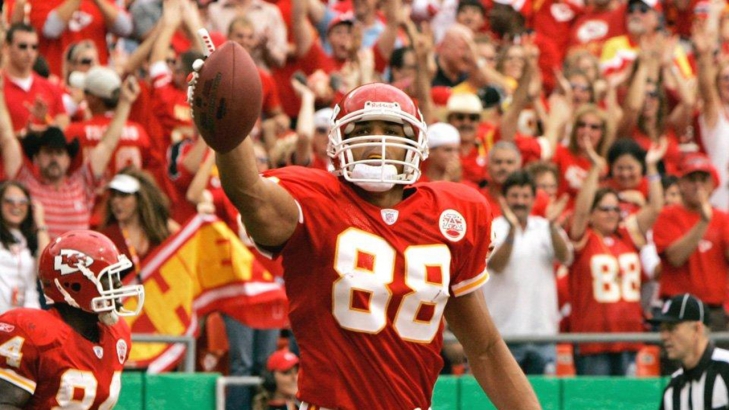
When the Kansas City Chiefs traded up to select Tony Gonzalez 13th overall out of California in 1997, they weren't just picking a tight end—they were securing a two-sport athlete who would fundamentally rewrite the blueprint for offensive football. Armed with a basketball player's footwork, elite aerial body control, and soft hands honed on the hardwood, Gonzalez completely transformed a blocking-centric position into the premier focal point of a modern passing attack.

After showing modest promise as a rookie, Gonzalez demonstrated star potential in 1998 with 59 receptions and fully broke out in 1999. During that third season, he received his first of ten straight Pro Bowl selections in red and gold and earned First-Team All-Pro honors with 76 catches for 849 yards and 11 touchdowns. In 2000, he continued his ascent by recording a remarkable 93 catches for 1,203 yards and nine touchdowns, establishing that a tight end could be the primary receiver for an offense.

Gonzalez showed remarkable consistency despite major roster changes, acting as the key driver for Dick Vermeil's dynamic early-2000s offenses with Trent Green and Priest Holmes. In 2001, he accumulated 917 receiving yards and six touchdowns, caught 63 passes in 2002, and in 2003, he had 71 catches for 916 yards and 10 touchdowns, aiding Kansas City's 13–3 season. His signature dunking of the goal post became a weekly highlight at Arrowhead Stadium, setting a new standard for tight end achievements.

His outstanding statistical achievement occurred during the 2004 season, when he excelled in secondary coverages to top the NFL with 102 receptions, accumulating a career-high 1,258 receiving yards and seven touchdowns. This impressive season set the then-record for single-season catches by a tight end and demonstrated his ability to thoroughly disrupt defensive strategies aimed at limiting him.

Despite the Chiefs entering a tough rebuilding phase later in the decade, Gonzalez remained highly productive. In 2005, he achieved 78 catches for 905 yards, followed by 900 yards in 2006. He then had two strong 1,000-yard seasons in 2007 (99 catches, 1,172 yards) and 2008 (96 catches, 1,058 yards, 10 touchdowns). Over his 12 impressive years with Kansas City, he surpassed 900 receiving yards seven times and exceeded 1,000 yards four times.

Beyond his staggering statistical volume, Gonzalez was an absolute marvel of physical durability. Over 12 seasons in Kansas City, he missed only one game, absorbing thousands of hits over the middle while pioneering dietary and training habits that extended his prime deep into his thirties. He departed Kansas City in 2009 after a trade to Atlanta, leaving behind a legacy as the most prolific pass-catcher in Chiefs history and the standard-bearer for all tight ends who followed.

Enshrined into the Chiefs Hall of Fame in 2018 and entering the Pro Football Hall of Fame on the first ballot in 2019, his career received ultimate national recognition in 2020 when he was named to the prestigious NFL 100th Anniversary All-Time Team as one of the game's immortal figures. Statistically, as a Chief, he had 916 receptions, 10,940 receiving yards, and 76 receiving touchdowns in Kansas City—all franchise records at the time of his departure.