Menu
A+ A A-
Site Admin

Site Admin

27. Priest Holmes

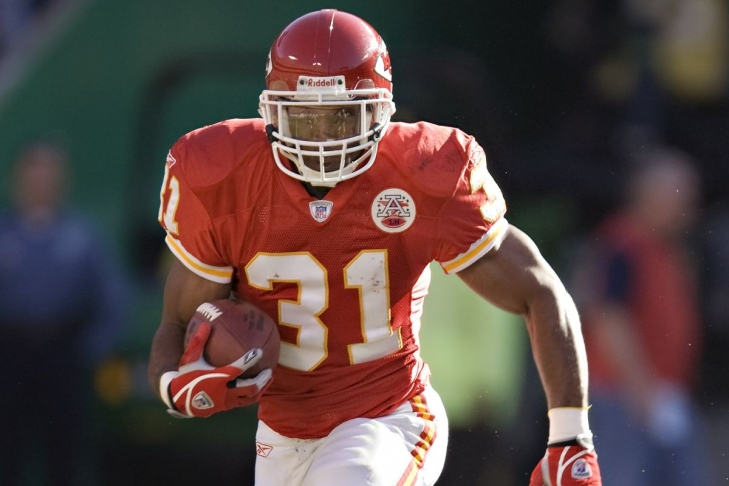
Undrafted out of Texas in 1997, Priest Holmes broke through with a 1,008-yard rushing campaign for the Baltimore Ravens in 1998 before fading into a secondary role behind Jamal Lewis over the next two seasons. When Dick Vermeil brought the low-key running back to Kansas City in free agency before the 2001 season, few anticipated the statistical explosion about to unfold on Arrowhead turf.

Holmes took complete control of Kansas City's backfield during his debut 2001 campaign. Behind a physical offensive line anchored by Willie Roaf and Will Shields, his vision, patience, and sudden acceleration unleashed a career-defining run as he led the NFL with 1,555 rushing yards and 2,169 scrimmage yards, earning his first Pro Bowl selection and AP First-Team All-Pro nod.

That opening act was merely the prelude to one of the most absurd multi-year peaks by any running back in pro football history. In 2002, Holmes was named AP NFL Offensive Player of the Year after leading the league with a staggering 2,287 scrimmage yards and 21 rushing touchdowns across just 14 games. He followed that up in 2003 by shattering the single-season NFL record with 27 rushing touchdowns, accumulating 1,420 rushing yards and 74 receptions for his third consecutive First-Team All-Pro selection.

Holmes continued his torrid production into 2004, scoring 14 touchdowns in just eight games before a knee injury shelved him. Midway through the 2005 campaign, a spinal trauma collision cut short another dominant stretch. The neck injury sidelined him for the entire 2006 season; though he mounted a courageous comeback in late 2007, he appeared in just four games before retiring from the NFL.

Comparatively speaking, Holmes played far fewer games in Missouri than many long-tenured franchise icons, but his sheer statistical brilliance at the absolute peak of his craft earned him immortal status. He was formally enshrined in the Kansas City Chiefs Hall of Fame in 2014.  He overall accumulated 6,070 rushing yards, 76 rushing touchdowns, 251 receptions for 2,377 receiving yards, 8,447 total scrimmage yards, and 83 total touchdowns.
26. Jack Rudnay

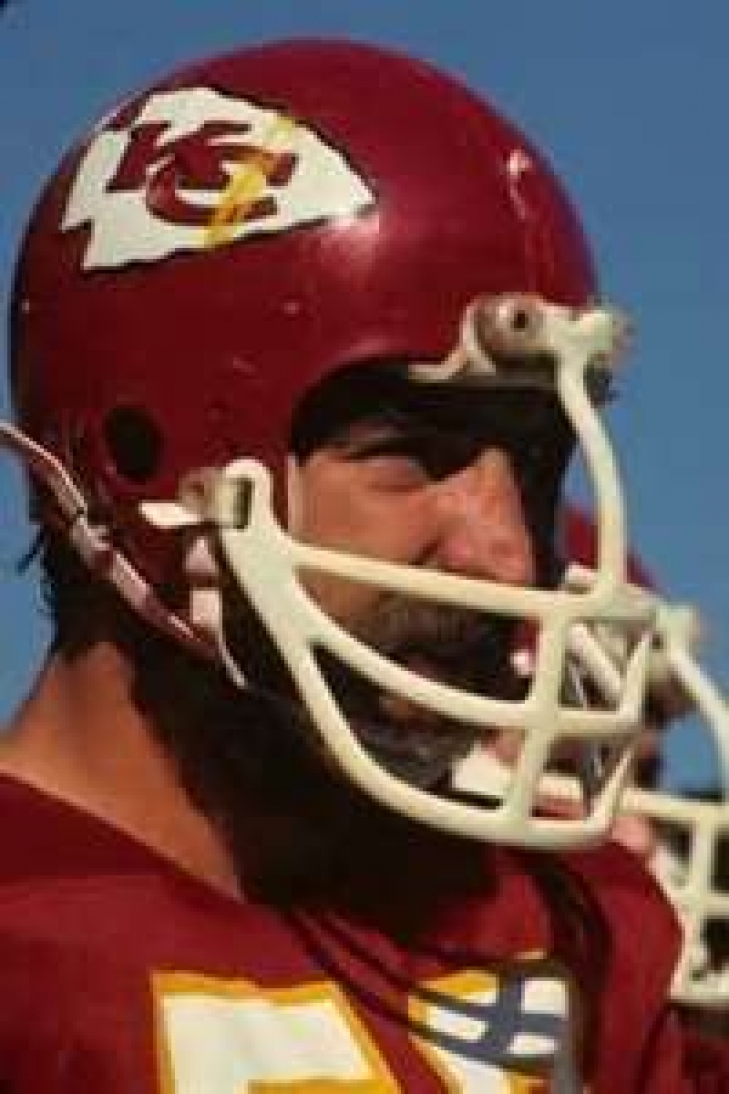
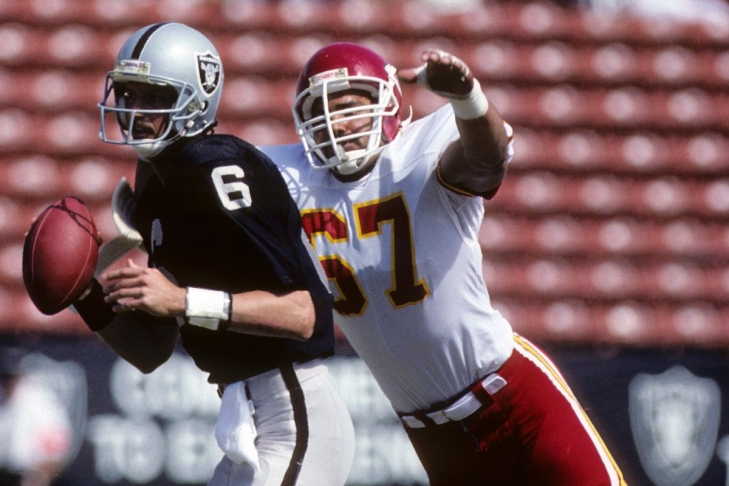
Drafted in the fourth round (101st overall) of the 1969 AFL Draft out of Northwestern, Jack Rudnay earned a Super Bowl IV ring during his rookie campaign without ever putting on a helmet, as a preseason back injury sidelined him all year. Once healthy, the 6-foot-3, 250-pound center stepped into the starting lineup in 1970 and instantly became the bedrock of Kansas City's interior offensive line for the next decade-plus.

Rudnay unlocked elite status in the mid-1970s through flawless execution, technique, and high-level pre-snap recognition. As the operational conductor up front, he directed protection schemes against aggressive 1970s defenses while paving interior lanes for running backs like Ed Podolak and MacArthur Lane.

His national individual peak arrived during a dominant four-year stretch from 1973 through 1976, earning four consecutive Pro Bowl selections alongside an AP Second-Team All-Pro nod in 1973. Widely regarded as one of the premier centers in professional football during this era, Rudnay was a rare bright spot and steadying leader as the organization navigated a post-Hank Stram roster transition.

He started 171 of his 178 games in Kansas City and entered the Chiefs Hall of Fame in 1994.

24. Art Still

Selected second overall in the 1978 NFL Draft following a Consensus All-American run at Kentucky, Art Still stepped directly into Arrowhead Stadium carrying towering expectations. Standing an intimidating 6-foot-7 and weighing 250 pounds, the imposing defensive end had rare reach and closing speed, quickly becoming the primary pass-rushing pillar for Kansas City's defensive front throughout the late 1970s and 1980s.

Still wasted no time asserting his physical dominance at the professional level. Anchoring the left side of the line, he generated 9.5 sacks during his 1978 rookie campaign and followed it up with 8.5 in 1979, using his massive wingspan to shed edge blockers and collapse pockets before quarterback scrambles could even materialize.

His national breakthrough materialized during a stellar 1980 campaign. Still earned his first Pro Bowl selection, an AP Second-Team All-Pro nod, and team MVP honors after terrorizing opposing backfields for a career-high 10.0 sacks (unofficial). Opposing offensive tackles routinely struggled to combat his long-arm bull rush and violent shed techniques along the perimeter.

Still matched that elite level of play in 1984, orchestrating his finest personal season in Missouri. He set a career high with 14.5 sacks, earning his second AP Second-Team All-Pro selection and another Chiefs Team MVP award. Across his ten-year tenure with the organization, Still surpassed the double-digit sack threshold twice and collected four total Pro Bowl honors (1980, 1982, 1984, 1985) as one of the league's premier edge rushers.

After ten seasons in K.C., Still was traded to Buffalo prior to the 1988 season, where he spent his final two professional campaigns providing veteran edge depth for a rising Bills contender before retiring. He was inducted into the Kansas City Chiefs Hall of Fame in 1998.  Statistically, Still gave the Chiefs 16 forced fumbles and 74 sacks.

23. Albert Lewis

Selected in the third round (61st overall) of the 1983 NFL Draft out of Grambling State, Albert Lewis arrived in Kansas City as a rare physical archetype for a cornerback in his era. Standing 6-foot-2 with 35-inch arms, a 38-inch vertical leap, and 4.38 track speed, he had the length and recovery gear to disrupt press-man coverage and press wideouts at the line of scrimmage.

Lewis gradually molded his rare athletic gifts into elite pass-defense instincts throughout the mid-1980s. Working alongside safety Deron Cherry and later cornerback partner Kevin Ross, he steadily elevated his technique every season, anchoring the perimeter for defensive coordinator Bill Cowher and picking off 16 passes across his first four active campaigns.

His ascent reached national prominence in 1987, kicking off a four-year run of consecutive Pro Bowl selections (1987–1990). At his individual peak in 1989 and 1990, Lewis earned back-to-back consensus AP First-Team All-Pro honors, serving as the shutdown corner on a star-studded Kansas City defense defined by Marty Schottenheimer's physical identity and linebacking terror Derrick Thomas.

Beyond his coverage dominance, Lewis stood as one of the most lethal special teams weapons in league history. Using his soaring vertical leap and extraordinary length off the edge, he blocked 11 kicks during his tenure in Kansas City—often turning high-leverage field goal and punt attempts into momentum-shifting takeaways.

In 2007, the Chiefs chose Lewis for their Hall of Fame.  In Kansas City, Lewis compiled 38 interceptions, 4.5 sacks, 555 tackles, and 11 blocked kicks.