Menu
A+ A A-
Site Admin

Site Admin

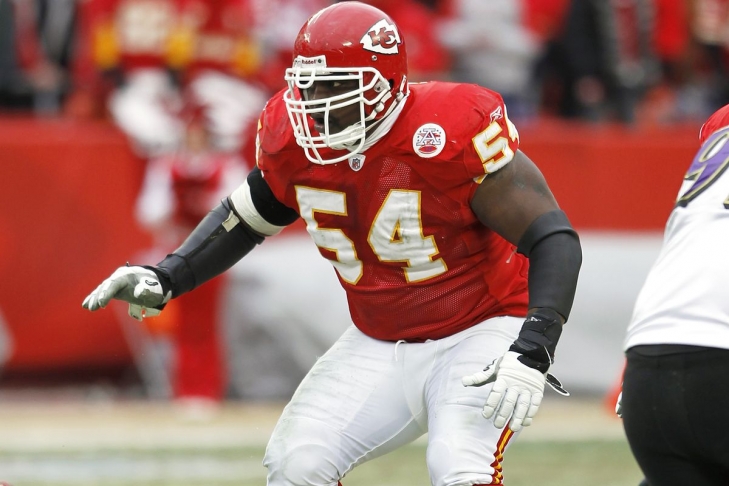
22. Brian Waters

Undrafted out of North Texas in 1999, the Waxahachie native entered the league with the Dallas Cowboys, trying to convert from college tight end to fullback. After being cut, Brian Waters landed in Kansas City in 2000, where Dick Vermeil and offensive line coach Willie Roaf/Will Shields quickly saw his true potential on the interior offensive line and shifted the 320-pound powerhouse to left guard.

Waters spent two seasons honing his footwork before seizing the full-time starting left guard job in 2002. Slotting in alongside Willie Roaf and Casey Wiegmann, he quickly evolved into one of the most dominant interior run-blockers in professional football, paving massive lanes for Priest Holmes and Larry Johnson during Kansas City's record-setting offensive explosion in the early 2000s.

His national breakthrough arrived during a historic 2004 campaign. After a 56–10 demolition of Atlanta in which Kansas City poured in an NFL-record eight rushing touchdowns, Waters earned AFC Offensive Player of the Week—becoming the first offensive lineman in NFL history to receive the weekly award. He capped off that stellar year with consensus AP First-Team All-Pro honors and his first Pro Bowl selection.

Waters replicated his First-Team All-Pro form in 2005 while cementing his status as an indispensable locker-room anchor. Over his 11-year run in Missouri, he earned five Pro Bowl nods in a Chiefs uniform (2004, 2005, 2006, 2008, and 2010), and two Second-Team All-Pro nods (2007, 2008), forming one of the most fearsome guard duos in league history alongside Hall of Famer Will Shields.

Beyond his dominance in the trenches, Waters distinguished himself as a generational community leader off the field. Through his 54-82 Foundation—which delivered resources, clothing, and athletic opportunities to underrepresented youth across Texas and Kansas City—he was awarded the prestigious 2009 Walter Payton NFL Man of the Year honor.

After leaving Kansas City in 2010, Waters earned his sixth Pro Bowl selection with New England in 2011 and finished his career with Dallas in 2013. He entered the Chiefs Hall of Fame in 2019.
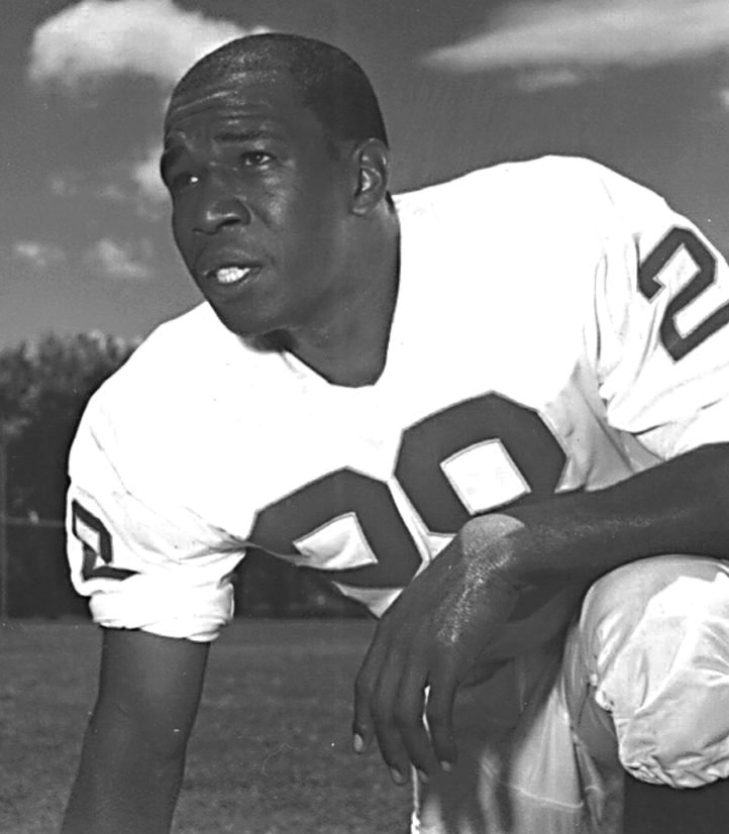
21. Abner Haynes

In terms of sheer games played in professional football, Abner Haynes does not rank among the top 50 on the franchise's all-time leaderboard. Yet few players in gridiron history ever made a more explosive, immediate impact than the North Texas product did at the birth of the American Football League. Joining Lamar Hunt’s Dallas Texans in 1960, Haynes immediately became the young league's signature draw, unleashing a dynamic style of play that defined Hank Stram’s high-flying offense from the very first snap.

Haynes immediately orchestrated one of the most remarkable debut seasons in professional football history. A multidimensional threat from the backfield, he captured the inaugural AFL rushing title with 875 yards, led the league with nine rushing touchdowns, and added 576 receiving yards, earning both AFL Rookie of the Year and AFL Player of the Year honors. He was not merely an elite open-field runner; his exceptional lateral agility and immediate acceleration enabled Stram to deploy him simultaneously as a flanker, a screen target, and a dangerous return specialist.

That record-setting inaugural campaign established a three-year stretch of unprecedented offensive dominance. Haynes topped the AFL in rushing touchdowns in each of the league’s first three seasons (1960, 1961, and 1962), routinely turning broken plays into runaway highlights. His personal peak came in 1962, when he racked up 1,049 rushing yards, 573 receiving yards, and 19 total scrimmage touchdowns, earning consensus First-Team All-AFL honors for the third straight year while propelling the Texans to an AFL Championship victory over the Houston Oilers.

When the franchise relocated to Missouri in 1963 to become the Kansas City Chiefs, Haynes remained the featured weapon in the offense. His versatility proved to be the ultimate cheat code for Len Dawson, giving Kansas City an explosive tailback who could stretch defenses horizontally on sweep plays or sprint past linebackers down the seam on passing downs. Over his five seasons with the franchise, he accumulated 9,734 all-purpose yards and 67 touchdowns, serving as the organization's first superstar before being traded to Denver in 1965.

In 1991, the Chiefs inducted Haynes into their Hall of Fame.

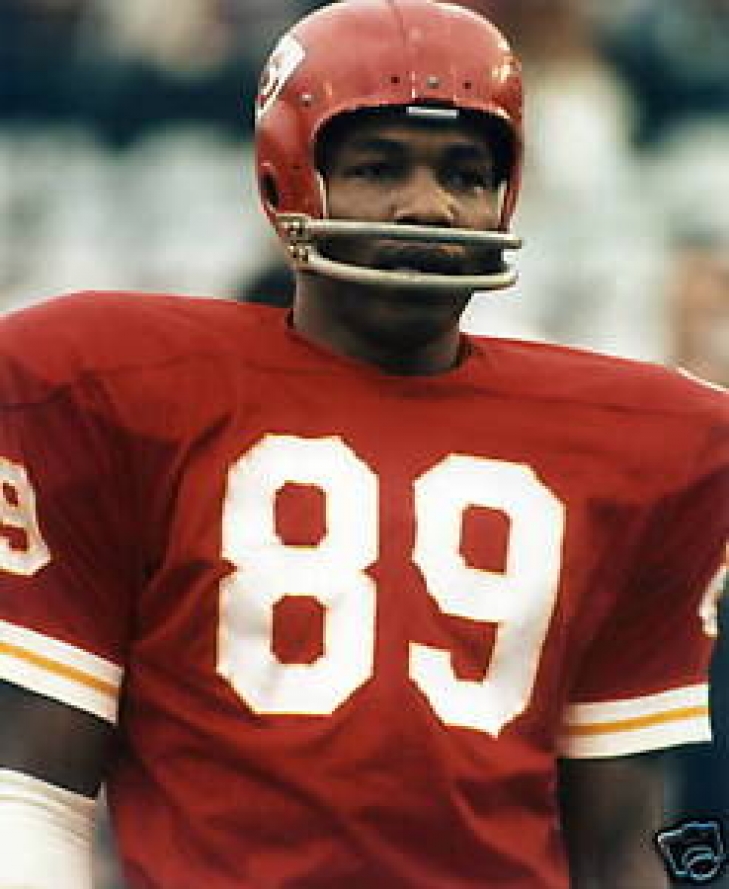
20. Otis Taylor

During the Kansas City Chiefs' golden era, Hank Stram’s defense rightfully stole the national headlines. Packed with future Hall of Fame titans like Willie Lanier, Buck Buchanan, Bobby Bell, and Emmitt Thomas, that defense choked out opponents and defined the franchise's identity. Yet, focusing solely on the defensive side of the ball ignores a crucial reality: Kansas City possessed a lethal offensive weapon capable of breaking any game open in a single stride, and his name was Otis Taylor.

Selected in the fourth round of the 1965 AFL Draft out of Prairie View A&M—while the NFL's Philadelphia Eagles also targeted him—Taylor chose the upstart AFL and stepped right into the lineup. Blessed with a towering 6-foot-3 frame, smooth long-striding speed, and raw physicality, he brought an imposing presence to both wide receiver and flanker. He quickly established an electric connection with Len Dawson, posting 26.4 yards per catch as a rookie before exploding for 1,297 receiving yards and eight touchdowns in his second season to help secure the 1966 AFL Championship.

As the decade turned, Taylor cemented his legacy in gridiron lore during the 1969 postseason run that culminated in Super Bowl IV. Facing the heavily favored Minnesota Vikings in the rain at Tulane Stadium, Taylor delivered the iconic highlight that put the game out of reach. Catching a short hitch pass from Dawson, he stiff-armed cornerback Karl Kassulke, broke a tackle along the sideline, and sprinted 46 yards into the end zone for the game-clinching score in a 23–7 triumph that crowned Kansas City world champions.

While the Super Bowl ring sealed his big-game reputation, Taylor's individual peak came in the early 1970s. His signature year came in 1971, when he dominated secondary after secondary to lead the NFL with 1,110 receiving yards on 57 catches (19.5 average) and seven touchdowns. That staggering display earned him consensus AP First-Team All-Pro selection and a Pro Bowl invitation, validating him as arguably the most dominant wideout in professional football.

He followed up that standout campaign with another First-Team All-Pro performance in 1972, hauling in 821 yards and six touchdowns despite defenses slanting their coverages entirely toward his side of the field. His rare combination of size and perimeter muscle allowed him to muscle through press coverage, snag high-pointed throws over smaller cornerbacks, and turn short screens into long gains.

Wear and tear eventually slowed the veteran wideout over his final three seasons in Kansas City, but his loyalty never wavered. Taylor spent all eleven of his active professional seasons in a Chiefs uniform (1965–1975), remaining the ultimate team leader through the transition years of the mid-1970s before hanging up his cleats following the 1975 campaign as one of the ultimate single-franchise legends of his generation.

Taylor accumulated 410 receptions, 7,306 receiving yards (17.8 Y/R), 57 receiving touchdowns, and three rushing scores, and was inducted into the Kansas City Chiefs Hall of Fame in 1982.

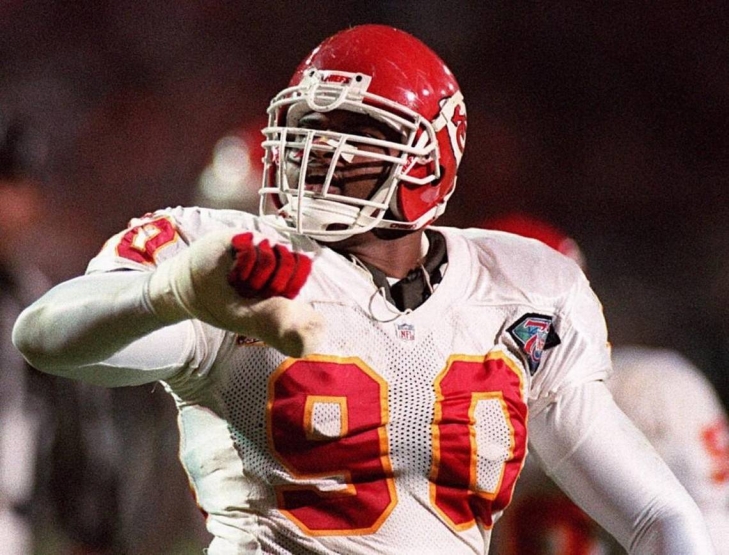
19. Neil Smith

Selected second overall in the 1988 NFL Draft out of the University of Nebraska, Neil Smith stepped onto the turf at Arrowhead Stadium with huge expectations. The All-American defensive end quickly established himself as a physical force off the edge, bringing rare closing speed, immense power, and a signature home-run celebration that made him a fan favorite across Kansas City.

After flashing potential during his first three seasons, Smith exploded into a dominant star as part of Marty Schottenheimer's defensive unit. Teaming up with linebacking legend Derrick Thomas, Smith formed one half of the most feared edge-rushing duos in professional football history. Opposing offensive lines were forced to pick their poison, and Smith made them pay routinely, earning his first Pro Bowl nod in 1991.

The peak of Smith's run in red and gold arrived during a remarkable four-year stretch from 1992 through 1995, where he topped double-digit sacks in four consecutive seasons. His crown-jewel performance came in 1993, when he led the entire NFL with 15.0 sacks while forcing three fumbles, earning First-Team AP All-Pro honors and helping propel the Chiefs to the AFC Championship Game.

Smith's dominant motor earned him five consecutive Pro Bowl selections (1991–1995) in Kansas City, alongside three All-Pro selections. Over his nine seasons with the Chiefs, his ability to collapse the pocket and stop the run anchored one of the league's elite defensive units. By the time he departed after the 1996 campaign, he had racked up 85.5 sacks for the franchise, sitting behind only Derrick Thomas on the team's all-time leaderboard.  He also had 32 forced fumbles and 527 combined tackles in Arrowhead.

Following his tenure in Kansas City, Smith joined the rival Denver Broncos in 1997, where he served as an impactful veteran presence and captured back-to-back Super Bowl rings (XXXII and XXXIII). He closed out his 13-year career with the San Diego Chargers in 2000, finishing with over 100 career sacks and earning a spot on the NFL 1990s All-Decade Team.

Despite wearing division-rival colors late in his career, Smith's heart and peak years remained rooted in Kansas City. In 2006, the franchise recognized his legendary contributions by inducting him as the 36th member of the Kansas City Chiefs Hall of Fame.