Menu
A+ A A-
Site Admin

Site Admin

31. E.J. Holub

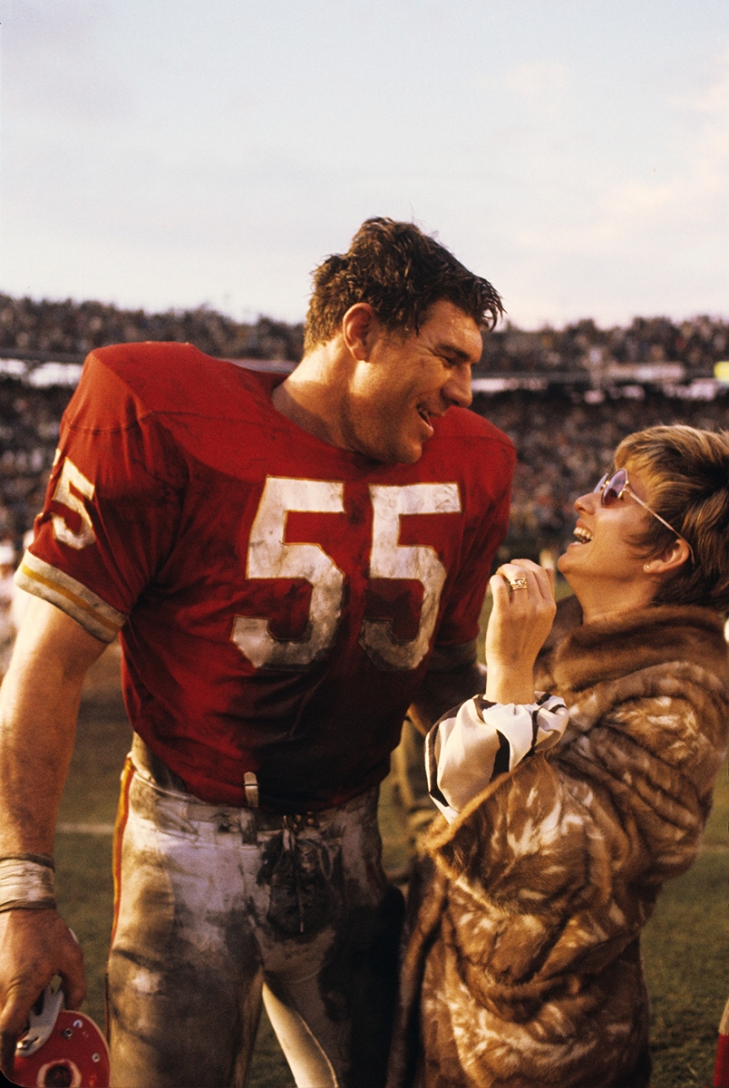
The first football player Texas Tech retired a jersey for, E.J. Holub entered pro football with the legendary nickname "The Beast"—and spent the next decade proving he earned every syllable of it. Selected sixth overall by the Dallas Texans in the 1961 AFL Draft, Holub made immediate professional history by doing what modern football specialization renders practically impossible: starting at two completely different, physically demanding positions on opposite sides of the ball.

Holub stepped onto the gridiron as an instant defensive anchor at linebacker. Over his first six seasons with the franchise, he commanded Hank Stram’s defense with relentless intensity, picking off 10 passes—returning one for a touchdown—and collecting five AFL All-Star selections (1961, 1962, 1964, 1965, 1966) alongside back-to-back First-Team All-AFL honors in 1962 and 1963. He was the emotional heartbeat of the 1962 Dallas squad that captured the AFL Championship in a dramatic overtime thriller over Houston.

Sustained collisions eventually levied a massive toll on his lower body, resulting in nine knee surgeries during his playing days. Rather than step away when knee instability ended his tenure at linebacker, Holub pulled off a miraculous mid-career transition: he moved full-time to offense and took over as the team's starting center in 1968, extending his career while giving Kansas City an elite interior anchor.

That unbelievable positional versatility yielded unique championship lore. Holub remains the only player in gridiron history to start two Super Bowls at two different positions, having started at middle linebacker in Super Bowl I and later at center in Kansas City’s Super Bowl IV victory over the Minnesota Vikings.

After the 1970 season, Holub retired after 10 years with the Texans/Chiefs, playing every pro snap for the organization.  He entered the Chiefs Hall of Fame in 1976.
30. Fred Arbanas

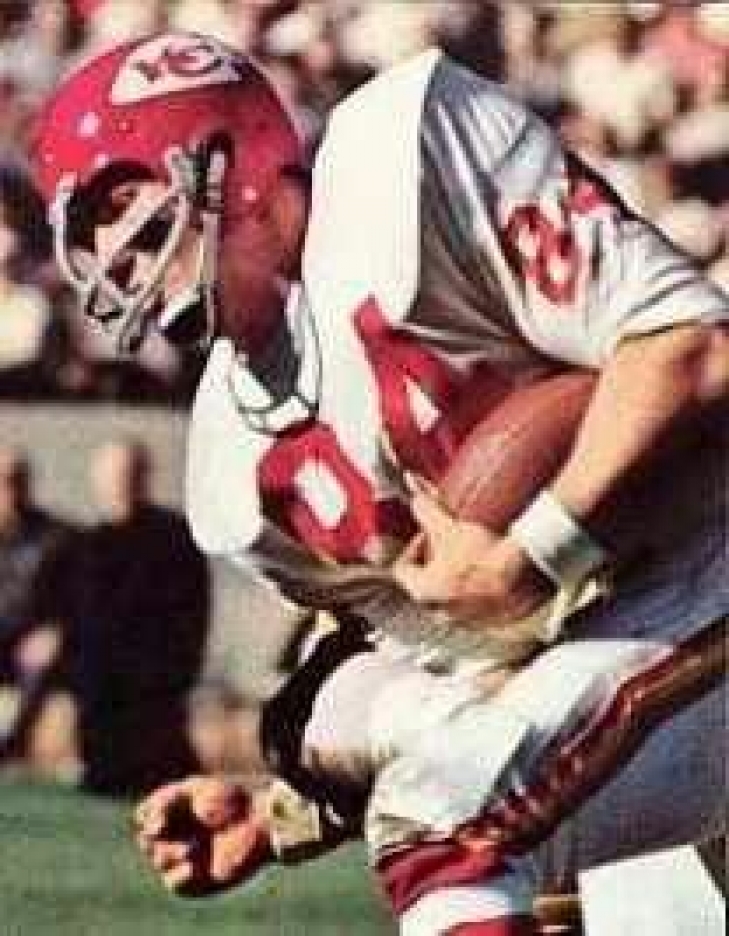
Before tight ends were routinely split out wide like oversized slot receivers, Fred Arbanas set the gold standard for what the position required in the upstart American Football League. Selected by the Dallas Texans in the second round of the 1961 AFL Draft out of Michigan State, Arbanas arrived as a bone-crushing blocker who doubled as a lethal downfield threat and immediately became the prototype flex weapon for Hank Stram's creative offensive schemes.

Arbanas made his debut during the 1962 campaign and wasted no time establishing himself as the league’s premier tight end. He secured an AFL All-Star selection as a rookie while helping lead the Texans to an overtime victory over the Houston Oilers in the 1962 AFL Championship Game. His broad frame allowed him to seal off defensive ends in Stram's signature trap-and-sweep running attack, while his soft hands made him Len Dawson’s favorite target whenever pass rushers collapsed the pocket.

Arbanas sustained that elite form across the middle of the decade, earning five AFL All-Star selections (1962–1965, 1967) and three consensus First-Team All-AFL nods (1964, 1966, 1967). Even after suffering a serious eye injury in 1964 that permanently altered his vision, his toughness and field awareness never wavered. He remained a central fixture through the franchise's transition to Missouri, capturing a second league title in 1966 and starting in the inaugural AFL-NFL World Championship Game.

His decorated career peaked during the 1969 postseason. Arbanas anchored the line as Kansas City claimed its third AFL title before defeating the Minnesota Vikings in Super Bowl IV, cementing the franchise's place in gridiron history. He retired following the 1970 campaign, having played every single snap of his nine-year professional career exclusively for the Texans/Chiefs organization. He had 198 receptions for 3,101 receiving yards (15.7 Y/R), 34 receiving touchdowns, and in 1973, Arbanas was inducted into the Chiefs Hall of Fame.

29. Eric Berry

When the Kansas City Chiefs selected Eric Berry with the fifth overall pick in the 2010 NFL Draft, they were not merely choosing a unanimous All-American from Tennessee; they were adding an exceptional presence to their secondary. The former SEC Defensive Player of the Year immediately established a high standard for the modern strong safety. As a rookie, he recorded 92 tackles and four interceptions, earning his first Pro Bowl selection. Although a torn ACL in Week 1 of the 2011 season sidelined him for the remainder of the year, Berry returned in 2012 and earned another Pro Bowl invitation, setting the stage for one of the most dominant multi-year peaks in football history.

Berry unleashed his full, world-class repertoire during a breakout 2013 season. As a movable chess piece in Bob Sutton’s secondary, he delivered a masterclass in hybrid safety play—racking up 73 tackles, 3.5 sacks, 10 passes defended, and three interceptions, two of which he returned for explosive touchdowns. His relentless range and devastating tackling force earned him his first consensus AP First-Team All-Pro selection, establishing him as the gold standard at his position.

His trajectory took an inspirational turn in late 2014 when persistent chest pain led to a Hodgkin’s Lymphoma diagnosis, cutting short his season after five games. Showing incredible resolve, Berry underwent chemotherapy treatments, beat the disease into remission in under nine months, and returned for the 2015 training camp in peak form. He went on to play all 16 games in 2015, recording 61 tackles and two interceptions to secure his second First-Team All-Pro nod alongside consensus AP Comeback Player of the Year honors.

Berry pushed his performance even higher in 2016, putting together a third First-Team All-Pro campaign. He anchored the defense with 77 tackles, nine passes defended, and four interceptions, returning two for scores. That magical season featured his iconic December performance in Atlanta—returning a late pick-six before intercepting Matt Ryan on a two-point conversion and sprinting 100 yards for a game-winning "pick-two," becoming the first player in NFL history to do so.

Tragically, injury luck deserted the superstar once again. An Achilles tear in the 2017 season opener against New England sidelined him for the remainder of the year, and lingering heel complications restricted him to just two regular-season games in 2018. Kansas City released the veteran safety in early 2019, ending a heroic nine-year run in red and gold in which he played every snap of his NFL career exclusively for the Chiefs.  He produced 445 tackles, 14 interceptions (three pick-sixes), 50 passes defended, and 5.5 sacks over his career.

Still, can you imagine just what a legend he would be in Kansas City if he was regularly healthy?

28. John Alt

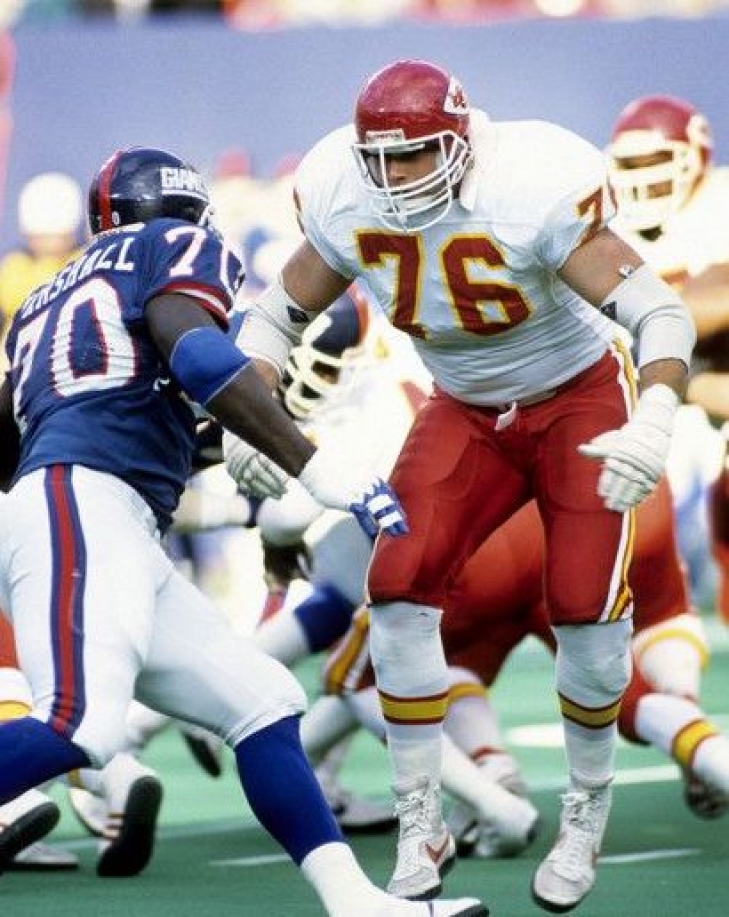
Chosen in the first round (21st overall) of the 1984 NFL Draft out of Iowa, John Alt entered the league as a towering physical specimen. Standing 6-foot-8 and weighing over 300 pounds, the former tight end-turned-lineman had extraordinary length and athletic footwork, which helped him adjust to the speed of professional pass rushers before he seized the starting left tackle job for good in 1985.

Alt developed into a rock-solid blindside protector as the 1980s progressed, holding down the left perimeter through multiple offensive scheme shifts and quarterback changes. His broad frame and long reach made him an ideal pass blocker against the era’s elite edge rushers, while his run-game technique helped spark the physical ground attacks that became the hallmark of Marty Schottenheimer's arrival in 1989.

His national reputation caught up with his on-field execution in the early 1990s. Alt earned AP Second-Team All-Pro recognition in 1990 before securing back-to-back Pro Bowl selections in 1992 and 1993. As the lead anchor along an offensive line that featured Tim Grunhard and Dave Szott, he protected Joe Montana during Kansas City's memorable run to the 1993 AFC Championship Game, solidifying his standing as one of the premier left tackles in football.

A model of durability and loyalty, Alt spent all 13 seasons with the Chiefs, anchoring left tackle for 179 regular-season games. He retired after the 1996 season, having played every NFL snap for Kansas City, and was inducted into the Chiefs Hall of Fame in 2002.