Menu
A+ A A-
Site Admin

Site Admin

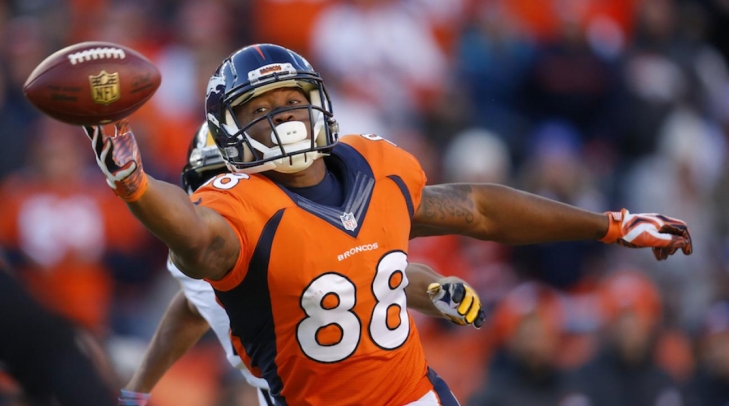
18. Demaryius Thomas

Drafted 22nd in the 2010 NFL Draft from Georgia Tech, Demaryius Thomas brought rare physical tools—6-foot-3, 225 pounds, fast in open field. Injuries limited him to seven starts in his first two seasons, but he showed potential during the 2011 postseason. His 80-yard walk-off catch from Tim Tebow in overtime against Pittsburgh is a legendary moment in Mile High history.

When Peyton Manning became the starting quarterback in 2012, Thomas developed into an exceptional wide receiver. With reliable hands and strong run-after-catch abilities, he achieved five straight 1,000-yard seasons and was selected to the Pro Bowl five times from 2012 to 2016. In Denver's record-breaking 2013 offense, Thomas recorded 1,430 receiving yards and a personal best of 14 touchdowns, earning Second-Team All-Pro honors. Despite the heartbreak of Super Bowl XLVIII, Thomas set a then-record with 13 receptions in the game.

His finest individual campaign arrived in 2014, when he set a Broncos single-season franchise record with 1,619 receiving yards on 111 catches. The following year, Thomas proved his value as an elite wideout, adjusting to shifting quarterback play to rack up 105 receptions for 1,304 yards. He served as the primary passing weapon for a squad that won Super Bowl 50, securing his championship ring. He added a final 1,000-yard effort in 2016 before being traded to the Houston Texans midway through the 2018 season.

Tragically, Thomas died suddenly in December 2021 at age 33, creating a deep void in the organization and among fans. Recognized for his infectious smile, relentless community efforts, and physical prowess, he was inducted into the Denver Broncos Ring of Fame in 2025 as a first-ballot honoree.

With the Broncos, Thomas played 125 games, with 111 starts, totaling 665 receptions, 9,055 yards, and 60 touchdowns. He ranks second in franchise history for receiving yards and touchdowns. A five-time Pro Bowler, two-time Second-Team All-Pro, Super Bowl 50 champion, and Hall of Famer, "D.T." is one of the Broncos’ most legendary playmakers.
17. Lionel Taylor

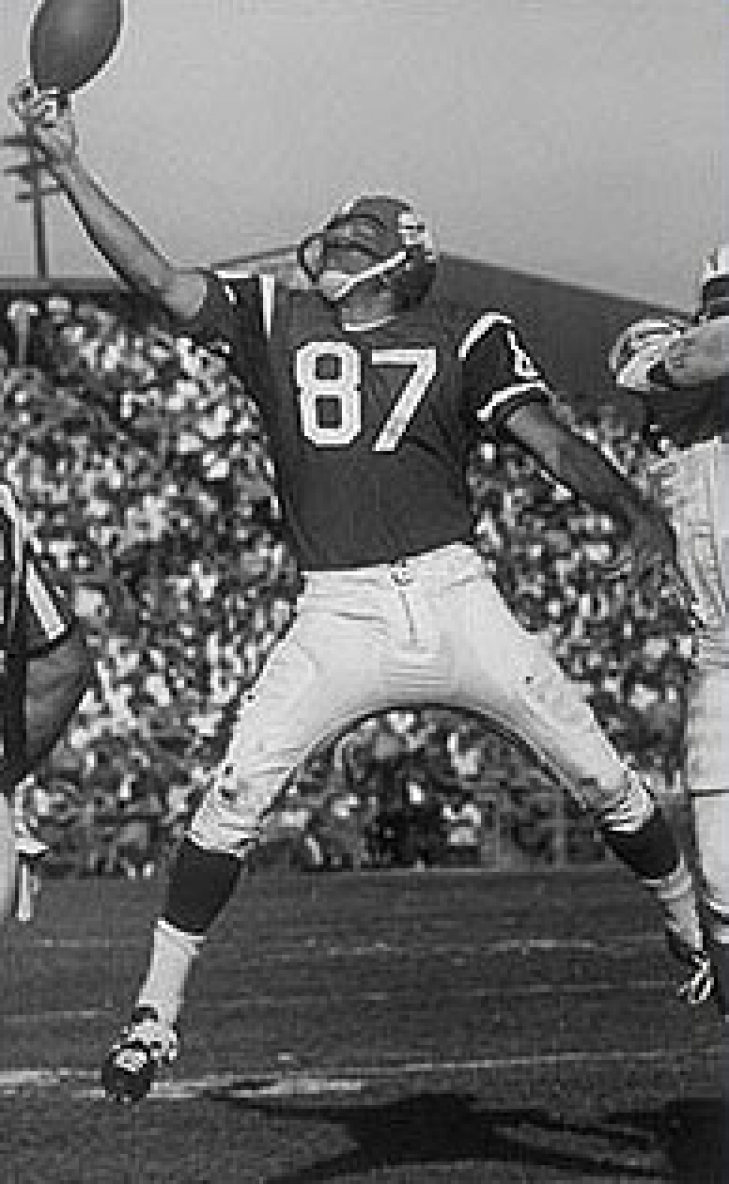
When the American Football League launched in 1960, the Denver Broncos were mostly overlooked, wearing outdated uniforms and rotating through mediocre quarterbacks. Still, during those tumultuous early years, split end Lionel Taylor established a pass-catching mastery that reshaped the structure of professional passing offenses. After a short period as a linebacker with the Chicago Bears, Taylor quickly became the league’s leading high-volume receiver, using his 6-foot-2 stature and "vice-grip" hands to dominate pass coverage in the AFL.

Taylor was almost impossible to contain, achieving an extraordinary streak by leading the AFL in receptions in five of its first six seasons (1960–1963, 1965). His standout year came in 1961, when he caught 100 passes for 1,176 yards in a 14-game season, making him the first player in professional football history to reach 100 receptions in a single season. This franchise record stood in Denver for nearly 40 years until Shannon Sharpe broke it in 2000. Over a six-year peak from 1960 to 1965, Taylor averaged 84.7 catches annually and never caught fewer than 76 passes in a season, a workload unmatched by any pass-catcher in both the AFL and NFL during that period.

Because his stats were accumulated primarily during his time with underdog Denver teams in a less prominent league, Taylor seldom gained the national recognition given to NFL stars of his time. Nevertheless, his impact in Mile High was clear: he won Denver’s Team MVP award three consecutive years (1963–1965) and set long-lasting franchise records for career catches and receiving yards. After his final Denver season in 1966 and two brief years in Houston, Taylor retired as the third all-time leading receiver in pro football history, with 567 career receptions. Later, he earned two Super Bowl rings while serving as the wide receivers coach for Chuck Noll’s iconic 1970s Pittsburgh Steelers.

Taylor played in 96 games, with 543 receptions, 6,872 yards, and 44 touchdowns. A four-time All-AFL, three-time AFL All-Star, and five-time receptions leader, he was one of the four original Denver Broncos Ring of Fame members in 1984.

14. Bill Thompson

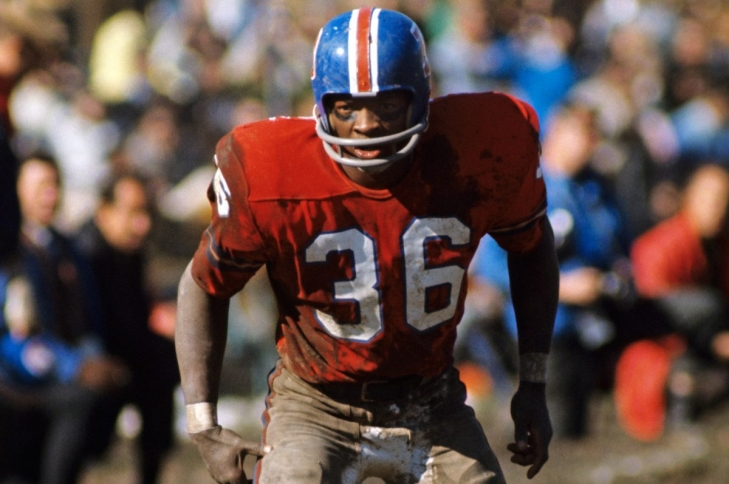
Taken in the third round of the 1969 AFL-NFL Draft out of Maryland State (now UMES), Billy Thompson made an immediate, multi-dimensional splash as a rookie. Deployed as a right cornerback and return specialist, Thompson put together an electric debut campaign, becoming the first player in professional football history to lead his league in both kickoff return average (28.5 yards) and punt return average (11.5 yards) in the same season.

Though Thompson was initially a dangerous special teams player, he became a franchise cornerstone after head coach John Ralston moved him from cornerback to strong safety in 1973. This switch unlocked his full potential, allowing him to serve as the tough, ball-hawking key figure of the secondary. He anchored Joe Collier's renowned "Orange Crush" defense, known for disciplined tackling, relentless pursuit, and frequent turnovers.

Thompson's best season was during Denver's storybook 1977 campaign. Snaring five interceptions, recovering three fumbles, and spearheading a defense that powered the Broncos to their first AFC championship and Super Bowl XII appearance, Thompson was named a First-Team All-Pro and earned his first Pro Bowl selection. He added back-to-back Pro Bowl nods in 1978 and 1981, routinely jump-starting the offense by converting opponent mistakes into instant points. In fact, Thompson scored seven career defensive touchdowns—three on interception returns and four on fumble recoveries—the latter standing as an NFL record for decades.

Beyond his playmaking prowess, Thompson was an absolute ironman. He started 178 of his 179 games in Denver, setting a franchise record with 142 consecutive starts that stood for years. A long-time team captain, he retired following the 1981 season as the first player in franchise history to log 13 active seasons in a Broncos uniform.

With Denver, he compiled 40 interceptions for a franchise-record 784 return yards, 21 fumble recoveries, and seven defensive touchdowns, while adding 2,970 combined return yards and was inducted into the Denver Broncos Ring of Fame in 1987 as the sole member of his class.

15. Peyton Manning

For over a decade, John Elway’s shadow hung over Mile High, fueling a long search for a worthy successor under center. In a twist fit for a movie script, it took Elway himself—serving as executive vice president and general manager—to finally solve the puzzle. After four neck surgeries forced Peyton Manning to miss the entire 2011 season, Indianapolis released their franchise icon and drafted Andrew Luck first overall. Elway pounced, luring the future Hall of Famer to Denver in 2012 amid a sea of eager suitors. Questions lingered about whether Manning’s arm strength and nerve function would hold up, but what followed was one of the most prolific second acts in sports history.

In 2012, Manning silenced critics by leading the NFL in completion percentage at 68.6%, throwing for 4,659 yards and 37 touchdowns. He received the AP Comeback Player of the Year award, was named a First-Team All-Pro, and helped Denver achieve a 13–3 record. The following year, he surpassed his own standards with what is considered the greatest statistical season by a passer in NFL history. Manning led the league's highest-scoring offense ever (606 points), setting single-season records with 5,477 passing yards and 55 touchdown passes. This outstanding performance earned him his fifth MVP award, another First-Team All-Pro honor, and an AFC Championship win.

Following another Pro Bowl and a 4,700-yard season in 2014, the physical toll of father time and accumulated injuries caught up to Manning in 2015. Plagued by a torn plantar fascia, he struggled through a nine-touchdown, 17-interception stretch and surrendered the starting job to Brock Osweiler. Yet true to his legendary intellect, Manning reclaimed the job in Week 17, serving as the ultimate game manager for Wade Phillips' historic "No Fly Zone" defense. In the postseason, Manning used his elite pre-snap command to pilot Denver through the AFC bracket, capping his career with a 24–10 victory over Carolina in Super Bowl 50. That would be the last game Peyton Manning ever played. Having become the first starting quarterback to win Super Bowls with two different franchises, Manning rode off into the sunset, announcing his retirement weeks after lifting the Lombardi Trophy.

As a Bronco, compiling 17,112 passing yards, 140 touchdown passes, and a 45–12 record as a starter. Manning was inducted into the Denver Broncos Ring of Fame in 2021, the same year he was enshrined into the Pro Football Hall of Fame in his first year of eligibility.