- Published in Top 50 Tampa Bay Rays
24. Jason Bartlett
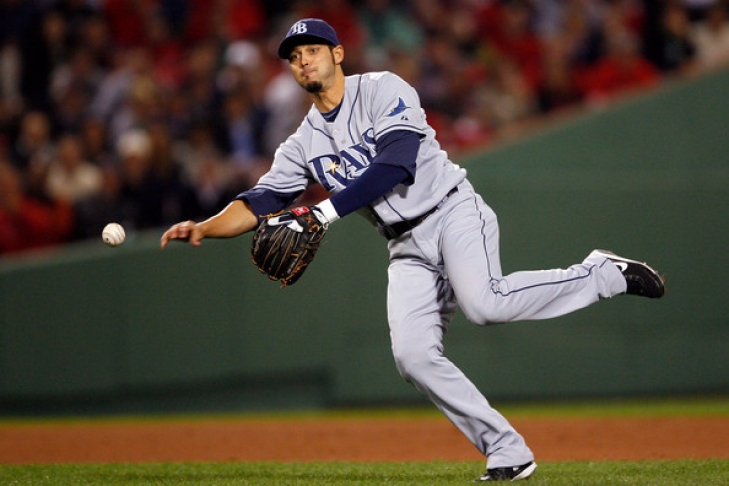
The best three seasons of Jason Bartlett’s career were with the Tampa Bay Rays (2008-2010), the second of what would be three Major League teams that he would play for.


The best three seasons of Jason Bartlett’s career were with the Tampa Bay Rays (2008-2010), the second of what would be three Major League teams that he would play for.

After having been named an All-Star four times in his career, Fred McGriff was left available in the 1998 Expansion Draft, and the Tampa Bay Rays were able to have the hometown star as an inaugural Ray.
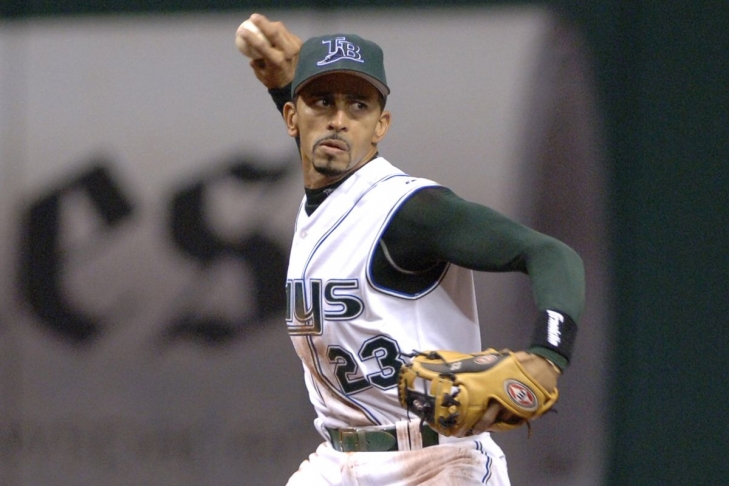
The signing of Julio Lugo in spring 2003 stands out as one of the most savvy and opportunistic moves by the Devil Rays’ front office during their early years. Released by the Houston Astros early in the season after an off-field arrest, the Dominican infielder was placed on waivers as a troubled player. With limited finances and a pressing need for stability at middle infield, the Rays took a calculated risk on his potential. This move quickly paid off for both Lugo and the franchise, as he immediately filled the shortstop position and maintained the starting role for over three and a half seasons.
Lugo’s impact on a perennially struggling defense was instantaneous and profound. During that initial 2003 campaign, he completely reconfigured the left side of the Tampa Bay infield with his exceptional lateral mobility and quick release. He finished the year leading all American League shortstops in Range Factor per Game—a metric reflecting his uncanny ability to get to balls that average defenders simply watched bleed into the outfield. He paired that elite defensive coverage with a highly respectable offensive baseline, swatting 15 home runs and hitting .275.
The 2004 season was a near-mirror image of consistency, as Lugo once again anchored the infield dirt while turning in identical offensive metrics. He proved that his first year in St. Pete was no fluke, giving manager Lou Piniella a reliable, high-energy catalyst who could slide into multiple spots in the batting order. While the Devil Rays as a whole were still mired in the American League East cellar, Lugo’s presence ensured that the shortstop position was an undeniable area of strength rather than a liability.
Lugo saved his absolute best individual performance for the 2005 campaign, putting together a definitive breakout year at the plate. He raised his batting average to a blistering .295 and collected a career-high 182 hits, showing an evolved approach that featured better gap-to-gap spray and sharper situational hitting. Meanwhile, his defensive wizardry remained fully intact, as he once again outpaced his junior circuit peers to finish first among AL shortstops in Range Factor per Game, cementing himself as one of the most complete players at his position in the league.
By the time the 2006 trade deadline approached, Lugo was playing the best baseball of his career, carrying a stellar .308 batting average and drawing immense interest from contenders looking for a postseason spark. Recognizing that the impending free agent was at the peak of his trade value, the Rays dealt him to the Los Angeles Dodgers in late July. He departed St. Petersburg with 550 hits and a sharp .287 batting average across 505 games, leaving behind a legacy as arguably the first truly elite defensive shortstop in the history of the young organization.
After his stint in Los Angeles, Lugo would parlay his success into a lucrative free-agent contract with the Boston Red Sox, where he would secure a World Series ring as their starting shortstop in 2007.
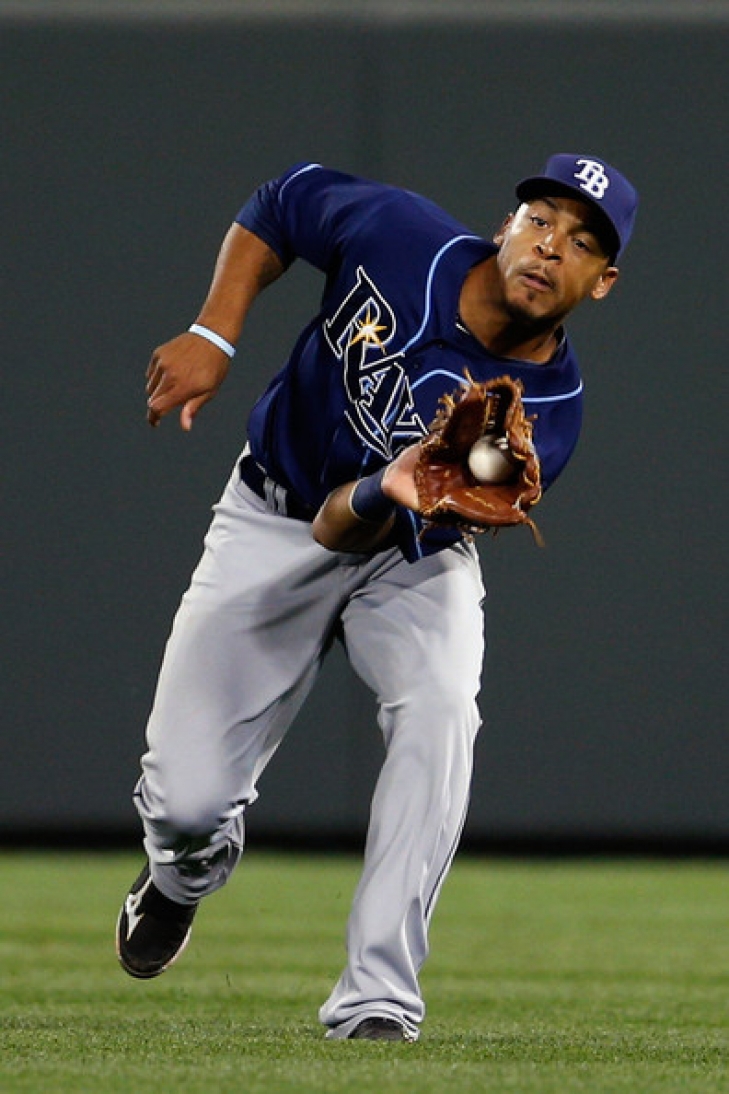
Desmond Jennings entered the Tampa Bay organization burdened by the astronomical expectations that come with being a consensus top-ten prospect in all of baseball. Blessed with breathtaking speed and electric physical tools, he was widely touted by scouts and fans alike as the natural heir apparent to B.J. Upton in center field. When he made his major league debut in the late summer of 2010, the anticipation was palpable, as the front office envisioned Jennings anchoring the premium real estate of the Tropicana Field outfield for the next decade.
The true peak of Jennings’ career materialized across a highly productive three-season window from 2012 through 2014. By 2013, he had firmly secured the everyday starting job in center field, serving as a durable and reliable fixture at the top of Joe Maddon's lineups. During each of those three consecutive campaigns, Jennings eclipsed the 115-hit mark, weaponizing his legs to stretch singles into doubles and turning routine grounders into close plays at first base, providing the Rays with a steady, high-energy presence during a competitive era.
On the defensive side of the ball, Jennings was an asset. While he lacked the theatrical flair of some of his contemporaries, his vast range, exceptional acceleration, and precise route-running allowed him to swallow up fly balls from gap to gap with above-average efficiency. In the cavernous and sometimes unpredictable environment of the Trop, his defensive reliability gave a highly sophisticated Rays pitching staff the ultimate safety net, ensuring that extra-base hits were routinely minimized.
However, while his defense and speed remained elite, Jennings’ overall value was capped by a relatively light bat. He struggled to consistently drive the ball, resulting in an underwhelming career triple-slash line of .245/.322/.393. While he showed occasional pull power, his high strikeout rate and difficulty adjusting to breaking pitches away meant he never truly evolved into the dynamic, top-tier leadoff force the organization had initially projected.
The wheels began to come off physically during the 2015 season, as a frustrating onslaught of knee injuries sapped Jennings of the elite speed that anchored his entire game. Shuffled back and forth from the disabled list, he was never able to recapture his fluid strides or explosive baseline. After a brutal 2016 campaign where his body clearly betrayed him, the cash-conscious Rays made the difficult decision to release him, effectively ending his big-league career at just 29 years old.
Over his career, Jennings collected 508 hits with 95 stolen bases.