
Menu
A+ A A-
Committee Chairman

Committee Chairman

Kirk Buchner, "The Committee Chairman", is the owner and operator of the site.  Kirk can be contacted at [email protected] .

32. Woodrow Lowe

Woodrow Lowe arrived in 1976 as a fifth-round pick out of Alabama after a three-time All-American career under Bear Bryant, and he immediately won the starting right linebacker job as a rookie. He kept that spot for nearly his entire 11-year run in San Diego, starting 151 of his 164 games and missing only one contest. At about 6-foot and 227 pounds, he was a solid run defender who could also drop into coverage, and that ability showed up in 21 interceptions—an unusually high number for a linebacker—four of which he returned for touchdowns.

His best seasons lined up with the Air Coryell years. In 1979, he picked off a career-high five passes and returned two for scores. The next year he became a team captain, a role he held for seven seasons, and he earned Second-Team All-AFC honors while the Chargers reached the AFC Championship Game. He was still productive later on, picking off three passes in both 1984 and 1985 and adding 15 career sacks. He was the kind of linebacker who could hold the edge against the run, then jump routes or sit in a zone and create turnovers when the offense attacked his area. One of the more memorable (and unfortunate) moments of his career came in the 1978 “Holy Roller” game against the Raiders, when he was the defender closing in on Ken Stabler as the controversial fumble-forward play unfolded.

Lowe retired after the 1986 season. Throughout his career with the Chargers, he was one of the steadiest, longest-tenured defenders of that era, finishing with 21 interceptions and a reputation as a durable, reliable starter who rarely missed time.

After his playing days, he was named to both the Chargers’ 40th and 50th Anniversary Teams, and in 2009 he was inducted into the College Football Hall of Fame, recognition for the three-time All-American who had spent more than a decade anchoring the Chargers’ linebacking corps.
12. Keenan Allen

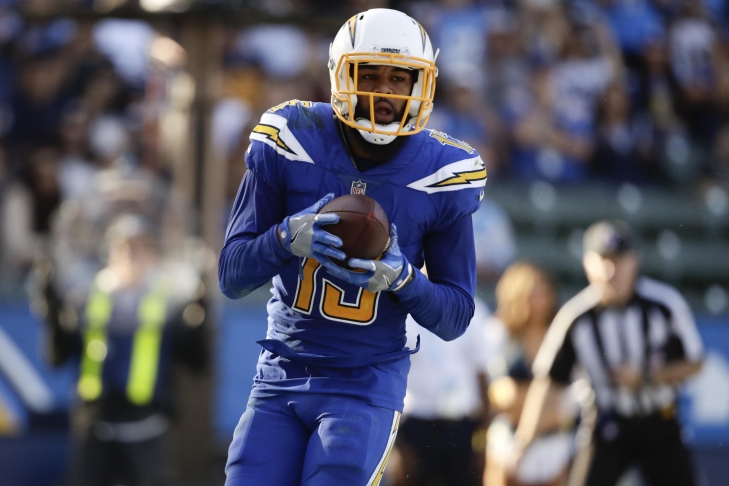
When the San Diego Chargers selected Keenan Allen in the third round (76th overall) of the 2013 NFL Draft out of Cal, few predicted how quickly the smooth route-running specialist would seize control of the team's aerial attack. Stepping into a prime role as a rookie, Allen erupted for 71 receptions, 1,046 yards, and eight touchdowns, earning PFWA All-Rookie Team honors and instantly becoming Philip Rivers’ most trusted target.

Despite that electric start, Allen soon ran into a brutal string of bad luck. After a quieter sophomore year, he was on pace for a career season in 2015, logging 67 catches through eight games before a severe kidney injury cut his campaign short. Misfortune struck again in the 2016 opener when he suffered a season-ending torn ACL, raising questions about his long-term durability.

Allen answered those doubts with a triumphant performance in 2017—the franchise's inaugural year in Los Angeles. He played all 16 games, catching 102 passes for 1,393 yards and six touchdowns to sweep AP and PFWA Comeback Player of the Year honors and earn his first Pro Bowl selection. That launched a dominant five-year Pro Bowl streak through 2021. In 2023, he set a single-season Chargers record with 108 receptions for 1,243 yards, earning his sixth Pro Bowl nod.

Contract negotiations led to a trade to the Chicago Bears for the 2024 season, where Allen posted 70 catches for 744 yards and seven touchdowns. But the separation from Southern California didn't last long. In August 2025, Allen returned home to the Chargers on a one-year deal. His reunion season proved historical: in Week 5 against Washington he became the fastest player in NFL history to reach 1,000 career receptions (159 games), and in Week 10 against Pittsburgh he officially passed Antonio Gates as the Chargers' all-time career receptions leader. He finished his 2025 homecoming season with 81 catches for 777 yards and four touchdowns.  He joined the Indianapolis Colts for the 2026 season.

With the Bolts, Allen caught 985 passes for 11,307 yards and 63 touchdowns.

31. Rodney Harrison

Rodney Harrison came out of Western Illinois as a fifth-round pick in 1994 and spent his rookie year mostly on special teams while the Chargers made their Super Bowl run. By his third season, he had locked down the starting strong-safety job, and from there the hits started landing with a little more force than the rulebook preferred. At 6-foot-1 and around 220 pounds, he played the position like a linebacker who had wandered into the secondary—blitzing, filling alleys, and finishing tackles in a way that made receivers think twice about cutting across the middle. He picked up the nickname “The Hitman,” and while he would later insist he was just a passionate, old-school player, the fines and the “dirtiest player” votes that followed suggested opponents saw it a bit differently.

Once he was a full-time starter, the production came in bunches. From 1996 through 1998, he piled up well over 100 tackles a season, and in 1998 he earned First-Team All-Pro and Pro Bowl honors with 114 tackles, three interceptions, and four sacks. After missing most of 1999 with an injury, he bounced back with more 100-plus tackle seasons, including a career-high 127 tackles and six interceptions in 2000, then made the Pro Bowl again in 2001. Teammates voted him the Chargers’ Defensive Player of the Year four times during his run in San Diego. He was the rare safety who could cover deep, come downhill and stuff the run, and still generate pressure when the defense dialed up a blitz—21.5 of his career sacks came while he wore the lightning bolt.

The Chargers released him after the 2002 season. In nine years with the franchise, he finished with 26 interceptions, 21.5 sacks, and 760 combined tackles, numbers that still rank among the best for a safety in team history.

He later found a home in New England, added a couple of Super Bowl rings, and in 2025 the Chargers inducted him into their Hall of Fame, finally giving the hard-hitting safety the franchise recognition that matched the reputation he built during those nine seasons in San Diego.

30. Louie Kelcher

Louie Kelcher joined the Chargers as a second-round pick out of SMU in 1975 and immediately became a massive presence in the middle of the defensive line. At 6-foot-5 and often listed at 280–300 pounds, he was one of the biggest interior linemen of his era, using that bulk to clog running lanes and push the pocket. As a rookie, he earned All-Rookie honors, then settled into a long run as a starter. In 1977, he was voted the team’s Most Valuable Player after helping the defense record 44 sacks, and the next year he earned First-Team All-Pro honors and his second Pro Bowl nod.

The best stretch came in the late 1970s and early 1980s alongside Fred Dean, Gary “Big Hands” Johnson, and Leroy Jones—the group that became known as the Bruise Brothers. Kelcher made three Pro Bowls (1977, 1978, and 1980) and earned Second-Team All-Pro honors in 1977, 1980, and 1981. In 1980, even after missing most of the previous season with a knee injury, he returned and helped the defense lead the NFL with 60 sacks. He was the kind of space-eating tackle who could occupy multiple blockers, disrupt the run, and still generate pressure up the middle when the play called for it. In the 1980 AFC Championship Game, he finished with 20 tackles, and in the famous “Epic in Miami” playoff the following year, he forced a fumble that helped keep the Chargers alive.

After the 1983 season, the Chargers traded him to the San Francisco 49ers, where he played one final year and won a Super Bowl. Across his nine seasons in San Diego, he had piled up roughly 40 unofficial sacks along with two interceptions and eight fumble recoveries.

The franchise later inducted him into its Hall of Fame in 2003, recognizing the big, physical defensive tackle who had been a cornerstone of the Chargers’ front during the late Air Coryell era.