Menu
A+ A A-
Site Admin

Site Admin

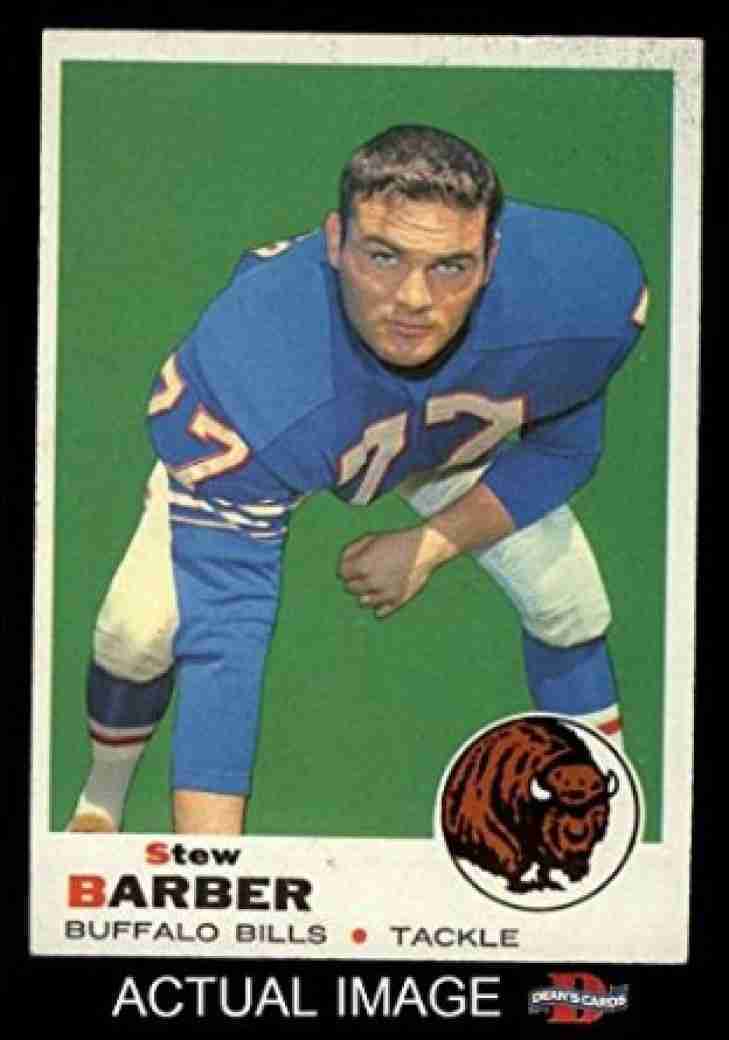
27. Stew Barber

Drafted out of Penn State in 1961, Stewart "Stew" Barber originally signed with Buffalo as a linebacker. It didn't take long for head coach Lou Saban to realize Barber's potential on offense, shifting him to the trenches, where he became the primary architect of the team's pass protection and edge blocking for nearly a decade.

Barber possessed a rare blend of linebacker agility and trench-warfare strength. Settling in at left tackle, he excelled at setting wide, immovable bases against the league's fastest pass rushers, keeping the pocket clean for Jack Kemp. In the run game, his athletic mobility allowed him to seal off defensive ends on the perimeter, creating massive cutback lanes for heavy-hitting backs like Cookie Gilchrist.

Barber locked down the left tackle spot in 1962, earning his first career AFL All-Star selection during a season that saw Buffalo introduce its high-powered offensive attack.

His prime coincided directly with Buffalo's back-to-back AFL Championship runs in 1964 and 1965. Barber was named a First-Team All-AFL selection in 1964 after leading an offensive line that paved the way for Cookie Gilchrist and captured the franchise's first league title. He backed that up in 1965 with his second First-Team All-AFL nod, keeping Jack Kemp protected through a 23–0 championship shutout of San Diego.

Barber remained a model of elite performance, racking up five total AFL All-Star selections (1962, 1964–1967) and adding a Second-Team All-AFL honor in 1966.

Spending his entire nine-year professional career (1961–1969) exclusively with the Bills, Barber played in 122 regular-season games, anchoring the line through the greatest decade in the organization's early history before retiring on the eve of the AFL-NFL merger. In 1998, the organization recognized his contributions to their early dynasty by inducting Barber into the Buffalo Bills Wall of Fame.
31. Ted Washington

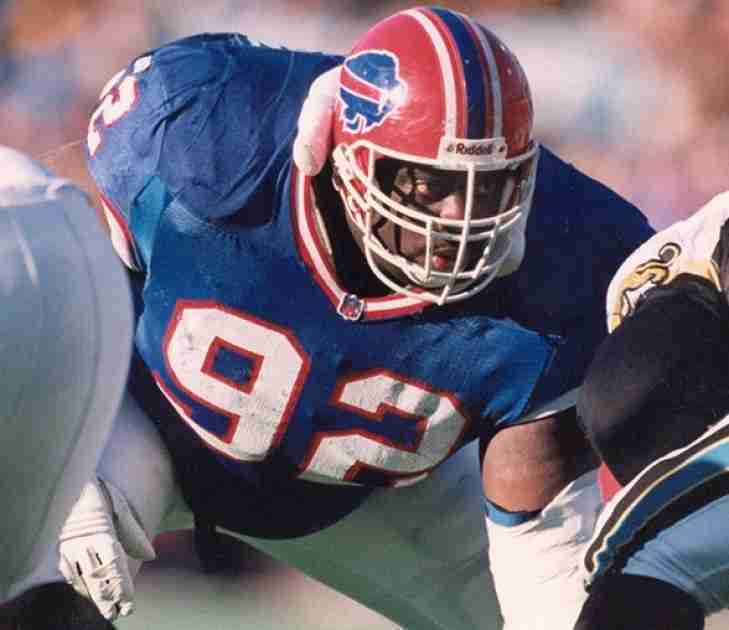
Ted "Mt. Washington" joined the Buffalo Bills as an unrestricted free agent in 1995, following periods with San Francisco and Denver. He arrived in Western New York as a formidable presence. At 6 feet 5 inches and over 365 pounds, Washington was the key pillar of Buffalo's 3-4 defense, delivering the most outstanding and commanding phase of his 17-year NFL career.

At his size, Washington redefined what it meant to play nose tackle in the 3-4 scheme. Lined up head-up over the center, he was virtually impossible to move with a single block, regularly absorbing double and triple teams without giving up an inch of ground. His ability to reset the line of scrimmage inside allowed pass rushers like Bruce Smith to operate on the edges, while leaving linebackers clean to flow freely and make plays in the run game.

Although nose tackles generally don't achieve flashy stats, Washington consistently contributed in the box score during his six seasons in Buffalo. Partnering with Pat Williams to create the well-known interior duo called "The Package," Washington led a run defense that consistently ranked as one of the AFC's toughest to face.

His peak came in the late 1990s, when he earned three Pro Bowl selections (1996, 1997, and 2000) and was named Second-Team All-Pro in 1997. Despite his large physique, Washington showed impressive durability and ability to collapse the pocket, missing no games throughout his time with the Bills.

After the 2000 season, the Bills faced a significant salary-cap crisis. Washington was released in March 2001 after refusing a second restructuring pay cut. He then signed with the Chicago Bears, earning a First-Team All-Pro honor and eventually winning Super Bowl XXXVIII with the New England Patriots before retiring in 2007.

In Buffalo, Washington played and started in 96 regular-season games, recorded 378 combined tackles and 19.5 sacks.

44. Charles Romes

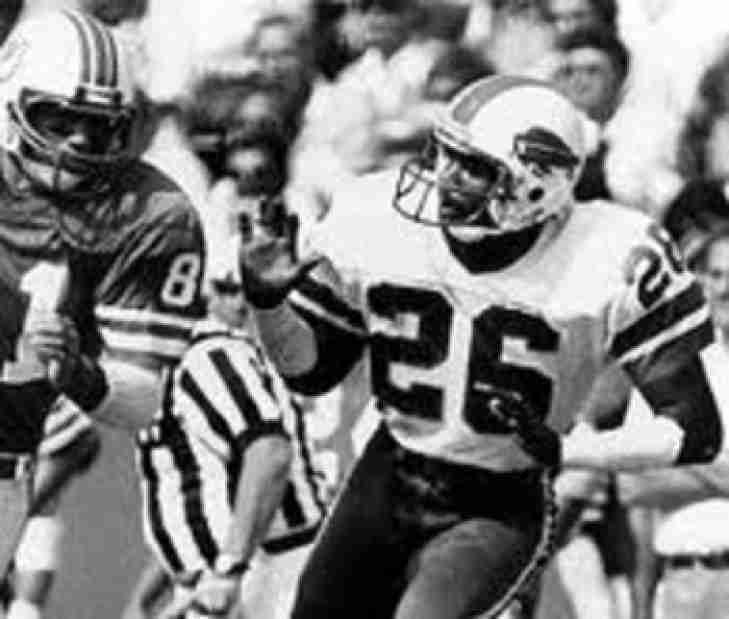
Charles Romes arrived in Buffalo as a late-round flyer (12th round, 309th overall in 1977) and distinguished himself as the first French-born player in NFL history. Stepping into the secondary as a rookie, Romes developed into an iron-man starter at right cornerback, holding down the position across a decade of service.

Romes possessed a typical length for a perimeter cornerback of his era. He primarily operated on the right boundary. His strengths included reading route stems, maintaining position in the hip pocket of outside receivers, and exploiting off-target throws through disciplined ball skills.

Romes’ defining characteristic as a Bill was his remarkable availability. After participating in all 14 games as a rotational defensive back during his rookie season, he assumed the role of the full-time right cornerback in 1978 and commenced every game for Buffalo over the subsequent nine seasons.

During his decade-long tenure in Buffalo (1977–1986), Romes participated in 151 consecutive regular-season games, including 137 consecutive starts—ranking as the eighth-most starts in the franchise's history. He functioned as a primary secondary anchor during Chuck Knox’s division-winning team in 1980 and their subsequent playoff campaign in 1981.

Romes logged at least one interception in nine consecutive seasons with the Bills (1978–1986). His individual peak came in 1985, when he recorded a career-high 7 interceptions. He also set a career-best mark the previous season, in 1984, with 5 interceptions.

In total, Romes recorded 28 interceptions for 493 return yards, eight fumble recoveries, and one defensive touchdown as a Bill, placing him fourth on Buffalo's all-time career interception leaderboard.

49. John Fina

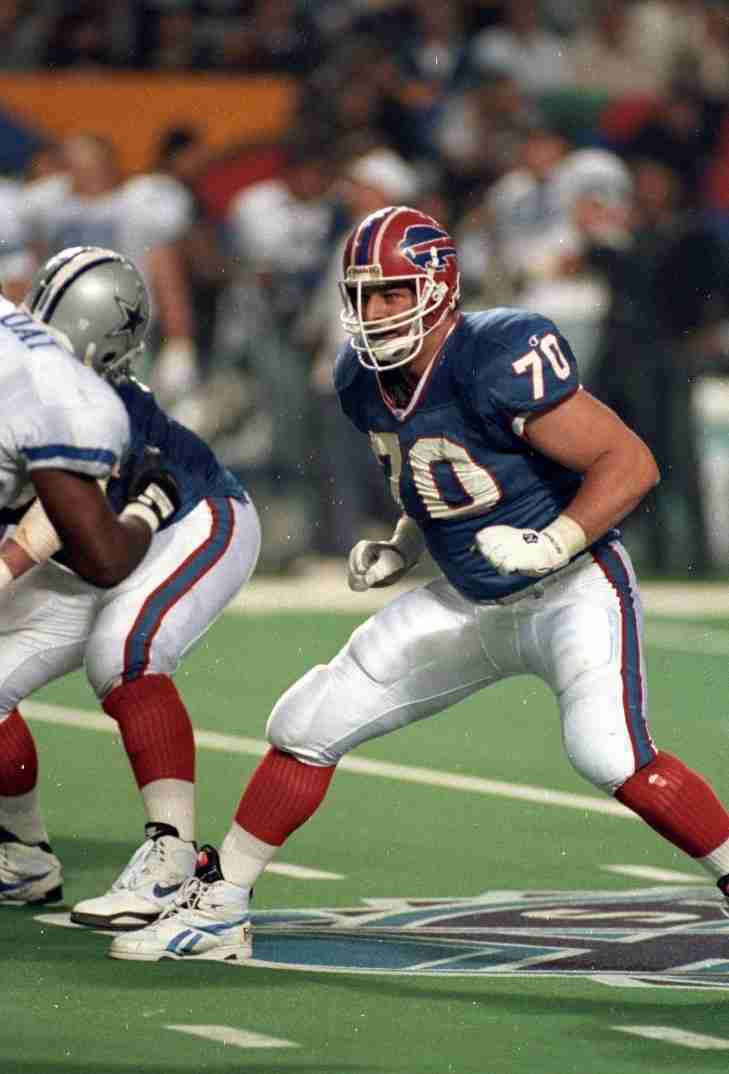
Taken 27th overall in the first round of the 1992 NFL Draft out of Arizona, John Fina became the long-term successor at left tackle for Marv Levy’s championship-caliber offense. Taking over as the full-time protector of Jim Kelly’s blindside in his second season, Fina spent a decade serving as an anchor along Buffalo’s offensive line.

Fina demonstrated integrated leverage, swift lateral footwork, and functional strength. Serving predominantly as the starting left tackle, his primary proficiency was in pass protection; he had the range to establish a wide stance against speed rushers on the edge, while employing effective hand placement to anchor against power rushes, thereby maintaining the integrity of the pocket within Buffalo’s K-Gun passing scheme.

Following his tenure as a primary rotational lineman and special teams contributor as a rookie in 1992—where he participated in Super Bowl XXVII—Fina assumed the role of starting left tackle in 1993. He commenced all 16 regular-season games and three playoff games, including Super Bowl XXVIII, thereby facilitating opportunities for Thurman Thomas and safeguarding Jim Kelly during Buffalo's fourth consecutive AFC championship campaign.

Fina served as the Bills' primary left tackle for nine successive seasons (1993–2001). Renowned for his consistent performance amid evolving offensive strategies and quarterback changes, he provided stability to offensive lines that facilitated 1,000-yard rushing seasons for Thurman Thomas, Bryce Brown, and Antowain Smith.

Fina ended his ten-year Buffalo tenure after 2001, then played his final NFL season with the Arizona Cardinals in 2002. He started 131 of 148 games for Buffalo.