
- Published in Top 50 Green Bay Packers
1. Aaron Rodgers
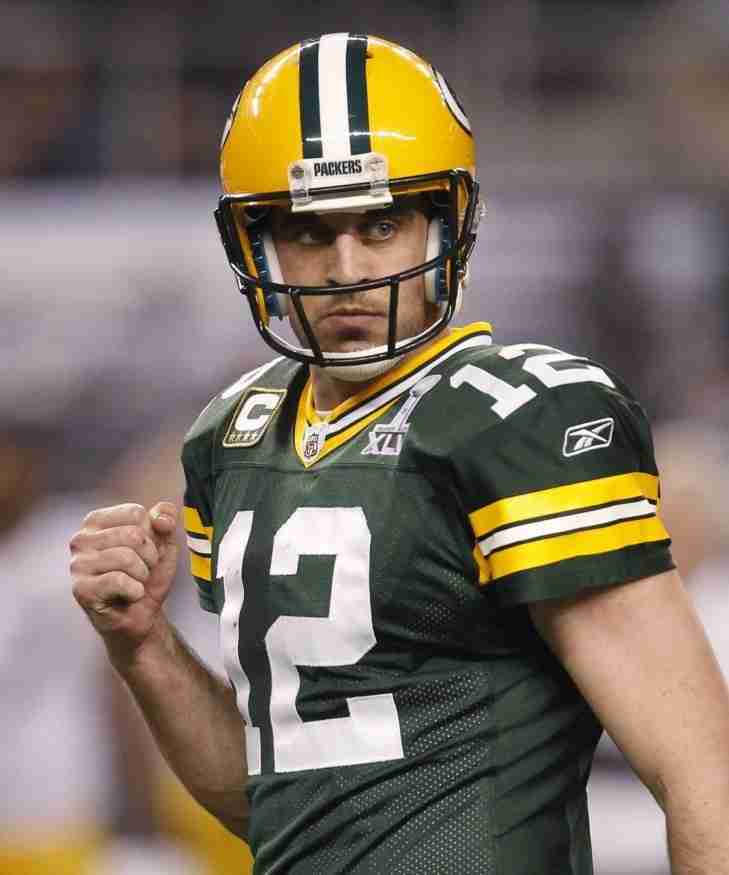
On draft night in 2005, Aaron Rodgers sat in the green room watching an agonizing fall down the draft board until the Green Bay Packers finally picked him 24th overall. Intended as Brett Favre's successor, Rodgers spent three years on the bench, navigating an awkward relationship with the legendary quarterback. When Favre was traded to the New York Jets in 2008, Rodgers took over as the starter under heavy scrutiny, quickly demonstrating precise passing, exceptional mobility, and a rare talent for protecting the football.
Rodgers quickly proved he was not just a replacement but an upgrade in efficiency. He threw for over 4,000 yards with 28 touchdowns in his first year as a starter, but his true coronation came in 2010. After barely making the postseason as a wild-card team, Rodgers went on a postseason tear for the ages, culminating in a pristine performance in Super Bowl XLV. Passing for 304 yards and three touchdowns against the Pittsburgh Steelers, he earned Super Bowl MVP honors and delivered Green Bay its fourth Lombardi Trophy.
In the following season, Rodgers delivered one of the most statistically impressive campaigns in NFL history. In 2011, he threw for 4,643 yards and 45 touchdowns, with only six interceptions, and set the NFL single-season passer rating record at 122.5. He earned his first AP NFL MVP award by a wide margin, solidifying his reputation as the top quarterback in the league. His signature style—marked by exceptional accuracy, a quick flick of the wrist for powerful throws, and a keen ability to draw defensive offsides through his hard count—became the model for modern quarterbacking.
Rodgers won his second MVP award in 2014 after throwing 38 touchdowns to just five picks, consistently leading Green Bay to deep playoff runs. Yet despite regular-season brilliance and four NFC Championship Game appearances, postseason heartbreak began to define the mid-2010s Packers. Agonizing, high-profile playoff losses—often exacerbated by defensive collapses or special teams blunders—left fans and analysts debating whether Green Bay was squandering the prime of a talent whose individual ceiling was as high as anyone to ever play the position.
As his career progressed into the late 2010s, friction brewed between Rodgers and the front office. Tensions reached a boiling point in the spring of 2020 when general manager Brian Gutekunst traded up in the first round of the draft to select quarterback Jordan Love without consulting Rodgers. Fueled by the perceived slight, Rodgers responded with a late-career revival that shattered any narrative of his decline, capturing back-to-back NFL MVPs in 2020 and 2021 behind staggering touchdown-to-interception totals of 48-to-5 and 37-to-4.
Off the field, Rodgers increasingly became a lightning rod for national controversy. His public media appearances—most notably on The Pat McAfee Show—and unvarnished views on organization management, media narratives, and holistic health frequently dominated headlines. The drama peaked during the 2021 season over his vaccination status, after revealing he was "immunized" despite not taking the COVID-19 vaccine, leading to intense public backlash, league fines, and a media firestorm that overshadowed his stellar play on the field.
His relationship with Green Bay management remained a rollercoaster of contract standoffs, cryptic offseason retirement hints, and public grievances regarding how veteran teammates were treated. Yet, even amidst the off-field noise and drama, Rodgers continued to operate as an absolute surgical force on the field, holding the defense accountable while throwing Hail Marys that seemed to defy the laws of physics.
Following a disappointing 8–9 campaign in 2022, the long-brewing divorce finally materialized in April 2023 when the Packers traded Rodgers to the New York Jets, bringing a dramatic 18-year era in Titletown to an official end. While his exit was messy and polarizing, his individual brilliance in Green Bay remains mathematically and historically unequaled by any quarterback who ever put on a helmet.
In Green Bay, Rodgers played in 230 regular-season games, completing 4,758 passes for 57,521 yards, 475 touchdowns, and just 105 interceptions—boasting the lowest career interception percentage in NFL history. A four-time NFL MVP (2011, 2014, 2020, 2021), four-time First-Team All-Pro, and a selection to the NFL 2010s All-Decade Team, Rodgers stands as statistically the most dominant player in Green Bay Packers history.
We also understand if you disagree with the assessment as to who is at the top of this list.