Menu
A+ A A-
Site Admin

Site Admin

41. Larry Johnson

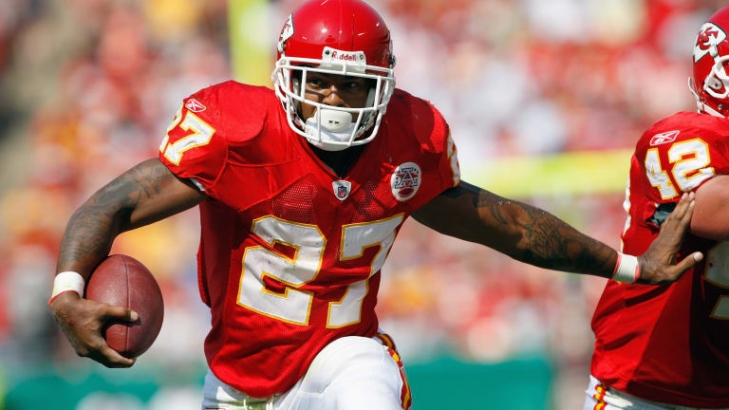
With the 27th overall pick in 2003, the Chiefs took Larry Johnson from Penn State under turbulent circumstances. Head coach Dick Vermeil made no secret that he hadn’t prioritized drafting the Doak Walker Award winner, which led to a cold start to Johnson’s pro career. Trailing Priest Holmes on the depth chart, Johnson logged sparse touches as a rookie, but his patience broke through late in 2004 when Holmes went down with an injury, offering a tantalizing glimpse of Johnson's raw, punishing power over nine games.

When Holmes suffered a season-ending neck injury midway through the 2005 campaign, Johnson stepped into the feature back role and unleashed one of the most physical rushing stretches in league history. Despite starting only nine games that year, he steamrolled defenses for 1,750 rushing yards and 20 touchdowns—adding 343 receiving yards to finish third in rushing and second in touchdowns in the NFL —earning his first Pro Bowl selection and an AP Second-Team All-Pro nod.

Johnson pushed his production even further in 2006 under Herm Edwards, putting together a legendary workhorse campaign. Carrying the entire offensive workload, he broke the NFL single-season record with 416 rushing attempts, racking up 1,789 rushing yards and 17 touchdowns while snagging 41 passes for 410 receiving yards. His dominant 2,199 scrimmage yards earned him consensus AP First-Team All-Pro honors and a second consecutive Pro Bowl berth as Kansas City clinched a postseason spot.

However, that historic volume exacted a steep physical toll. A foot injury halted his 2007 campaign after nine games, limiting him to 559 rushing yards, and he again stayed under 1,000 yards in 2008. Tensions over his workload and off-field controversies mounting in the local media eventually led to a mid-season release in 2009, ending his tenure in Missouri before brief, quiet stops in Cincinnati, Washington, and Miami.

Though his trajectory in Kansas City was volatile and polarizing, Johnson’s absolute peak stands as one of the most overwhelming two-year runs ever executed by a running back in franchise history.

With Kansas City, Johnson had 6,015 rushing yards, 55 rushing touchdowns, 151 receptions for 1,369 receiving yards, 7,384 total scrimmage yards, and 61 total touchdowns.
4. Travis Kelce

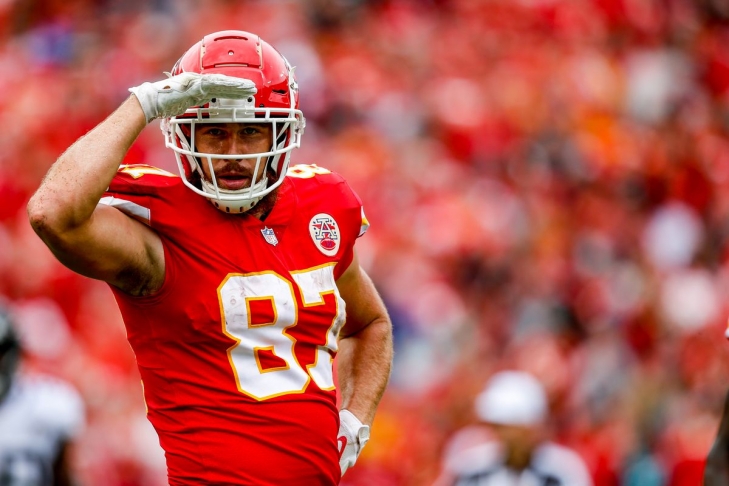
For years, conventional wisdom dictated that any tight end in Kansas City would permanently play second fiddle to Tony Gonzalez. Selected in the third round out of Cincinnati in 2013, Travis Kelce didn't just challenge that narrative—he dismantled it entirely. Combining a receiver's route-running ingenuity with an improvisational flair, Kelce evolved from a fiery young prospect into the most prolific postseason target in NFL history and a global pop-culture phenomenon.

Kelce's career took a major turn after missing nearly all of his 2013 rookie season due to knee surgery. He made a strong comeback with two consecutive 800-yard seasons, culminating in a breakout year in 2016 when he recorded 1,125 receiving yards and earned his first First-Team All-Pro honor. This marked the start of a remarkable period of elite performance. Kelce's unique advantage was his almost telepathic rapport with Patrick Mahomes; he had an exceptional ability to interpret defensive zone coverages instantly, dropping his route stems to find open space as Mahomes exited the pocket on scrambled plays.

Between 2016 and 2022, Kelce made history as the first tight end to achieve seven straight 1,000-yard receiving seasons. His standout year was 2020, when he set the NFL tight end record with 1,416 yards and 11 touchdowns in 15 games. He continued his excellence in 2022 with a career-best 110 receptions, 1,338 yards, and 12 touchdowns, becoming the key player in an offense that won Super Bowl LVII.

Beyond his regular-season stats, Kelce built his ultimate legacy in January and February. Serving as Kansas City's postseason safety valve, he surpassed Jerry Rice for the most career playoff receptions in NFL history and captured three Super Bowl rings (LIV, LVII, LVIII). Whether hauling in clutch touchdown passes in comeback victories or engineering clock-killing drives, Kelce became the Chiefs' defining big-game weapon in their modern dynasty.

Off the field, Kelce’s cultural footprint exploded into unprecedented territory. Hosting Saturday Night Live in 2023 validated his charismatic star power, but his high-profile relationship with music icon Taylor Swift launched him into a tier of global fame rarely seen for an American football player. Yet through the intense media spotlight, Kelce remained intensely focused on his craft, continuing to serve as the emotional heart and vocal leader of Andy Reid’s squad.

Even as age and defensive double-teams began to alter his usage, Kelce’s impact remained vital through the 2024 and 2025 campaigns. Across a challenging 2025 season where the Chiefs navigated team-wide adjustments, he still pulled down 76 passes for 851 yards and five touchdowns, earning his 11th consecutive Pro Bowl nod and officially surpassing Tony Gonzalez as Kansas City's all-time leader in career receiving touchdowns.

Now entering the 2026 season as a senior statesman of the locker room, Kelce stands at the summit of tight end royalty. With his place in Canton long since sealed, every snap he takes only adds polish to a career that has redefined the tight end position for future generations.

Kelce enters this year having already accumulated 113 receptions, 13,157 receiving yards, and 85 receiving touchdowns, all franchise records for touchdowns and catches.

39. Tim Grunhard

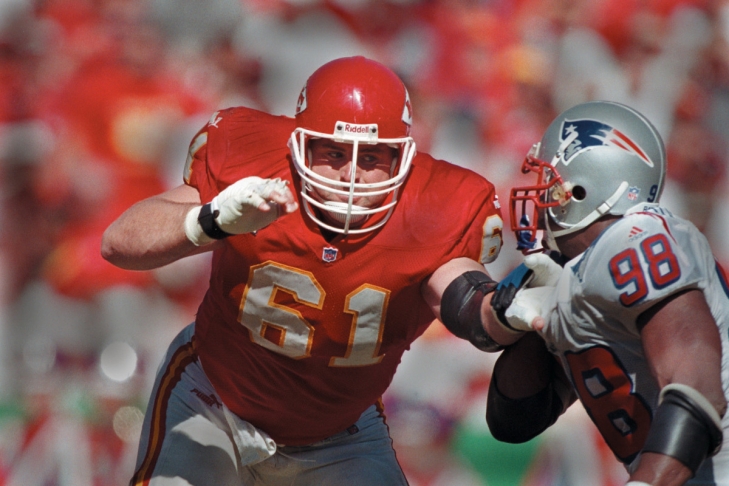
Chosen in the second round (40th overall) of the 1990 NFL Draft after winning a national championship at Notre Dame, Tim Grunhard arrived in Kansas City as the ideal fit for Marty Schottenheimer's brand of physical, blue-collar football. After spending part of his rookie year rotating along the interior line, Grunhard fully locked down the starting center job in 1991—a position he held as an unyielding fixture for the next decade.

Grunhard quickly became the gritty, aggressive heartbeat of the Chiefs offensive line. Flanked by guards Dave Szott and Will Shields, he anchored one of the most cohesive and physical interior units of the 1990s, clearing lanes for running backs like Christian Okoye, Barry Word, and Marcus Allen while protecting Joe Montana and Steve Bono during Kansas City's perennially competitive playoff runs.

Beyond his mean streak on the field, Grunhard stood out for his remarkable durability and consistency. He started 120 consecutive games during his prime, anchoring the offensive front through multiple playoff appearances, including the franchise's run to the 1993 AFC Championship Game. His long-overdue national recognition came in 1999, when he earned his first career Pro Bowl selection.

Equally impactful off the gridiron, Grunhard became an iconic figure in the local community through his extensive charitable efforts. Through his involvement with Special Olympics Missouri and numerous youth development programs across the metropolitan area, he cemented a lasting legacy in Kansas City that extended far beyond his play in the trenches.

Grunhard retired after the 2000 season, having played all 169 games as a Chief.  The team enshrined Grunhard in its Hall of Fame in 2021.

36. Jim Lynch

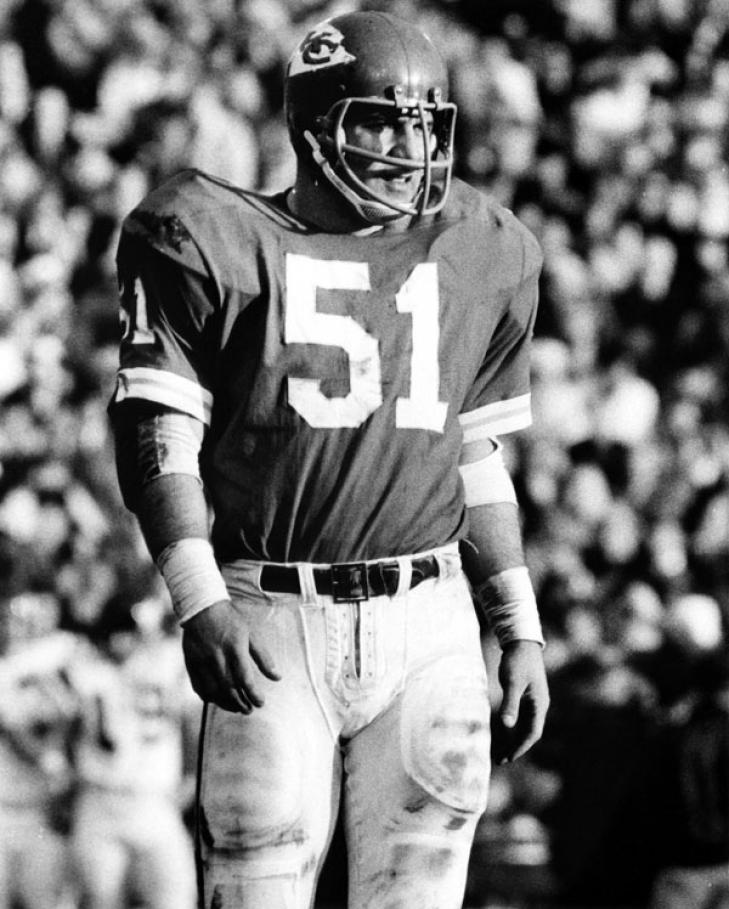
Selected in the second round (47th overall) of the 1967 AFL Draft after winning the Maxwell Award and captaining Notre Dame to a national championship, Jim Lynch arrived in Kansas City as a complete, cerebral linebacker. Slotting alongside Pro Football Hall of Famers Willie Lanier and Bobby Bell, Lynch completed arguably the greatest linebacking trio in professional football history, bringing disciplined positioning and elite tackle execution to Hank Stram's defense.

After serving in a rotation during his rookie campaign, Lynch took over the starting strong-side (Sam) linebacker role in 1968 and never relinquished it. He earned his first AFL All-Star selection and an AP Second-Team All-AFL nod during his breakout sophomore year, showing rare durability by starting every single game he played over his final ten professional seasons.

Lynch’s tactical intelligence peaked during the 1969 postseason run that culminated in a Super Bowl IV victory over the Minnesota Vikings. Tasked with covering tight ends and setting a firm edge against the run, his diagnostic speed let Bell and Lanier roam freely, forming an impenetrable wall that held Minnesota to just seven points in the championship triumph.

Lynch retired after the 1977 season, playing his entire career with Kansas City. He had 17 interceptions and 18 sacks over his 11-season career, and in 1990, he entered the Chiefs Hall of Fame.