Menu
A+ A A-
Site Admin

Site Admin

45. Kevin Ross

Long before late-round draft picks were regularly expected to contribute, Kevin Ross arrived in Kansas City as a 173rd overall selection in 1984 with everything to prove. Standing 5'9", he faced plenty of skepticism about whether his frame could hold up against larger pro receivers. Ross quickly erased those doubts through raw physicality, razor-sharp instincts, and a mean streak in run support, taking over a starting job and earning the moniker "Rock."

Ross hit his prime at the turn of the decade, earning consecutive Pro Bowl selections in 1989 and 1990. Under Marty Schottenheimer and defensive coordinator Bill Cowher, his ability to blanket wideouts in press coverage while stepping down to blow up running plays gave the secondary its aggressive, blue-collar identity.

Ross was equally adept at turning defense into instant offense. Over his 11 years as a Chief, he picked off 30 passes—returning two for touchdowns—and recovered 13 fumbles (with one returned for a score). He even made his mark on special teams, returning two blocked kicks for touchdowns to finish his Chiefs career with five non-offensive scores.

Following a three-year stint with Atlanta and San Diego, Ross returned to Kansas City in 1997 for one final season, providing valuable veteran wisdom to a defense that went 13–3.  Overall, he had 30 interceptions, 13 fumble recoveries, five total touchdowns, and was inducted into the Chiefs Hall of Fame in 2011.

44. Dale Carter

Selected 20th overall in the first round of the 1992 NFL Draft out of Tennessee, Dale Carter arrived in Kansas City possessing pure shutdown coverage traits and an aggressive, physical edge. Slotted into Marty Schottenheimer's secondary as an instant starter, the rookie cornerback took the league by storm, intercepting seven passes and returning two punts for touchdowns to claim the 1992 AP NFL Defensive Rookie of the Year award.

Carter became one of the league's most feared cover cornerbacks through the middle of the decade. Combining fluid hip turn with fiery press-man coverage skills, he anchored a secondary alongside James Hasty that routinely suffocated opposing top receivers. Between 1994 and 1997, Carter earned four consecutive Pro Bowl selections and AP Second-Team All-Pro recognition in 1995 and 1996, serving as a primary defensive engine for Chiefs squads that repeatedly claimed top seeds in the AFC.

Yet despite his on-field brilliance, off-field turbulence continually shadowed his trajectory. Substance abuse policy violations and disciplinary suspensions disrupted his momentum in Kansas City, hinting at a career that threatened to derail just as it hit its absolute peak.

After the 1998 season, Carter left Arrowhead in free agency and signed a landmark contract with the rival Denver Broncos that briefly made him one of the highest-paid defensive players in NFL history. However, his tenure in Denver unraveled almost immediately: a fourth violation of the league's substance abuse policy triggered an entire season-long suspension for the 2000 campaign. Though he eventually returned to play additional seasons with Minnesota, Baltimore, and New Orleans, he never again replicated the elite form he displayed in Kansas City.

Carter retired following the 2005 season, leaving behind a complex NFL legacy defined by flashes of Hall of Fame-caliber talent mixed with unfulfilled potential. With the Chiefs, he had 21 interceptions.

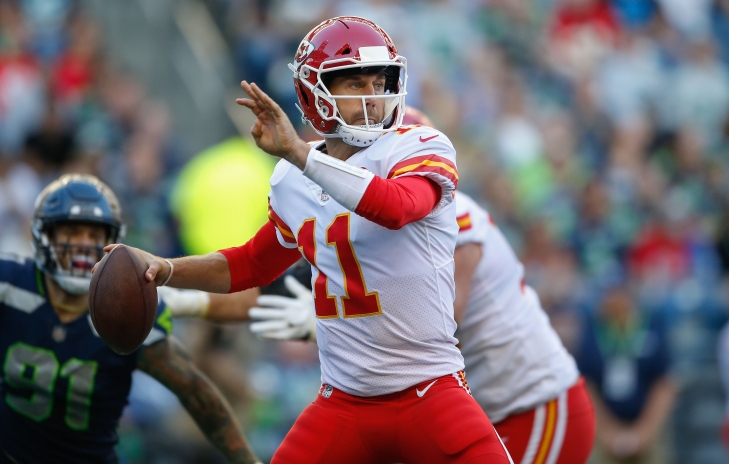
43. Alex Smith

Select any first overall pick in NFL history, and you’ll usually find a narrative built around immediate stardom or spectacular failure. Alex Smith fit neither box. Selected ahead of Aaron Rodgers by San Francisco in 2005 out of Utah, Smith endured a grueling trial by fire, churning through six offensive coordinators in his first six seasons while battling injuries—including shoulder damage that wiped out his entire 2008 campaign. By the time Jim Harbaugh resurrected his trajectory in 2011, Smith had earned the unfair reputation of an unwanted afterthought, only for a 2012 concussion to open the door for Colin Kaepernick to steal his starting job mid-season.

Traded to Kansas City in 2013 alongside new head coach Andy Reid, Smith walked into a franchise reeling from a 2–14 collapse. Few in Chiefs Kingdom expected a transcendent franchise savior, but Smith provided something infinitely more crucial: flawless operational stability. He won his first nine starts in red and gold, engineering an immediate turnaround that brought Kansas City back to the postseason while earning his first career Pro Bowl selection.

Skeptics routinely tagged him with the "Game Manager" label, criticizing his preference for short high-percentage throws over dangerous downfield risks. Yet that calculated risk aversion fueled Reid’s offensive machine. Smith excelled at protecting the football, unleashing elite dual-threat mobility when pockets collapsed—racking up 1,672 rushing yards in Missouri—and letting Jamaal Charles and Travis Kelce tear defenses apart after the catch.

His redemption peaked in 2017. Shaking off the "captain checkdown" narrative, Smith attacked defenses at every depth, led the entire National Football League with a 104.7 passer rating, and threw for a career-high 4,042 yards, 26 touchdowns, and just five interceptions. He earned his third Pro Bowl nod and orchestrated the league's most efficient passing attack—all while serving as an extraordinary mentor to a rookie first-round pick waiting in the wings named Patrick Mahomes.

History repeated itself in early 2018 when Kansas City traded the veteran to Washington, handing the keys to Mahomes. Yet unlike his exit from the Bay Area, Smith departed Arrowhead as a respected hero who had stabilized a struggling franchise and laid the culture, discipline, and winning foundation for a championship dynasty. After surviving a life-threatening leg injury and infection in Washington to win the 2020 NFL Comeback Player of the Year award, he hung up his cleats as one of the most resilient signal-callers of his generation.

He threw for 17,608 passing yards and 102 touchdown passes against just 33 interceptions, and he rushed for 1,672 yards and 10 touchdowns, posting a 50–26 starting record for Kansas City.

37. Willie Roaf

While Willie "Nasty" Roaf's legendary career is most often tied to his nine dominant seasons in New Orleans, the Hall of Fame left tackle showed no decline when Kansas City acquired him via trade before the 2002 season. Coming off a severe knee injury that sidelined him for most of 2001, Roaf arrived in Missouri seeking a fresh start—and proceeded to deliver four of the most flawless seasons of pass protection and run blocking ever put on film.

Inserting Roaf directly onto the left edge transformed Dick Vermeil’s offense into an absolute juggernaut. Lining up alongside guard Brian Waters and center Casey Wiegmann, Roaf anchored what many regarded as one of the greatest offensive lines in pro football history, clearing massive lanes for Priest Holmes and Larry Johnson while giving Trent Green a pristine pocket on every dropback.

Roaf swept postseason accolades during his four-year tenure in red and gold. He was selected to the Pro Bowl in all four seasons (2002, 2003, 2004, and 2005) and earned AP All-Pro recognition every year—securing Second-Team nods in 2002 and 2003 before claiming back-to-back consensus First-Team All-Pro honors in 2004 and 2005.

His arrival sparked an era in which Kansas City consistently led the NFL in points and total yards, highlighted by the record-setting 2004 campaign, when the Chiefs poured in an NFL-record eight rushing touchdowns in a single game against Atlanta. Despite playing in his mid-30s, Roaf’s rare blend of 320-pound power, light footwork, and violent hand placement made him virtually un-rushable for opposing edge rushers.

Roaf elected to hang up his cleats prior to the 2006 season, ending his decorated 13-year NFL career at the absolute top of his game. His rare distinction as a member of both the NFL’s 1990s and 2000s All-Decade Teams culminated in his formal induction into the Pro Football Hall of Fame in 2012, alongside his enshrinement into the Kansas City Chiefs Hall of Fame that same year.