
Site Admin
5. Pete Alexander
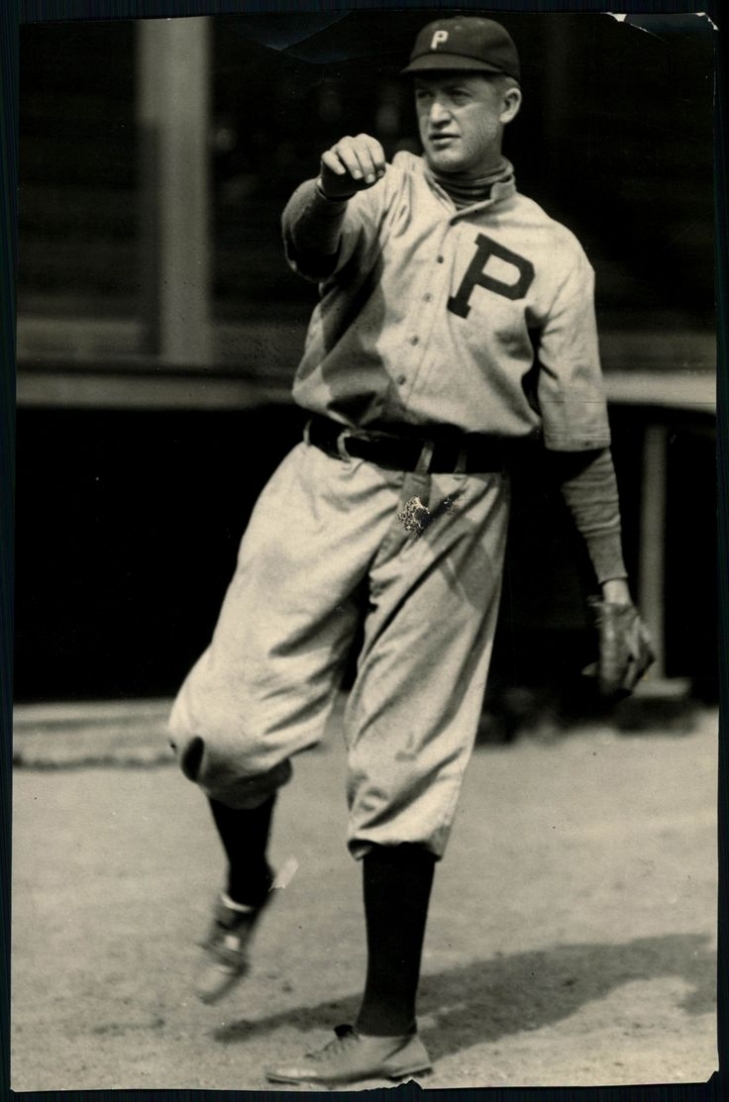
Inducted into the Baseball Hall of Fame in 1938, Grover Cleveland “Old Pete” Alexander might be surprising to see ranked so highly, considering he only played eight seasons for Philadelphia. In fact, we typically consider just the first seven seasons, as his eighth was his final at age 43, during which he was less effective. Still, examining Alexander’s first seven years of professional play reveals he’s a deserving top-five choice among the greatest Philadelphia Phillies of all time.
Hardly anything was expected of the tall, unassuming farm boy from Nebraska when he arrived in the spring of 1911. He went on to deliver a historic rookie masterpiece, capturing 28 victories and setting an enduring modern major-league rookie record. He paced the senior circuit in wins, shutouts (7), and innings pitched (367.0), instantly establishing himself as the primary horsepower of the Philadelphia staff.
After a series of highly successful follow-up seasons, Alexander reached an unmatched level of dominance between 1914 and 1917. He consecutively led the National League in wins for four seasons, with tallies of 27, 31, 33, and 27. Renowned for his efficiency and workload, he earned four straight strikeout titles, two ERA championships, and two WHIP titles. His peak value was crucial for the franchise, as he topped all NL pitchers in pitcher wins above replacement (bWAR) during these summers, including a remarkable 1915 season where he posted a minuscule 1.22 ERA, guiding the Phillies to their first-ever National League pennant.
The athlete's career sharply declined after 1917. Fearing the loss of their key player to the World War I draft without compensation, his team sold him to the Chicago Cubs in a quick cash-and-player deal. Alexander was drafted and served as a sergeant in France's artillery units. The intense shellfire damaged his physical health, causing partial deafness in his left ear and epilepsy, leading to a lifelong struggle with alcoholism. Despite his perseverance and winning 183 more games post-war, his peak performance was never fully realized, remaining hidden in Baker Bowl.
He concluded his primary tenure in Philadelphia with 190 victories, a stellar 2.18 ERA, and a franchise-record 61 shutouts. His status as an immortal pioneer was cemented by his induction into the National Baseball Hall of Fame in 1938.
Decades later, the organization carefully reconstructed his rightful legacy. In 1981, the team inducted Alexander into the Philadelphia Baseball Wall of Fame. Since he played before uniform numbers were standard, the Phillies devised a creative and lasting way to commemorate him: in 2001, they officially celebrated his memory by retiring a stylized, vintage 1915-style "P" logo alongside the team's other iconic numbers.
3. Steve Carlton
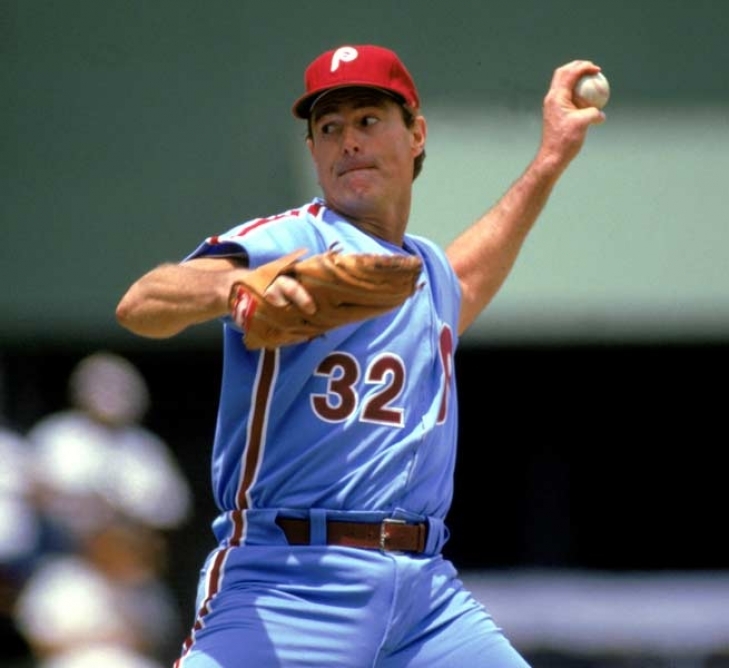
The arrival of Steve Carlton in Philadelphia prior to the 1972 season significantly impacted the baseball world, stemming from a contentious contract dispute with St. Louis. He was not an unproven prospect; he already held a World Series championship and had achieved a 20-win season with the Cardinals. Nevertheless, upon his debut at Veterans Stadium, his career trajectory advanced from commendable to legendary.
His initial summer wearing pinstripes remains among the most remarkable individual accomplishments in the history of sports. Representing a struggling, last-place Phillies team that secured only 59 victories throughout the season, Carlton individually recorded 27 wins—constituting an impressive 46% of the team's total wins. He led the National League with a 1.97 ERA, completed 30 games, and struck out 310 batters, earning his first Cy Young Award. This performance stands as a historic demonstration of resilience and durability, marking the last occasion on which any National League pitcher achieved the 25-win milestone.
As his tenure progressed, Carlton gained equal fame for his enigmatic demeanor and his lethal slider. He adopted a training regimen inspired by Eastern philosophies, involving twisting his left arm through buckets of rice to strengthen his wrist, and enforced a comprehensive, decade-long media blackout. Although this silence distanced him from beat writers, his pitching performance spoke volumes. He maintained his position as the undisputed ace of the rotation as the Philadelphia Phillies assembled a competitive core around Mike Schmidt and Larry Bowa, securing two additional Cy Young Awards in 1977 and 1980.
The 1980 campaign furnished the ultimate validation for his relocation to Philadelphia. Dominating the senior circuit with 24 wins and 286 strikeouts, Carlton led the pitching staff straight into October. In Game 6 of the World Series against Kansas City, he pitched seven exemplary innings to secure the decisive victory, thereby securing the franchise's inaugural world championship.
He secured a historic fourth Cy Young Award in 1982, demonstrating an unwavering dedication to striking out batters, ultimately accumulating 3,031 strikeouts while playing for the Phillies—and a total of 4,136 throughout his entire career, ranking second only to Randy Johnson among left-handed pitchers. The effects of aging gradually diminished his once exceptional arm strength in the mid-1980s, resulting in his release in June 1986 and marking the conclusion of a distinguished fifteen-year tenure with Philadelphia, during which he achieved 241 wins.
In 1988, the Phillies added Carlton to their Wall of Fame and retired his number 32 a year later. Carlton entered the Baseball Hall of Fame in 1994.
2. Robin Roberts
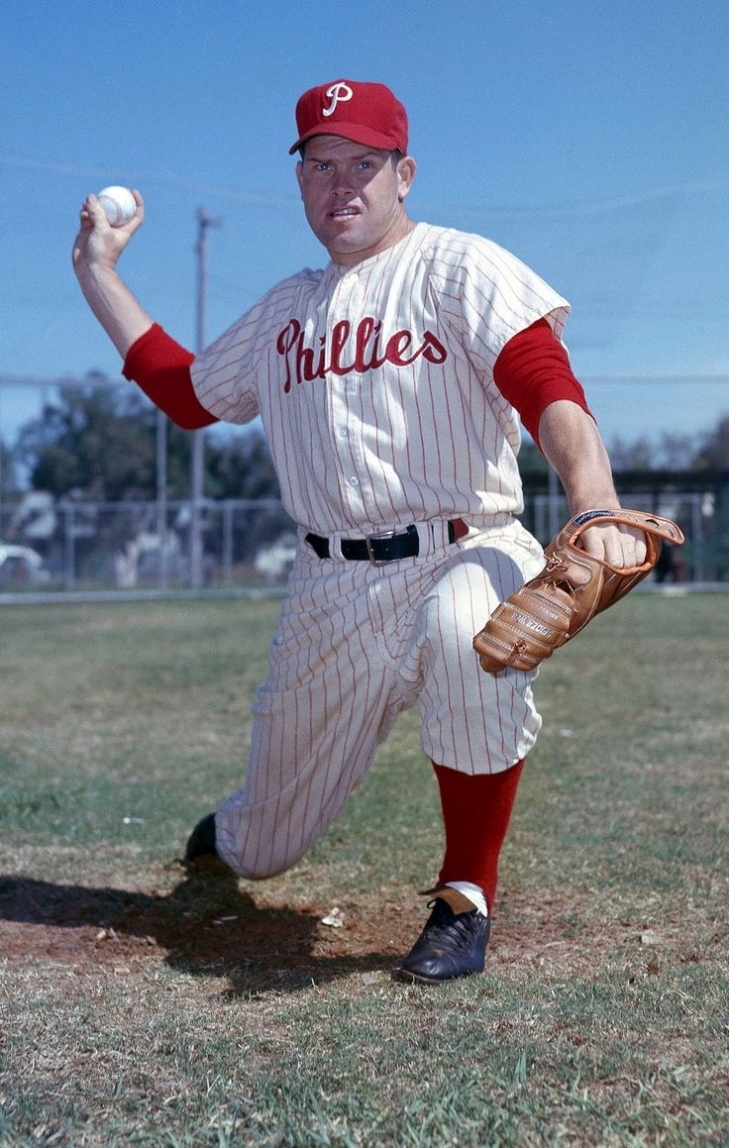
Robin Roberts from Michigan State first took the mound at Shibe Park in June 1948 as a highly athletic right-hander with a precise fastball and strong stamina. During an era when starters finished their work, Roberts became the gold standard of workhorse pitchers.
After two strong seasons, Roberts became dominant in the early 1950s. He anchored the pitching staff with such volume that, if the Cy Young Award had existed then, he might have won it five years in a row. Modern statistics support this, showing he led the National League in pitcher bWAR from 1950 to 1954—an impressive stretch where his performance consistently outshined his peers. Traditional voters would also have been persuaded; he led the Senior Circuit in wins for four consecutive years (1952–1955) and ranked among the top in strikeouts twice. MVP voters acknowledged this elite level of production, giving him votes for six straight years from 1950 to 1955, with finishes of seventh, thirteenth, second, sixth, seventh, and fifth.
Regarding his peak period, in 1950, Roberts exploded into superstar status by winning 20 games and leading the National League with 5 shutouts, serving as the frontline ace for the famous "Whiz Kids" squad that captured the franchise's first pennant in 35 years. He built beautifully on that foundation, rattling off a historic 28-7 record with a brilliant 2.59 ERA in 1952, a masterpiece of a summer where he completed 30 of his 37 starts and threw an astonishing 330 innings to claim The Sporting News Major League Pitcher of the Year honors.
He maintained that intense workload across three seasons, pitching an impressive 346.2 innings with 23 wins and a career-best 198 strikeouts in 1953. He followed up with another 23-win season in 1954, during which he issued only 56 walks over 336.2 innings. His peak performance came in 1955, when he won 23 games for the fourth-place Phillies, leading the league in starts (38), complete games (26), and innings pitched (305), earning his second Pitcher of the Year award.
The grueling toll of throwing over 300 innings for six consecutive seasons eventually caught up to his right arm, leading to a decline in velocity and efficiency as the late 1950s wore on. Following the 1961 season, when, with the team deep in a rebuilding cycle, he was sold to the New York Yankees before finding a successful mid-1960s second act with the Baltimore Orioles.
Roberts was inducted into the Baseball Hall of Fame in 1976 on his fourth ballot. Two years later, in 1978, he and veteran teammate Richie Ashburn became the first two players to be honored on the Philadelphia Phillies Wall of Fame, affirming their central roles during the Whiz Kids era. The organization cemented his legacy in 1982 by retiring his No. 36 jersey, ensuring no future Phillie would wear it.
Roberts compiled a 234-199 record, a 3.46 ERA, and 272 complete games as a Phillie.
1. Mike Schmidt
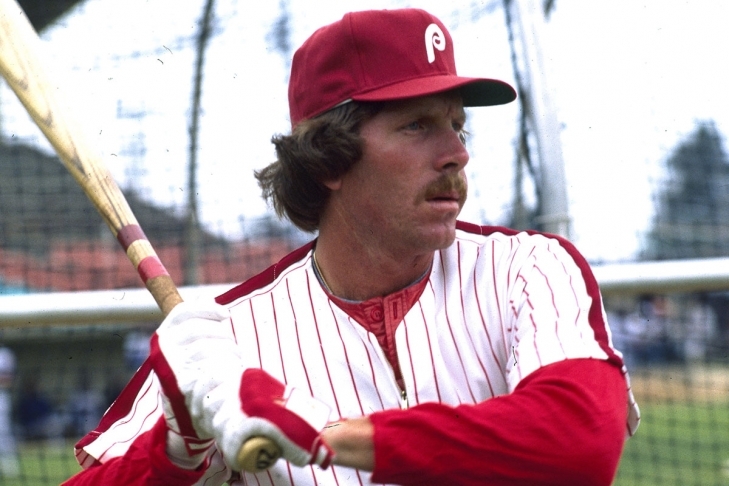
Mike Schmidt first stepped onto the Veterans Stadium turf in September 1972, a second-round draft choice out of Ohio University tasked with manning the hot corner for a struggling franchise. Initially, he appeared thoroughly overmatched by big-league pitching, struggling to a meager .196 batting average during his first full year. Yet, beneath those early growing pains lived a fiercely determined, flawlessly balanced athlete who would systematically revolutionize his position and define a franchise.
After initial struggles as a rookie, Schmidt improved significantly, leading the NL with 36 home runs, along with 116 RBIs, 108 runs, and 106 walks, earning a 9.7 bWAR. He maintained this level of performance for the next two years, hitting 38 homers in both 1975 and 1976. The 1976 season marked a turning point: Schmidt won his first Gold Glove, helped the Phillies reach 101 wins, and ended a 26-year postseason drought. He continued his success in 1977, with 38 homers, 101 RBIs, and a career-high 114 runs, as the Phillies secured the division title again.
After a slight decline in 1978, Schmidt reached a peak in 1980 both individually and as a team. That summer, he delivered an outstanding performance, hitting a career-high 48 home runs and driving in 121 runs to lead the league in both categories, while maintaining a 1.004 OPS. This earned him his first National League MVP Award through a unanimous vote. Significantly, he carried that success into October, hitting two home runs and driving in seven runs, helping the Phillies win the World Series and secure their first franchise championship.
During the strike-shortened 1981 season, he achieved a level of raw efficiency that many consider his peak structural campaign. In just 102 games, Schmidt hit 31 home runs—seven more than any other player in the league, and led the National League in runs (78), RBI (91), walks (73), on-base percentage (.435), and slugging (.644), securing his second straight NL MVP Award. Over the next three years, he continued to dominate the Senior Circuit, winning consecutive home run titles in 1983 (40) and 1984 (36), and regularly leading the league in walks to maintain a high on-base percentage.
His final great season was in 1986, a late-career resurgence when he moved back to third base after a brief stint at first. At 36, Schmidt won his eighth home run crown with 37 homers and led the league with 119 RBI, striking out just 84 times, the fewest in a full season. This high-leverage performance earned him his third National League MVP Award, joining an elite group of icons.
Declining afterward, Schmidt elected to call it a career in May of 1989 at a very emotional press conference. He walked away as one of the rare legends to exceed 100 career bWAR (106.9) entirely with one franchise, leaving behind 2,234 hits, 1,595 RBI, and 548 home runs.
To no surprise, Schmidt was a first ballot Baseball Hall of Fame inductee in 1995. The Phillies inducted Schmidt to their Wall of Fame in 1989, and the franchise retired his number 20 the year after.