

Site Admin
The Buck Stops Here -- Free Agency Part 2
16. Bob Johnson

When Robert Lee "Indian Bob" Johnson made his debut as a 27-year-old rookie in 1933, he entered a team in decline. The renowned Philadelphia franchise, which had secured three consecutive pennants from 1929 to 1931, was being methodically dismantled by Connie Mack in an effort to prevent financial collapse. With legends such as Al Simmons and Jimmie Foxx departing, Johnson was tasked with carrying the responsibility for much of the team's offensive production alone, anchoring a roster that was rapidly deteriorating during a period of prolonged struggle in the American League.
Despite the challenging team environment, Johnson quickly proved himself as one of the most formidable and machine-like run producers in the sport. Playing in left field, this strong right-handed hitter mounted a relentless attack on American League pitching. He exceeded 20 home runs in each of his first nine seasons with Philadelphia—a rare consistency of power, culminating in three summers surpassing 30 homers, including a career-high 31 in 1940.
His offensive brilliance was rooted in a highly advanced approach at the plate. Johnson was more than just a pull-hitter taking advantage of short fences; he had an exceptional eye for batting, accumulating 853 walks compared to only 546 strikeouts while at Shibe Park. This top-tier discipline led to three seasons with an on-base percentage exceeding .400, maximizing his effectiveness even as opposing managers often pitched around him due to the lack of protection in the Athletics' lineup. Between 1935 and 1941, he achieved seven straight seasons with at least 100 RBIs, driving the offense with sheer determination.
Johnson, the sole bright spot for lean Philadelphia clubs, earned five All-Star selections during ten years, serving as a respected, quiet professional amid franchise overhaul. When traded to the Washington Senators after 1942, he left an enduring statistical legacy.
He left Philadelphia with 1,617 hits, 252 home runs, and a .298/.395/520 slash line. His volume and efficiency kept him high on the club's all-time list, fifth in hits and home runs, and third in RBIs with 1,040, behind Al Simmons and Jimmie Foxx.
15. Harry Davis
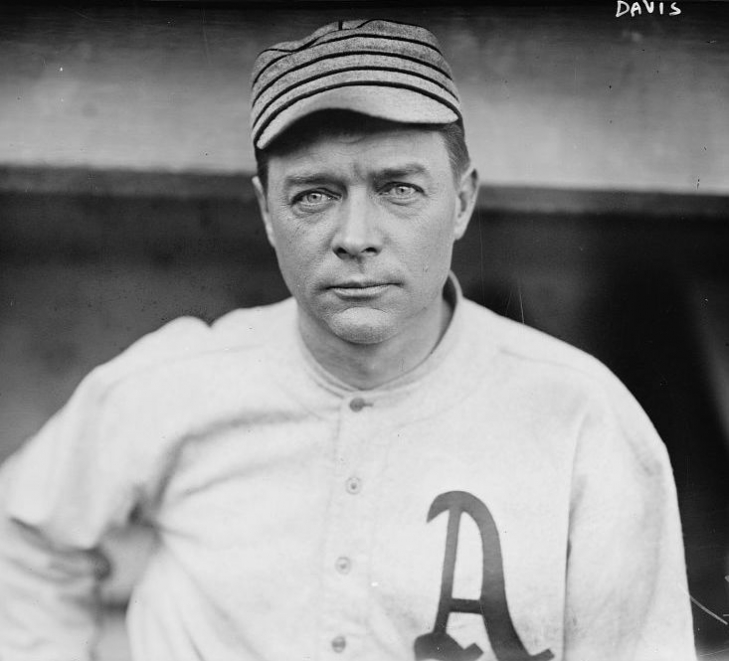
During the assembly of the original Philadelphia Athletics roster for the American League's inaugural season in 1901, Connie Mack looked to the minor leagues for a key addition. Harry Davis, aged 27 and seemingly prepared to retire after an inconsistent career across four National League clubs and a tenure with the Providence Grays, was identified as a promising talent. Mack recognized the potential in the right-handed infielder and persuaded Davis to relocate to Philadelphia. This decision catalyzed a revival, transforming Davis into one of the most formidable and enduring run producers of the dead-ball era.
Initially positioned at first base, Davis promptly emerged as the cornerstone of the early Athletics lineups. He adapted seamlessly to his new environment, achieving three consecutive summers with a batting average exceeding .300. While his patient approach did not always result in a high on-base percentage, settling at a modest .337 during his tenure, he compensated with exceptional line-drive power. He utilized his swing effectively to lead the American League in doubles on three occasions, consistently providing Philadelphia with a superior extra-base threat in the heart of the batting order.
That offensive value soared to a historic peak between 1904 and 1907. In an era characterized by deep fences and a soft, scuffed ball that made home runs extremely rare, Davis achieved an extraordinary feat by leading the American League in home runs for four consecutive seasons. His power was complemented by a precise efficiency with runners on base; he secured consecutive junior circuit RBI titles in 1905 and 1906, leading the offensive efforts for Mack’s early pennant contenders and establishing himself as the first authentic captain of the franchise.
As the decade progressed, his consistent presence within the clubhouse and leadership on the field served as a crucial bridge to the franchise's inaugural true dynasty. Although the younger and more athletic Stuffy McInnis would ultimately assume the daily responsibilities at first base, Davis continued to be an indispensable veteran. He made substantial contributions to the Athletics' consecutive World Series victories in 1910 and 1911, notably batting an impressive .353 in the 1910 Fall Classic against Chicago, thereby securing his first championship ring.
After managing Cleveland briefly in 1912, he returned as a coach and occasional defensive replacement. He played only 19 games from 1913 to 1917 but earned a third World Series ring with the 1913 team. He finished with 1,500 hits and 761 RBIs for Philadelphia, known as the foundational captain who helped modernize the Athletics.
12. Bert Campaneris
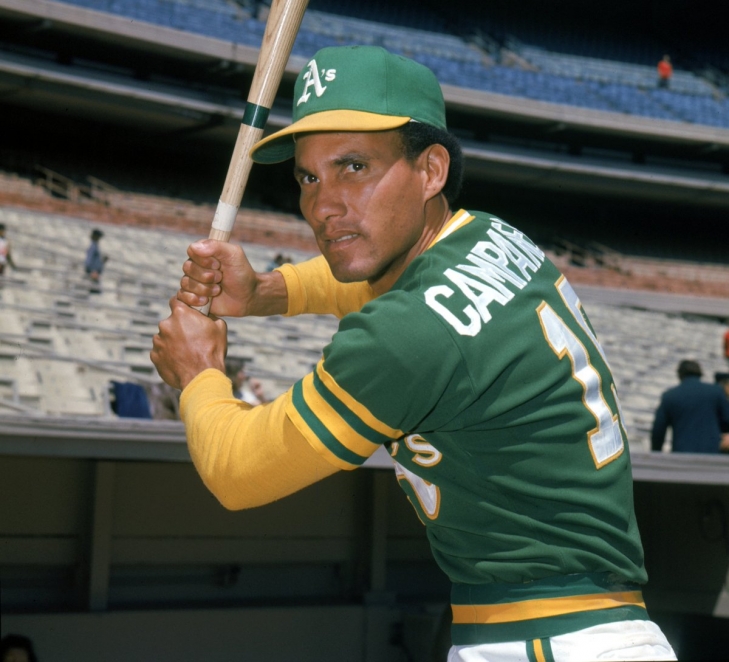
Bert Campaneris made his debut for the Kansas City Athletics in July 1964, providing an immediate boost to a team in trouble. At just 22, this Cuban shortstop announced his presence by hitting two home runs against Minnesota's Jim Kaat in his first game. While he showcased rare power early on, his main talent was in creating chaos with his speed and securing the infield with his glove.
By his first full season in 1965, "Campy" had truly harnessed his exceptional speed, leading the American League with 12 triples and 51 stolen bases. That September, owner Charlie Finley organized an exciting promotional event against the California Angels, showcasing Campaneris as the first player in modern major league history to play all nine positions in a single game, and even pitching a full inning on the mound. While this incredible feat highlighted his natural athletic talent, it was his consistent performance at shortstop that truly laid the foundation for the team's bright future.
When the franchise moved to Northern California in 1968, Campaneris became a key link between the cities and sparked the offense. That first summer in Oakland, he led the league with 177 hits and set a career high with 62 stolen bases, earning his first All-Star nod. While his focus on not walking limited his on-base percentage, his sharp baserunning skills made him incredibly dangerous once he got on base; he went on to win six American League stolen-base titles and was often among the most effective base stealers out there.
In the early 1970s, Campaneris became the key driver of the "Swingin' A's" modern dynasty. He was a top ten defender, combining range with a reliable arm to secure the left side of the infield alongside Sal Bando. His consistent performance helped Oakland secure five consecutive division titles and achieve their historic three-peat in the World Series from 1972 to 1974. Even during postseason tensions, like his infamous bat-throwing incident against Detroit in the 1972 ALCS, his situational hitting and threat on the bases remained crucial to winning those three championships.
After the 1976 season, Charlie Finley's long tenure came to an end. As free agency reshaped the league and dismantled Finley’s roster, Campaneris signed with the Texas Rangers. He left California holding franchise records for career games, hits, and at-bats, leaving a lasting legacy as the team’s key spark plug during the dynasty.
In 2019, the Athletics inducted Campeneris into their franchise Hall of Fame.