

Site Admin
23. Tim Hudson
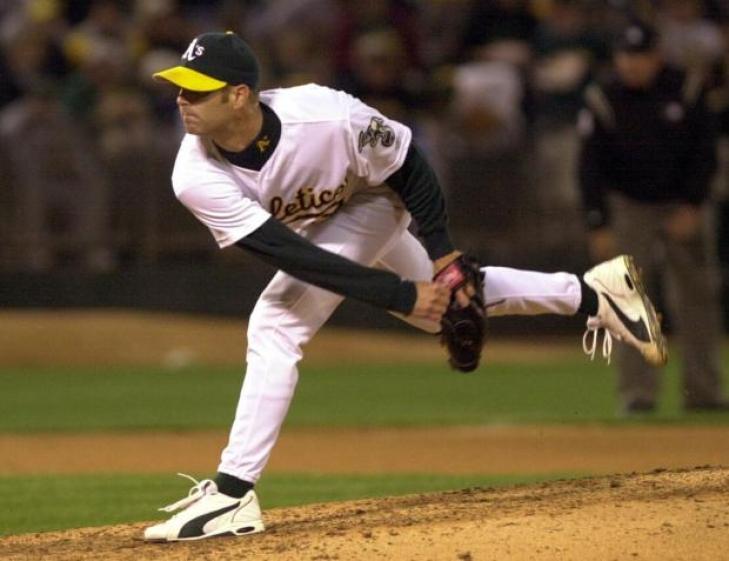
When Tim Hudson emerged in summer 1999, he quickly sparked a new era of baseball in the East Bay. Together with rising stars Barry Zito and Mark Mulder, Hudson led the legendary "Big Three" starting rotation, which would dominate the American League and become the pitching core of the renowned "Moneyball" teams of the early 2000s.
Hudson utilized a dynamic, explosive split-finger fastball and a powerful, biting sinker, establishing himself as a formidable competitor during his six years with Oakland. His skill in consistently producing weak ground balls and navigating high-pressure situations resulted in an impressive 92-39 record and a remarkable .702 winning percentage, making him one of the most efficient pitchers in the sport during that period.
His rapid ascent reached an elite national peak during his sophomore 2000 campaign. Putting on an absolute pitching clinic for the junior circuit, Hudson paced the American League by racking up a magnificent 20 victories against just 6 defeats, carrying a sharp 4.14 ERA over 202.1 intense innings. That dominant display earned him his first career All-Star selection and a brilliant, runner-up finish to Pedro Martinez for the 2000 AL Cy Young Award.
Far from a one-year wonder, he remained remarkably consistent as the franchise's frontline workhorse, anchoring a string of four consecutive postseason appearances for the Athletics from 2000 through 2003. He supplemented his resume with two additional top-six finishes in the Cy Young balloting, placing sixth in 2001 and fourth in 2003, before securing his second All-Star nod in an Oakland uniform during a stellar 2004 season that featured a microscopic 3.32 ERA.
However, as financial constraints in a small market and upcoming free-agent prospects affected the organization, the front office orchestrated a significant transition. In December 2004, Oakland transferred their leading pitcher to the Atlanta Braves as part of a multi-player deal, marking the conclusion of the best chapter in his career.
22. Danny Murphy
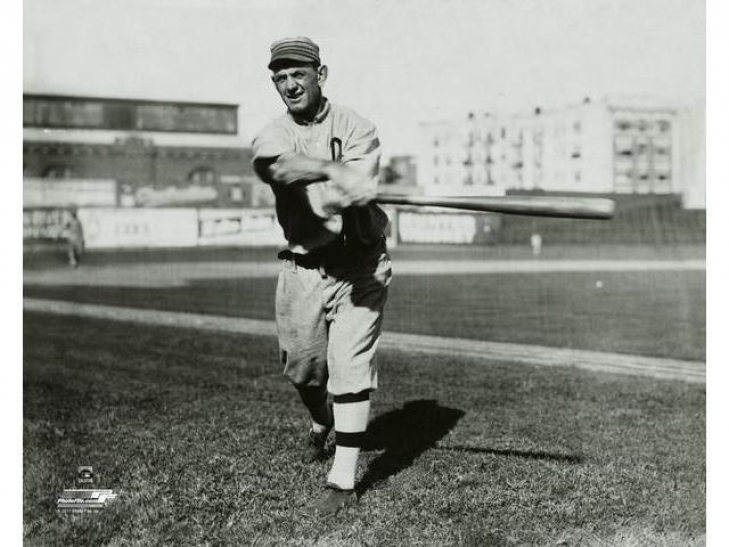
When Connie Mack established his pioneering Philadelphia Athletics dynasty at the beginning of the twentieth century, the team roster rapidly became filled with some of the most notable figures of the dead-ball era. Sharing the field with legendary players such as Home Run Baker, Chief Bender, and Eddie Plank, it was surprisingly easy for Danny Murphy to be neglected by history. Nevertheless, his adaptable, decade-long contribution served as the critical, high-impact offensive driver that contributed to the transformation of the early Athletics into a respected baseball empire.
Murphy arrived in Philadelphia during the midpoint of the 1902 season, initially establishing himself as the team's regular second baseman. He managed the position with consistent reliability until the emergence of a young, generational talent prompted a tactical adjustment. Acknowledging the exceptional defensive skills of future Hall of Famer Eddie Collins, Mack decided to reposition Murphy from the infield to the outfield. Rather than allowing the demotion to adversely affect his mindset, Murphy embraced the transition, demonstrating commendable selflessness and adaptability that maintained the elite defensive standard of the infield while ensuring his potent bat remained in the lineup.
That bat proved to be a highly potent weapon in an era defined by low-scoring, tactical baseball. Murphy was a remarkably aggressive, line-drive hitter who accumulated 1,489 hits during his pinstriped tenure. While his free-swinging approach resulted in a relatively low .336 on-base percentage, his raw, extra-base power was an absolute anomaly for the period. He possessed an uncanny ability to drive the ball deep into the gaps, twice finishing second in the American League in triples and placing inside the junior circuit's top ten in slugging percentage and overall OPS on six separate occasions.
His clutch, heavy-hitting style served as a critical catalyst when the franchise reached its absolute peak. Murphy acted as a driving force for the back-to-back 1910 and 1911 World Series Championship teams, routinely delivering high-leverage hits in the Fall Classic to help secure the organization's first tastes of global supremacy.
His extended tenure in Philadelphia ultimately concluded after the 1913 season. Similar to numerous undercompensated star athletes of his era who became increasingly dissatisfied with Mack's stringent financial policies, Murphy opted to switch leagues by signing a lucrative contract with the nascent Federal League's Brooklyn Tip-Tops. He ended his distinguished eleven-year tenure with the Athletics with a robust .290 batting average, leaving a legacy characterized by discreet, versatile excellence that laid the groundwork for the sport's inaugural significant American League dynasty.
24. Jason Giambi

When contemporary fans reflect on the career of Jason Giambi, their understanding is often unjustly influenced by the lucrative, high-pressure contract he signed later in New York, as well as the subsequent injuries and controversies that impeded his progress. However, from this perspective, his entire baseball journey significantly misrepresents the actual scope of his achievements in the East Bay. During his peak years in Northern California, Giambi was not merely an outstanding player; he was arguably the most formidable and feared offensive force globally, serving as the pivotal and intimidating figure during the early "Moneyball" era.
Giambi officially entered the major leagues with Oakland midway through the 1995 season, rapidly establishing himself as a fundamental member of a burgeoning young roster. He demonstrated an exceptionally perceptive eye at the plate and a powerful, left-handed swing ideally suited for driving balls into the gaps. From 1996 through 2001, he displayed remarkable offensive consistency, achieving six consecutive seasons with no fewer than 150 hits and 20 home runs, with his performance metrics seemingly increasing in value each summer.
The pinnacle of this regular-season mastery was achieved during the historic 2000 campaign. Giambi demonstrated exceptional offensive prowess, batting an impressive .333 with 43 home runs and 137 RBIs, thereby guiding the Athletics to secure the AL West division title. His exemplary plate discipline was evident as he led the league with 137 walks and maintained an outstanding .476 on-base percentage. This remarkable performance earned him his first career All-Star selection and the prestigious 2000 American League Most Valuable Player Award.
Far from reaching a peak in his performance after one year, he managed to further enhance his abilities to an even more formidable level during the 2001 season. Giambi exceeded his previous personal bests significantly, recording an impressive 47 doubles, which led the league, and generating a remarkable slash line of .342/.477/.660. His exceptional efficiency was a notable statistical anomaly, leading Major League Baseball with a 199 OPS+, and earning him a second-place finish in the 2001 AL MVP voting as well as his second consecutive All-Star selection while representing Oakland.
With the impending approach of free agency, the limited financial resources of the front office in a small-market team necessitated an arduous transition. After the 2001 postseason performance, Giambi departed from the East Bay to agree to a substantial contract with the New York Yankees, where he subsequently earned three further All-Star selections.
When Jason Giambi's career in Oakland was said and done, he would play 1,036 Games and have the illustrious 3/4/5 in the Slash Line with .300/.406/.531. That is an impressive feat, indeed!
20. Mickey Cochrane
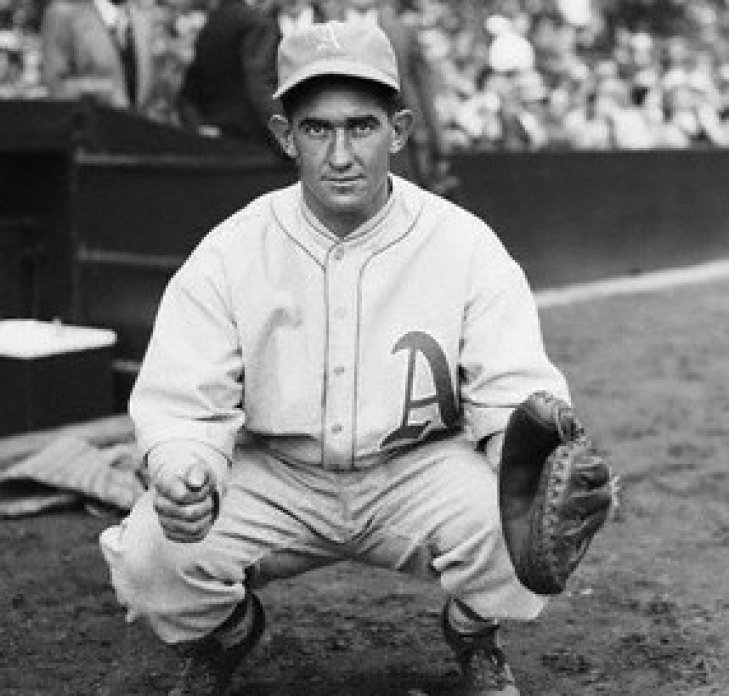
When Connie Mack surveyed the baseball landscape in late 1924, he knew his rebuilding Philadelphia Athletics required a dynamic center of gravity behind the plate to challenge the New York Yankees' emerging dominance. He found his man in the Pacific Coast League, aggressively prying Mickey Cochrane away from the Portland Beavers. Mack wasted absolutely no time, immediately thrusting the young backstop into the starting lineup for the 1925 campaign, igniting a run that permanently redefined the offensive baseline for the modern catcher.
Cochrane burst onto the major league scene with an impressive rookie summer, batting .331 and finishing tenth in the American League MVP voting. He effortlessly produced base hits as a left-handed hitter, combining excellent plate discipline with a crisp, line-drive swing.
During his nine outstanding seasons in Philadelphia, he broke the conventional expectations for a catcher by batting over .300 six times. His skill in controlling the strike zone was also renowned; he posted six seasons with an on-base percentage above .400, with his peak during his last year here when he led the entire American League with a remarkable .459 OBP.
Focusing solely on his offensive statistics overlooks the intense, motivating leadership that strengthened the team. Cochrane was a highly athletic and quick defender who neutralized base-stealers and played with a passionate, vigorous spirit. His exceptional defensive stance and relentless energy made him stand out, enabling him to lead all junior circuit catchers in Range Factor per Game for five straight seasons from 1925 to 1929.
The ultimate validation of this complete, all-around impact came during the 1928 season. Though it was a rare sub-.300 batting average (.293), his masterful handling of the pitching staff, and clutch intangibles were so deeply respected by voters that he captured the American League MVP Award.
With Cochrane as the clear emotional driving force, the historic core Mack developed around him matured completely. The Athletics demonstrated a true dynasty, winning consecutive World Series in 1929 and 1930, and securing another AL pennant in 1931.
The severe economic challenges of the Great Depression quickly affected the franchise. With attendance dropping sharply and limited funds, Mack decided to break up his star lineup. After the 1933 season, he sold Cochrane’s contract to the Detroit Tigers for a hefty $100,000. The legendary catcher demonstrated that his greatness was not tied to any one team, earning his second AL MVP award in 1934 and leading Detroit to a world championship as a player-manager in 1935.
He left Philadelphia having authored an astonishing .321/.412/.490 slash line alongside 1,317 hits and 108 home runs. The national baseball community delivered the ultimate punctuation to his historic legacy in 1947, overwhelmingly electing Cochrane into the National Baseball Hall of Fame. He was later inducted into the Philadelphia Baseball Wall of Fame in 1982 and permanently enshrined in the Athletics Hall of Fame as part of the 2021 class.