1. Tom Brady

Who else could it possibly be?

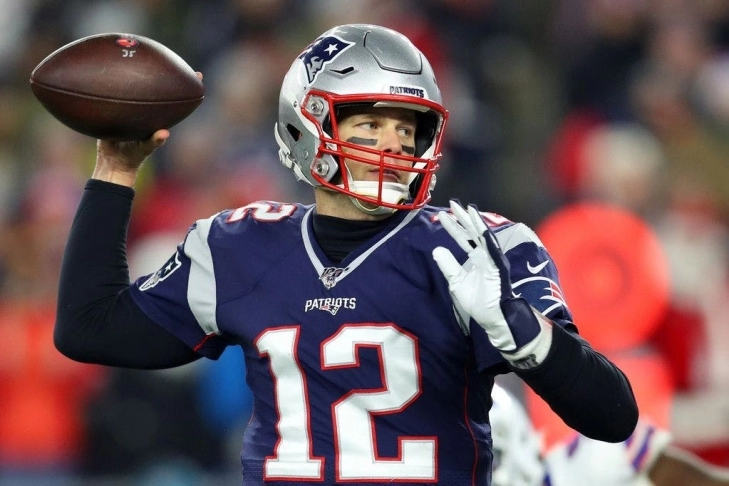
Tom Brady arrived in New England as a sixth-round pick out of Michigan in 2000 with no fanfare and spent his rookie season as a backup. The following year, an injury to Drew Bledsoe forced him into the starting lineup early in the season. He led the Patriots to an 11-3 finish in his starts, earned a Pro Bowl selection, and guided the team to its first Super Bowl title. In Super Bowl XXXVI, he engineered a late drive that set up the game-winning field goal against the Rams and earned Super Bowl MVP honors.  A legend was born.

The early success continued. In 2003, Brady helped the Patriots to a 14-2 record and another Super Bowl appearance. He threw for 354 yards and three touchdowns in the win over the Panthers in Super Bowl XXXVIII and earned his second Super Bowl MVP. The next season produced a third championship in four years. Brady completed 23 of 33 passes for 236 yards and two scores in the 24-21 victory over the Eagles in Super Bowl XXXIX. Those three titles in four seasons established the foundation of the dynasty. 

In 2007, Brady threw for 4,806 yards and a then-record 50 touchdowns while completing 68.9 percent of his passes. The Patriots went 16-0 in the regular season, and Brady won his first NFL MVP award. The undefeated run ended in Super Bowl XLII against the Giants, but the regular-season numbers remain among the most efficient in league history. He followed with another strong year in 2009 after missing most of the previous season to injury, then won his second MVP in 2010 with 36 touchdowns against only four interceptions.

Brady’s consistency defined the next decade. He led the Patriots to the Super Bowl again in 2011, throwing for 276 yards and two touchdowns in a loss to the Giants. In 2014, he guided another championship run. He completed 37 of 50 passes for 328 yards and four touchdowns in the 28-24 win over the Seahawks in Super Bowl XLIX and earned his third Super Bowl MVP. The following year he threw for 4,770 yards and 36 scores as the Patriots returned to the postseason.

The production stayed high even into his late 30s. In 2011, he threw for 5,235 yards and 39 touchdowns. He followed with 4,827 yards and 34 scores in 2012. Those seasons lined up with continued deep playoff runs and another Super Bowl appearance. Brady also led the league in touchdown passes four times and in passer rating twice during his time in New England. His interception percentage ranked among the league leaders in multiple seasons.

The 2016 season produced one of the most memorable games in Super Bowl history. Brady threw for 466 yards as the Patriots erased a 28-3 deficit against the Falcons and won in overtime. He earned his fourth Super Bowl MVP. In 2017, he led the NFL in passing yards with 4,577 and won his third regular-season MVP at age 40. The Patriots reached Super Bowl LII but lost to the Eagles despite Brady’s 505-yard performance. He closed his Patriots tenure with a sixth championship in Super Bowl LIII, a 13-3 win over the Rams.

Brady’s style centered on quick decision-making, accuracy in the short and intermediate areas, and the ability to extend plays when needed. He rarely forced throws and consistently found open receivers within the offense's structure. That approach produced sustained efficiency across two decades. From 2001 through 2019, he started every season the Patriots played and never finished with a losing record as the starter. He earned 14 Pro Bowl selections and three first-team All-Pro honors while in New England.

After the 2019 season, Brady left the Patriots as a free agent and signed with the Tampa Bay Buccaneers. He led Tampa Bay to a Super Bowl title in his first year there before retiring after the 2022 season. With New England, he finished with 74,571 passing yards and 541 touchdowns across 19 seasons as the starter. Those totals, paired with six Super Bowl wins and three regular-season MVPs, placed him at the top of every relevant franchise record.

The Pro Football Hall of Fame inducted him in 2024. He had already been named to the 2000s and 2010s All-Decade Teams and the NFL 100th Anniversary Team. Both the individual awards and the championships reflected a career that redefined what sustained excellence at the quarterback position could look like. Brady never had a losing season as a starter in New England and led the team to 17 division titles. No other quarterback has matched the combination of regular-season production and postseason success he produced while wearing a Patriots uniform. His Approximate Value of 280 with the team remains the highest total in NFL history. When the league eventually selects a 200th Anniversary Team, Brady’s place on it will not be in doubt. The numbers and the rings leave little room for debate.

Hell, if someone takes this over for us 100 years from now, won’t Tom Brady still be on top?
10. Vince Wilfolk

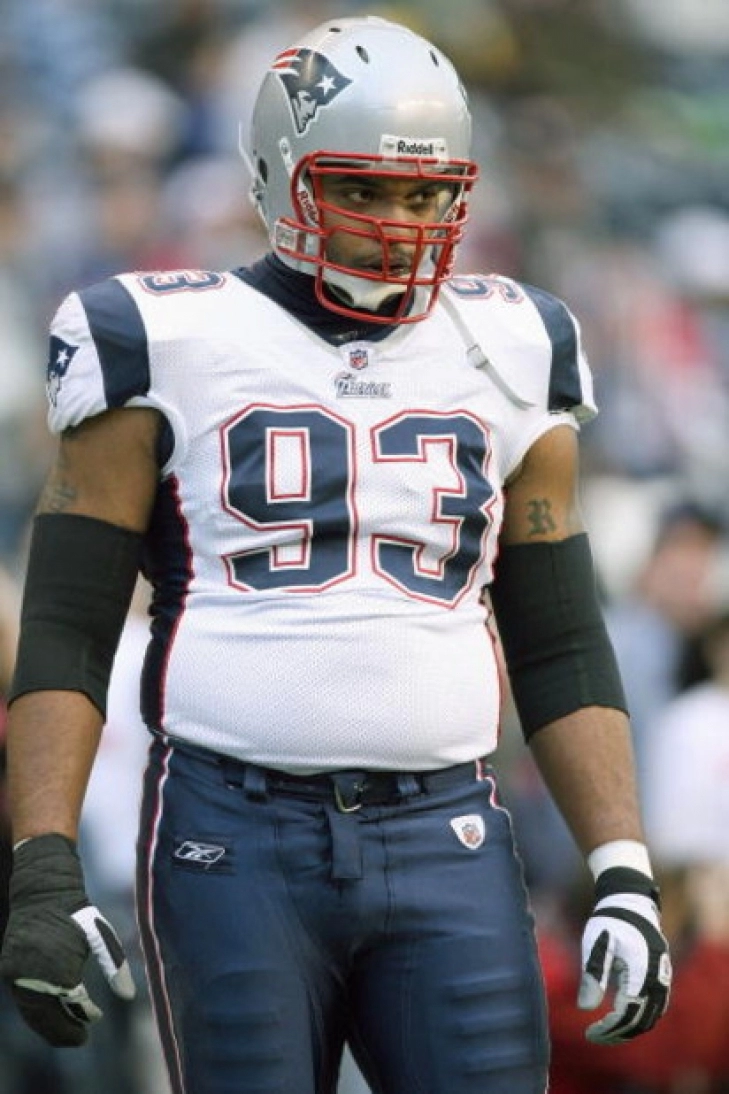
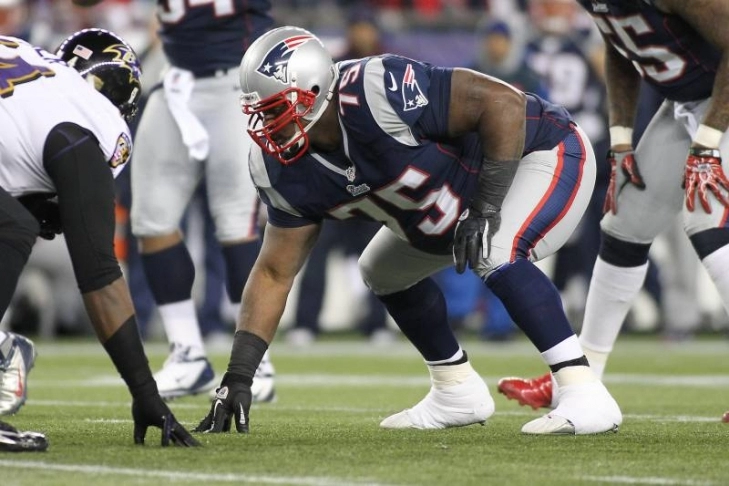
Vince Wilfork showed up in New England as a 21st-overall pick in 2004, looking like a mountain that had somehow learned how to play nose tackle, and the Patriots put the 325-pounder to work right away. The former Miami national champion shared time as a rookie yet still started Super Bowl XXXIX, helping close out the win over the Eagles and grabbing the first ring of his career.

The starting job became permanent in 2005. From that point forward, Wilfork locked down nose tackle and defensive tackle, the immovable object in the middle who forced offensive lines to double-team him or watch runs die at the line. He earned his first Pro Bowl in 2007 and then stacked four more consecutive selections from 2009 through 2012. The 2012 season brought first-team All-Pro recognition; that year he also piled up three sacks, four fumble recoveries, and constant pressure that made life easier for everyone behind him. Opposing centers learned early that moving him required a full committee.

The production stayed steady across the prime years. Wilfork routinely finished among the team leaders in tackles while the Patriots remained contenders. He missed most of 2013 with a torn Achilles, then returned in 2014 for one final run in New England. That season he helped the defense hold firm through the playoffs and contributed to the Super Bowl XLIX victory over Seattle. Two rings bookended his time in Foxborough, with the second arriving a decade after the first.

After the 2014 season, Wilfork left as a free agent and signed with the Houston Texans. His eleven years with the Patriots ended there. With New England, he finished with 16 sacks and 517 tackles across 158 games and 148 starts. He did that as a multi-time captain and a constant presence in the middle of the front. Off the field, he somehow made overalls look cooler than any player before or since, a human wrecking ball who treated game day and everything around it with the same unmovable presence.

Wilfork later played two seasons in Houston before retiring. The Patriots placed him in their Hall of Fame in 2022. The massive nose tackle who showed up as a champion from Miami left as one of the most reliable interior anchors of the dynasty era.

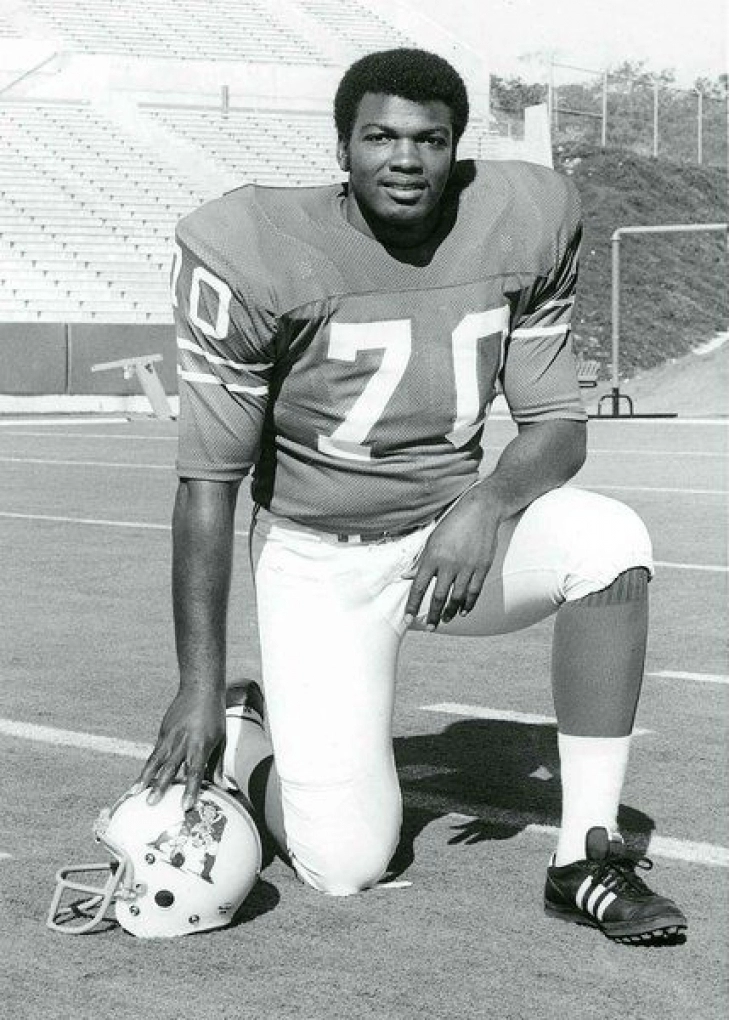
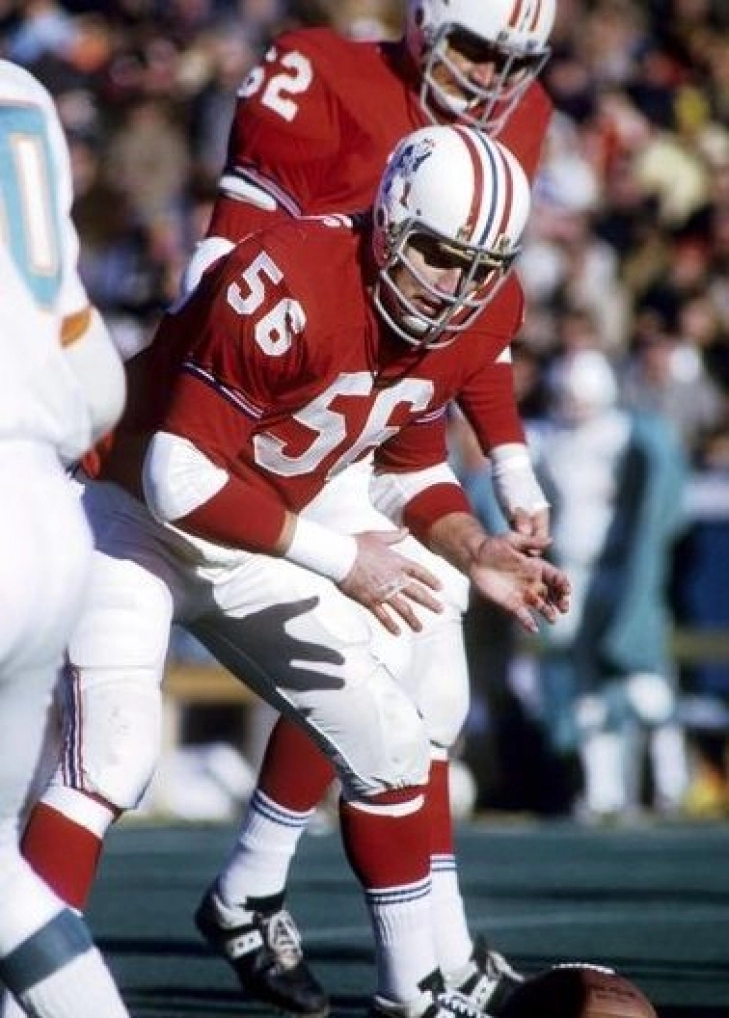
13. Jon Morris

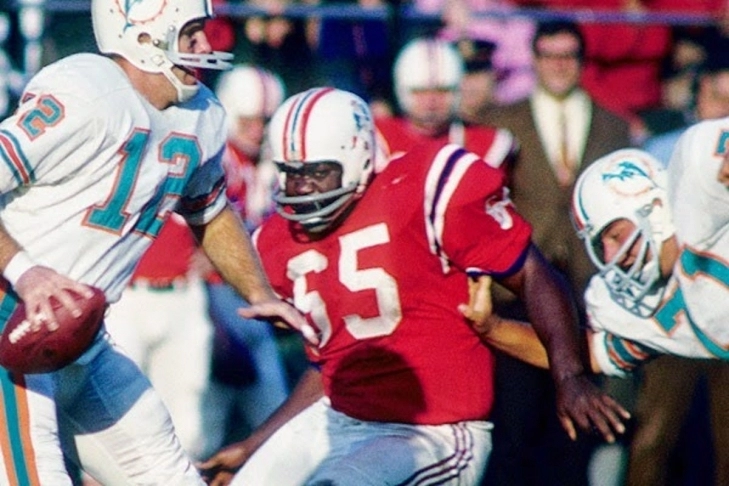
Jon Morris chose the Boston Patriots over Vince Lombardi’s Packers in 1964, and the decision paid off immediately. The Holy Cross product stepped in as a rookie starting center and never really gave the job back. In an era when the Patriots often lacked consistent skill talent around him, Morris became the steady presence in the middle of the offensive line.

The recognition arrived right away. Morris earned AFL All-Star honors in each of his first six seasons from 1964 through 1969, and he was named first-team All-AFL in 1966. He anchored the line during Jim Nance’s best rushing years and served as a team captain. When the leagues merged, Morris became the first Patriots player selected to the Pro Bowl in 1970. His durability stayed high through those early years; he started nearly every game as the franchise navigated the transition from the AFL to the NFL.

The later years in New England brought fewer individual awards, but the reliability remained. Morris continued starting through the early 1970s before his role diminished. After the 1974 season, he left the Patriots and was traded to the Detroit Lions. His eleven seasons in New England ended there. With the Patriots, he appeared in 130 games and started 125. He earned those numbers while earning seven consecutive league All-Star or Pro Bowl selections and serving as one of the few consistently excellent offensive linemen on the roster.

Morris spent three seasons starting for Detroit, then finished his career with a year as a backup in Chicago in 1978 before retiring. The Patriots later placed him in their Hall of Fame in 2011, and he was also named to the AFL All-Time Team. The center, who turned down Lombardi and spent more than a decade in New England, left as one of the franchise’s foundational players.

6. Ty Law

Ty Law came out of Michigan as the 23rd overall pick in the 1995 draft and stepped into a starting role with the Patriots almost immediately. His first three seasons produced steady interceptions and solid coverage, including a score in 1996 as the team reached Super Bowl XXXI. The foundation was already there for a corner who could contest throws and create turnovers.

The breakout arrived in 1998. Law led the NFL with nine interceptions and 26 passes defended, earned his first Pro Bowl selection, and landed first-team All-Pro honors. He finished third in Associated Press Defensive Player of the Year voting that season. He remained the primary cover corner as the franchise transitioned to Tom Brady at quarterback. From 2001 through 2003, he earned three straight Pro Bowl nods and added another first-team All-Pro season in 2003 with six interceptions. The secondary became one of the league’s more reliable units during that stretch, and Law led the NFL in passes defended a second time during his prime years.

Law’s biggest moments arrived in the postseason. In Super Bowl XXXVI against the St. Louis Rams, he intercepted Kurt Warner and returned it 47 yards for a touchdown, the first score of a game the Patriots would win. Two seasons later, he contributed in Super Bowl XXXVIII against Carolina, and the team captured its third title in Super Bowl XXXIX. He earned three championships while remaining a starter and a consistent presence at safety.

Injuries limited him in 2004. After the season, Law left as a free agent and signed with the New York Jets. With the Patriots, he finished with 36 interceptions, six of them returned for touchdowns, and 638 combined tackles. The production and the championships defined a decade spent almost entirely in one place

Law was later named to the 2000s All-Decade Team. The Patriots placed him in their Hall of Fame in 2014. Five years later, he entered the Pro Football Hall of Fame. The interceptions, the pick-six in the first Super Bowl win, and the three rings still mark his time in New England.

7. Richard Seymour

Richard Seymour landed in New England as the sixth overall pick in 2001 and immediately became the kind of defensive lineman coaches could drop into any gap without hesitation. At 6-foot-6 and well over 300 pounds, he mixed length and quickness in a way that let the Patriots treat him as both a run-stuffer and a pass-rusher from the start.

As a rookie, he earned All-Rookie recognition and contributed to the Super Bowl XXXVI win over the Rams. The versatility showed early; coaches moved him between defensive end, tackle, and even nose tackle without losing effectiveness. By 2002 he was a full-time starter and earned the first of five straight Pro Bowl selections.

The peak years followed. In 2003 Seymour recorded a career-high eight sacks while the defense switched to a 3-4 scheme, and he earned first-team All-Pro honors. He repeated as a first-team All-Pro in 2004 and 2005, remaining a constant problem for opposing lines even as the Patriots captured Super Bowls XXXVIII and XXXIX. Offensive coordinators had to account for him on every snap; his combination of length, strength, and quickness created mismatches few teams solved cleanly.

The production stayed steady through the mid-2000s. Seymour continued making Pro Bowls while the Patriots remained contenders, and in 2008 he again reached eight sacks. Injuries limited him in 2007, yet he returned to form the next year. Throughout those seasons, he functioned as a defensive captain and the kind of interior force that made the rest of the front seven more dangerous. The physical dominance was obvious, but so was the football intelligence that let him diagnose plays and occupy multiple blockers.

Before the 2009 season, the Patriots traded Seymour to the Oakland Raiders for a first-round pick. His time in New England ended after eight seasons. With New England, he finished with 39 sacks and 359 tackles. He did so while helping the franchise win three Super Bowls and establish the early part of its dynasty. Seymour later earned two more Pro Bowl nods with the Raiders and was named to the 2000s All-Decade Team. The Patriots placed him in their Hall of Fame in 2020. Two years later he entered the Pro Football Hall of Fame.

4. Andre Tippett

Andre Tippett came out of Iowa as an All-American and landed with the Patriots in the second round of the 1982 draft. Limited snaps as a rookie gave way to a starting role at left outside linebacker in 1983, where he quickly showed the speed and strength that would define him. From there, he became the primary edge presence on a defense still learning how to win consistently.

The 1984 season produced 18.5 sacks and the first of five straight Pro Bowl selections. The following year Tippett followed with 16.5 sacks, forced fumbles, and a recovery returned for a touchdown as the Patriots reached Super Bowl XX for the first time in franchise history. He finished third in Associated Press Defensive Player of the Year voting, shared the Newspaper Enterprise Association award, and United Press International named him AFC Defensive Player of the Year. First-team All-Pro recognition came with the production that helped carry the team through three road playoff wins.

Tippett’s game mixed speed off the edge with the strength to set the edge against the run. In the playoffs that season, he added tackles and another sack across four games. The two-year stretch of 35 sacks stood as one of the highest totals by a linebacker in league history. He continued the Pro Bowl run through 1988 and added another first-team All-Pro season in 1987 with 12.5 sacks, remaining the consistent force on a unit that fluctuated around him.

A shoulder injury wiped out the 1989 campaign. Tippett returned in 1990 and remained a starter through the 1993 season before retiring. With New England, he finished with exactly 100 sacks, still the franchise record, along with 19 fumble recoveries. At the time of his departure, he held the top three single-season sack marks in Patriots history.

Tippett was named to the 1980s All-Decade Team. The Patriots placed him in their Hall of Fame in 1999. Nine years later, he entered the Pro Football Hall of Fame. The numbers and the Super Bowl run had already made the case for a player who spent his entire career in one place. He remains the measuring stick for edge pressure in Patriots history.

2. John Hannah

John Hannah came out of Alabama already looking like a problem for anyone lined up across from him. He had been a two-time All-American under Bear Bryant, who once called him the finest offensive lineman he had ever coached. The Patriots took him fourth overall in 1973, and he never played a snap for anyone else. From the moment he arrived, he started at left guard and stayed there for the next thirteen seasons.

Hannah’s game mixed power with surprising quickness. He exploded off the ball, sealed defenders, and could pull and lead sweeps like anyone in the league. In 1976, he earned his first Pro Bowl selection and first-team All-Pro honors. The recognition kept coming. From 1978 through his final season, he made the Pro Bowl every year and collected seven first-team All-Pro selections across that stretch. 

Paired with tackle Leon Gray, Hannah helped form one of the best left sides in football. The 1978 Patriots rushed for a then-record 3,165 yards, and Hannah anchored that line. Even in seasons when New England struggled, he remained the constant. Opponents knew the left side of the Patriots line would be physical and technical on every snap. Hannah was so respected that in 1979, he became one of the few Offensive Linemen to receive Offensive Player of the Year votes.

Hannah missed only five games to injury across his entire career and started all 183 games he played. He led by example and expected the same effort from everyone else on the field. When the Patriots finally reached the Super Bowl in the 1985 season, Hannah was still starting and still earning first-team All-Pro recognition. He retired after that loss to the Bears.

With New England, he finished with nine Pro Bowl selections and ten All-Pro nods in thirteen seasons. Those totals, paired with the durability and the dominance on the left side, placed him among the most complete guards the league has seen. The Pro Football Hall of Fame inducted him in 1991, his first year of eligibility. The same year the Patriots placed him in their own Hall of Fame as the first player enshrined.

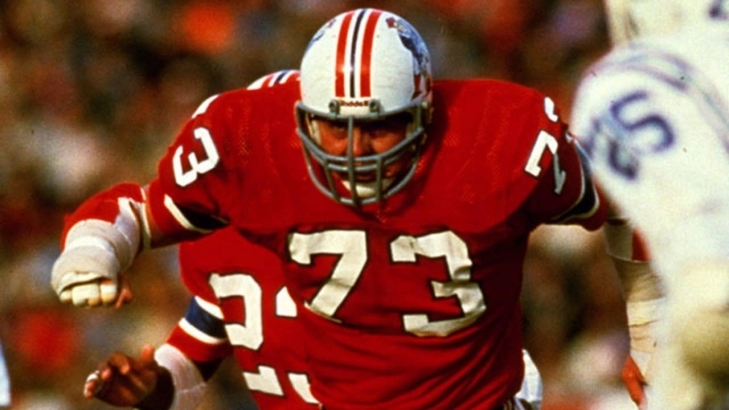
Hannah was later named to the 1970s and 1980s All-Decade Teams, the NFL’s 75th Anniversary Team, and the 100th Anniversary Team. The Patriots also retired his number 73. For a player who never left New England, the recognition followed him long after the last snap. He remains the standard for what an offensive guard can be.

8. Nick Buoniconti

Nick Buoniconti left Notre Dame as a captain and second-team All-American, yet NFL scouts dismissed him as too small for middle linebacker. The Boston Patriots still used a 13th-round pick on him in 1962, and the undersized prospect quickly proved the evaluators wrong.

He stepped into the starting lineup as a rookie and never looked back. By 1963, he helped the Patriots capture the AFL Eastern Division title. The next four seasons brought a run of first-team All-AFL honors and AFL All-Star selections, with Buoniconti operating as the hard-hitting, freelancing center of the defense. Opposing quarterbacks learned that knocking him down rarely ended the play; he simply got up and found the ball again.

In 1964, he reached a career-high five interceptions. The production stayed consistent across the middle of the decade, with three or four picks in most seasons and a reputation as the best middle linebacker in the AFL. He earned five AFL All-Star nods in all and four first-team All-Pro selections while wearing the Patriots uniform. The size concerns that followed him into the league never slowed the tackling or the range.

After the 1968 season, the Patriots traded Buoniconti to the Miami Dolphins. His time in Boston ended after seven seasons. With the Patriots, he finished with 24 interceptions, which still ranks seventh in franchise history, along with an unofficial 18 sacks. He posted those numbers while establishing himself as the top defensive player of the AFL era and earning a place on the All-Time AFL Team.

In Miami, he led the No-Name Defense, helped the Dolphins win Super Bowls VII and VIII, and added two more Pro Bowl selections. The Patriots placed him in their Hall of Fame in 1992. Nine years later, he entered the Pro Football Hall of Fame. The overlooked 13th-rounder from Notre Dame remains the standard for middle linebackers in the franchise’s early years.

3. Rob Gronkowski

There is only one Gronk. 

Rob Gronkowski arrived in New England as a second-round pick out of Arizona in 2010 and immediately looked like a problem for every defense that tried to cover him. He earned All-Rookie honors and then exploded the following year, leading the NFL with 17 touchdowns. The spikes started early and never really stopped. He played with a combination of size, power, and soft hands that made him nearly impossible to tackle in the open field once the ball was in his hands.

Gronkowski’s personality matched the physical style. He blocked with the same energy he used to celebrate, and teammates noticed. The party-boat reputation and the constant grinning were real, but so was the work. He showed up ready to compete even when his body wasn’t fully cooperating. Injuries hit hard and often. Ankle issues, broken forearms, a torn ACL, and various other setbacks limited him in multiple seasons. Still, when he was on the field, he produced at a level few tight ends have matched.

In 2011, he set the single-season touchdown record for a tight end and earned first-team All-Pro honors. He followed with more Pro Bowl and All-Pro recognition across the next several years, collecting five Pro Bowl selections and four first-team All-Pro nods in total with the Patriots. The production came with Tom Brady as the primary target, and the two developed a connection that defenses could not consistently disrupt. Gronkowski was as effective sealing the edge in the run game as he was finding soft spots in coverage.

The playoff moments stood out. He helped the Patriots win Super Bowls XLIX, LI, and LIII. Across 16 postseason games, he totaled 1,163 receiving yards and 12 touchdowns. Those numbers included big catches in the biggest games, including the drive that set up the only touchdown in the 13-3 win over the Rams in Super Bowl LIII. He played through pain in those runs, as he had throughout the regular seasons.

After the 2018 season, Gronkowski retired, citing the cumulative toll of the injuries. The next year he was named to the NFL 100th Anniversary Team. He returned in 2020 when the Patriots traded his rights to the Tampa Bay Buccaneers, reuniting him with Brady. He played two more seasons there, won another Super Bowl, and then retired for good after the 2021 season. With New England, he finished with 7,861 receiving yards and 79 touchdowns across nine seasons.

The numbers placed him among the most productive tight ends in franchise history and among the best the position has seen. The personality made him one of the more memorable players of his era. Gronkowski was inducted into the Patriots Hall of Fame in 2026. The Pro Football Hall of Fame is expected to follow in due time. For a player who treated the game like a celebration more often than not, the résumé still reads like the work of someone who took the competition seriously every Sunday.

11. Stanley Morgan

Stanley Morgan arrived from Tennessee as a 25th-overall pick in 1977, looking more like a running back who could fly than a pure receiver, yet the Patriots quickly realized the “Stanley Steamer” belonged on the outside. In an offense that rarely featured multiple skill threats, he became the one player defenses had to account for on every snap. The speed was obvious from the start—he could separate deep and finish plays after the catch—but the route running improved quickly enough that he also threatened intermediate areas.

After a modest rookie season that produced 21 catches for 443 yards, the production jumped in 1978. Morgan averaged 24.1 yards per reception that year while also handling significant return duties. In 1979, he caught 44 passes for 1,002 yards and a league-leading 12 touchdowns, earning his first Pro Bowl. The next two seasons followed the same pattern: 45 catches for 991 yards and six scores in 1980, then 44 for 1,029 and six more in 1981. Across those three years, he led the NFL in yards per catch each time. Defenses that tried to play him one-on-one usually paid for it; the combination of deep speed and the ability to track the ball made single coverage a liability.

The mid-1980s brought more volume. In 1983, he caught 58 passes for 863 yards, and in 1985 he helped the team reach Super Bowl XX with another solid season: 39 catches for 760 yards and five scores. The 1986 campaign produced his best statistical year: 84 receptions for a then-franchise-record 1,491 yards and 10 touchdowns. That performance earned another Pro Bowl nod and second-team All-Pro recognition. He added one more Pro Bowl in 1987 after catching 40 passes for 672 yards in a shortened season. Throughout those years, Morgan remained the clear primary target in an offense that lacked other reliable downfield threats; his ability to win on vertical routes and still produce after the catch gave the Patriots a consistent explosive element they otherwise struggled to find.

After the 1989 season, Morgan left the Patriots and finished his career in Indianapolis. His thirteen seasons in New England ended there. With the Patriots, he finished with 10,352 receiving yards and 67 touchdowns, plus another 989 return yards. The franchise still lists him as its all-time leader in receiving yards, and his 19.2 yards-per-catch average ranks among the highest in NFL history for players with more than 500 receptions. He posted those numbers while serving as one of the few true skill weapons the team had for most of his tenure. Morgan was inducted into the Patriots Hall of Fame in 2007.

5. Mike Haynes

Mike Haynes arrived from Arizona State as the fifth overall pick in the 1976 draft and immediately gave the Patriots a cornerback who could cover and return punts. As a rookie, he intercepted eight passes, returned two punts for touchdowns (the franchise’s first on that play), and led the AFC in punt-return yards. He earned Defensive Rookie of the Year honors and the first of six Pro Bowl selections in seven seasons with New England.

The production continued in 1977 with five interceptions and another Pro Bowl nod. The following year Haynes recorded six picks, including one returned for a touchdown, as the Patriots reached the playoffs. He earned All-Pro recognition and remained a starter through the late 1970s, adding three more interceptions in 1979. The secondary leaned on his coverage and ball skills during those seasons while the team hovered around contention.

Injuries limited Haynes in 1980 and 1981, though he still made the Pro Bowl in 1980. He returned fully in the strike-shortened 1982 campaign with four interceptions and another Pro Bowl appearance. Over those years, he became one of the league’s more consistent cover corners, using speed and range to contest throws and create turnovers. From 1977 through 1982, he remained among the AFC’s top defensive backs even as team results varied.

Contract issues arose as Haynes approached free agency. He held out in 1983, and the Patriots eventually traded him to the Los Angeles Raiders that November after a legal settlement. The move ended his time in New England. With the Patriots, he finished with 28 interceptions, the bulk of his career total of 46, along with more than 1,100 punt-return yards. He posted those numbers while starting most of his games in New England.

Haynes later helped the Raiders win Super Bowl XVIII and added further Pro Bowl and All-Pro seasons. He was named to the 1980s All-Decade Team, the NFL’s 75th Anniversary Team, and the 100th Anniversary Team. The Patriots retired his No. 40 and inducted him into their Hall of Fame in 1994. Three years later, he entered the Pro Football Hall of Fame. The early production and the trade that followed still define his time in New England.

9. Logan Mankins

Logan Mankins walked into Foxborough as the final pick of the 2005 first round and immediately claimed the left guard job like he had been there for years. The Fresno State mauler earned a runner-up finish for Offensive Rookie of the Year, All-Rookie honors that season, and never gave up the starting spot.

Two years later, the Pro Bowls started. After a short pause, he rattled off five straight from 2009 through 2013. The absolute peak came in 2010, when he earned first-team All-Pro while turning the left side of the line into a no-fly zone for pass rushers and a highway for the running game. Five second-team All-Pro nods followed. Defensive linemen who lined up across from him quickly learned there were no easy snaps when Mankins got into his stance.

Then came 2011, the season that still feels almost unbelievable. Mankins played the entire year, playoffs included, on a torn ACL. He started 15 regular-season games and three more in the postseason, gutting through Super Bowl XLVI against the Giants while the other knee was also compromised. The toughness was quiet and absolute. The cruel irony sat right next to it: nine seasons protecting Tom Brady produced zero Super Bowl rings. The one trip to the big game ended in a loss, and the championships that defined the Brady era arrived just outside Mankins’ window. The rings came before he got there and after he left.

Once the 2013 season ended, Mankins pushed for a bigger payday and was traded to Tampa Bay. His nine-year run in New England stopped there. With the Patriots, he started all 130 games he played. His availability and Pro Bowl streak told the story: he was the steady left-side anchor while the team stayed in the mix, even if the ultimate prize never landed on his finger.

He added one final Pro Bowl in Tampa before hanging up his cleats. The Patriots later put him on their 50th Anniversary Team and All-2010s Team. The last pick of the 2005 first round left as one of the most reliable guards of his generation in New England, a quiet force whose peak simply never synced up with a championship.

Richard Seymour enters the New England Patriots HOF

Richard Seymour was inducted into the New England Patriots Hall of Fame today, beating out Mike Vrabel and Bill Parcells in an online vote.

Seymour arrived in New England when the Patriots used their number 6 pick of the 2001 Draft to select the All-American from Georgia, and he became a starting Defensive End as a rookie.  Seymour helped the Pats win their first Super Bowl that year, and he was named to the Pro Bowl the following season. 

Seymour became one of the leaders of the defense, and was a key component of New England’s second and third Super Bowl win.  Individually, he went to four additional Pro Bowls and had a three-year streak of First Team All-Pro Selections (2003-05).   His run with New England ended when he was traded to the Oakland Raiders before the 2009 season.  

Statistically, Seymour recorded 39/0 Sacks with 359 Combined Tackles for New England.

Seymour becomes the Patriots Hall of Fame 30thinductee. 

The date and time for the induction ceremony is pending.

Seymour has been a Pro Football Hall of Fame Finalist the last two years.

We here at Notinhalloffame.com would like to congratulate Richard Seymour for earning this prestigious honor, and openly wonder if this opens the door a little wider for Canton.

  • Published in Football

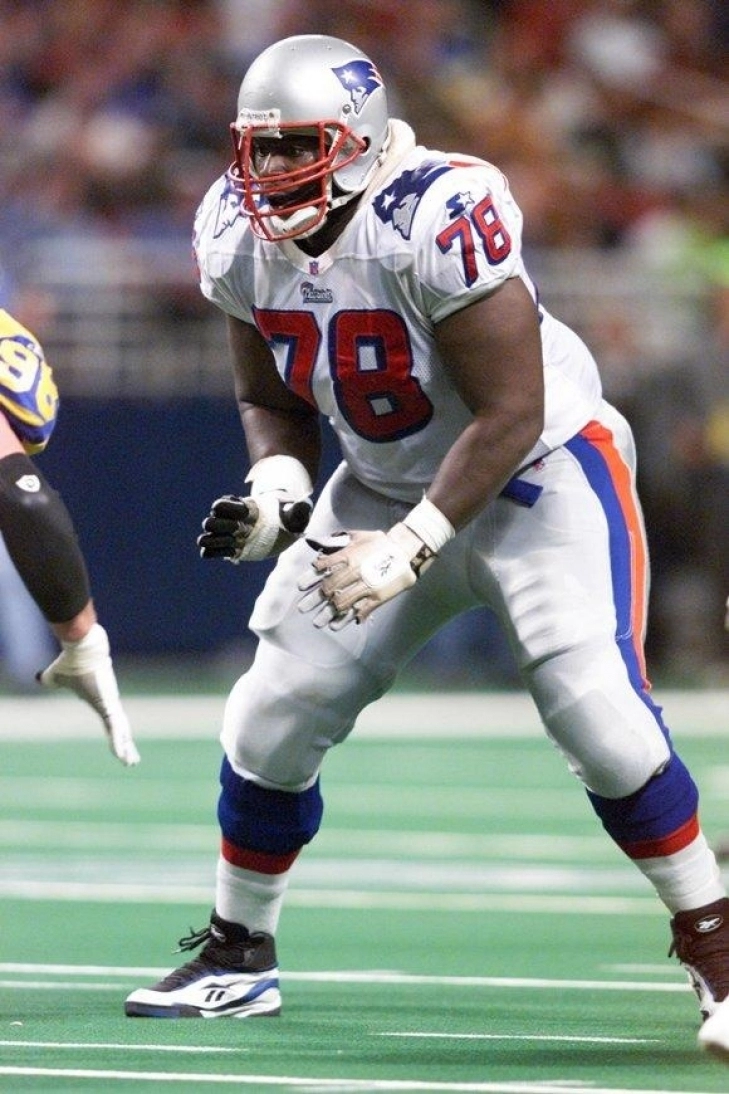
290. Leon Gray

Drafted in the 3rd Round from Jackson State in 1973, Gray would join a not-so-good New England Patriots team.  Gray won a starting job as a rookie and became a fixture at Left Tackle, where he showed steady improvement annually, much like the Pats themselves.  He was named to the Pro Bowl in 1976 and again in 1978, when he was also a First Team All-Pro.

Gray was shockingly traded to the Houston Oilers in what was widely viewed as a cost-cutting move.  John Hannah, his linemate, famously quipped, “There goes our Super Bowl” upon hearing the news.  Gray anchored the Houston Oilers O-Line and again was a Pro Bowler in 1979, while being a First Team All-Pro in both 1979 and 1980.  He would go to the Pro Bowl again in 1981 and finished his career with a pair of years with the New Orleans Saints.

  • Published in Football

216. Bruce Armstrong

Bruce Armstrong would start all 212 of his games at Left Tackle in a career that was spent exclusively with the New England Patriots.  Armstrong's career predated the Brady dynasty, so he isn’t as celebrated as he should be, but he is a six-time Pro Bowl selection and a two-time Second Team All-Pro.  He was also a member of the All-Rookie Team in 1987.

  • Published in Football

267. Jon Morris

A member of the AFL All-Time Team, Jon Morris chose the Boston Patriots over Vince Lombardi's Green Bay Packers when both teams drafted him in 1964.

This was a bold decision to eschew Lombardi, don't you think?

Choosing the AFL gave Morris more playing time, but the Pats were far from the team they would become years later.  The 1960s Patriots didn't have many eyes on them, but those who did saw that Morris was a very good football player who helped block Jim Nance into two league rushing titles.  He was named an AFL All-Star in his first six years and was a Pro Bowl Selection the year after.  The center was also a First Team All-Pro twice and played 182 Games over his 15-year career.

  • Published in Football

220. Houston Antwine

Houston Antwine eschewed the Detroit Lions of the NFL for the Boston Patriots of the AFL, which seemed the right decision by all accounts. 

Antwine would become an AFL All-Star six years in a row (1963 to 1968) and was one of the few reasons to watch the Patriots in the '60s.  The Defensive Tackle was a First Team All-Pro in 1963 and a four-time Second Team All-Pro.  The All-Time AFL Selection would have 38 “unofficial” Quarterback Sacks over his career, and he deserves to be remembered far more than just in Boston.

  • Published in Football

140. Gino Cappelletti

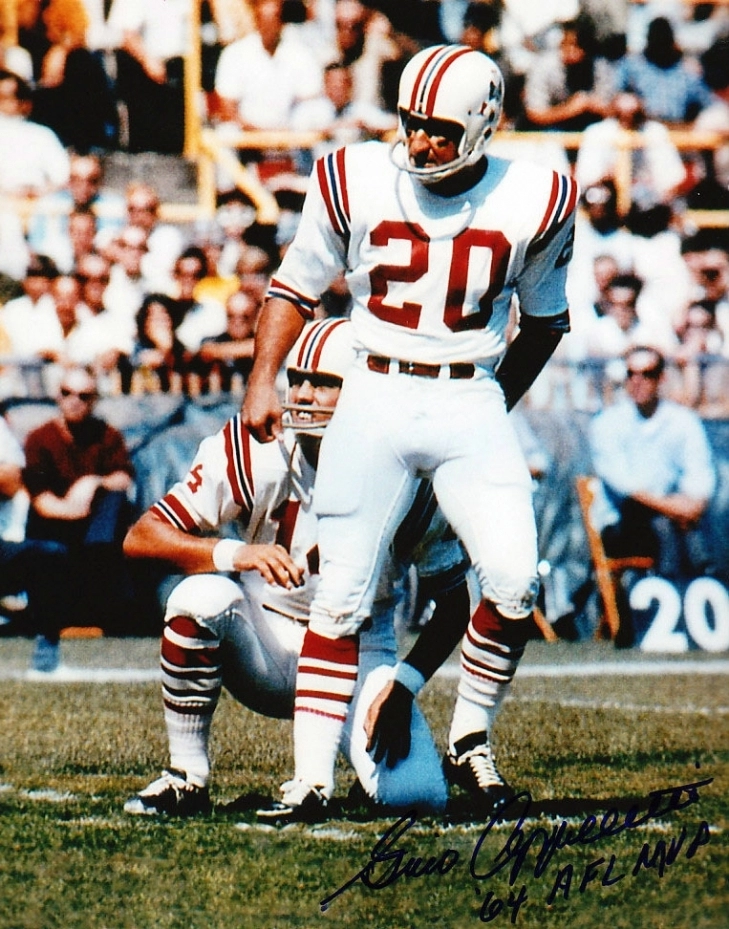
The New England Patriots would have a lot of talent wearing their uniform, but only one of them would have the nickname"Mr. Patriot."

The road to the pros was long for Cappelletti: he went undrafted in 1955 after an excellent college career at the University of Minnesota and played semi-pro for a few years.  The creation of the American Football League in 1960 would create opportunities, and Cappelletti signed with the Boston Patriots, where he was hired as a Kicker and Cornerback.  He found a perfect home on the East Coast, and over the 1960s, he became the team's permanent kicker and led the AFL in field goals three times.  That, however, was not the only job that Cappalletti would have for the Pats.

Cappelletti moved away from the defensive side of the ball and would also play at Flanker and Split End, and over his 11 seasons in Boston, he would accrue 292 Receptions for 4,589 Yards and 42 Touchdowns.  Four of his seasons would see him finish in the top ten in Receiving Yards.

Scoring TDs, Field Goals, and Extra Points, Cappelletti would retire by far as the franchise leader in points, though Adam Vinatieri has since eclipsed that.  He is, however, the All-Time leader in Points Scored for the AFL, a record we feel certain anyone, Vinatieri included, can never touch.


The New England Patriots HOF open their new exhibit: Yes, It's Still A Dynasty

Regular visitors of Notinhalloffame.com know that we are slowly working on the top 50 of every major team in the NHL, NBA, NFL and MLB. Once that is done, we intend to look at how each team honor their past players and executive. As such, it is news to us that the New England Patriots Hall of Fame have announced the opening of a new exhibit called “Yes, It’s Still A Dynasty”.

Obviously, you would have to be a really good team for the past decades to have an exhibit with that title and arguably only the New England Patriots can pull that off!

The new section will focus on events of the last 20 years, which as NFL fans know would see New England win six Super Bowls, nine AFC Conference Championships and 16 AFC East Titles.  The last time the Patriots did not win their division was in 2002, and they are strongly favored to win it again this year.  The Patriots Hall of Fame Executive Director, Bryan Morry, stated that it seemed to fit as this is “Bill Belichick’s and Tom Brady’s 20thseason with the team.”

Some of the showcases announced will be:

Tom Brady’s game worn jersey when he threw his 50thTouchdown of the 2007 season.

Rob Gronkowski’s game worn jersey in his last home game; their 2018 playoff win over the Los Angeles Chargers.

Willie McGinest’s cleats that he wore during Super Bowl XXXIX.

Vince Wilfork’s gloves when he made his first career interception against the Chargers in 2011.

Ty Law’s cleats worn during New England’s Super Bowl XXXVIII win.

Troy Brown’s 2002 game worn Pro Bowl Jersey.

Julian Edelman’s game worn jersey when he caught 10 passes for 100 Yards in New England’s 2015 Playoff win over the Kansas City Chiefs.

We here at Notinhalloffame.com would like to congratulate the New England Patriots Hall of Fame for their continued growth and dedication to their history.

Subscribe to this RSS feed