
Menu
A+ A A-
Committee Chairman

Committee Chairman

Kirk Buchner, "The Committee Chairman", is the owner and operator of the site.  Kirk can be contacted at [email protected] .

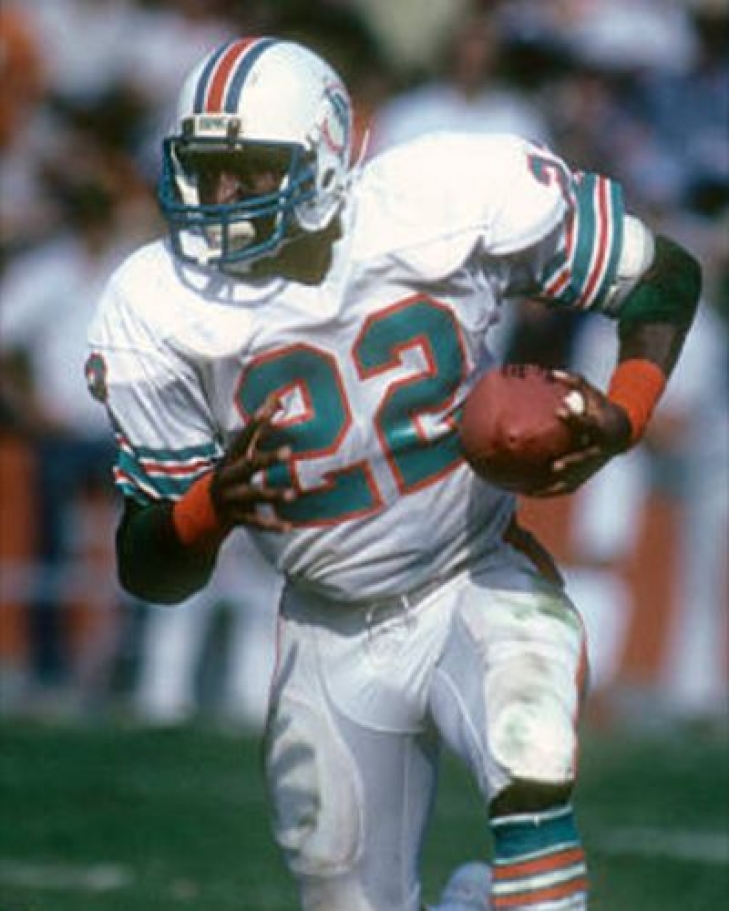
37. Tony Nathan

A national champion at Alabama in 1978, Tony Nathan joined the Dolphins the following spring as a third-round pick. Miami saw a versatile back who could contribute in multiple ways, and he began his career primarily as a kick and punt returner. As a rookie, he earned first-team All-Pro honors on special teams, establishing himself as one of the league’s more dangerous return men that season.

He developed into one of the more well-rounded running backs of his era. Nathan was equally effective carrying the ball and catching it out of the backfield, giving Don Shula’s offense a reliable dual threat. He helped the Dolphins reach the playoffs multiple times and started in Super Bowls XVII and XIX. One of his lasting memories came in the 1981 playoffs against the Chargers, when he scored the game-tying touchdown on the famous hook-and-lateral play that helped spark a dramatic comeback.

In nine seasons with Miami, he rushed for 3,543 yards and 16 touchdowns on 732 carries while adding 3,592 receiving yards and another 16 touchdowns on 383 catches. He also contributed on returns early in his career and added 1,176 yards from scrimmage across 12 playoff games. After retiring, he stayed with the organization and joined Shula’s coaching staff. Nathan’s combination of college pedigree, all-around production, and postseason moments made him a steady, valuable piece of those Dolphins teams.
36. Tim Bowens

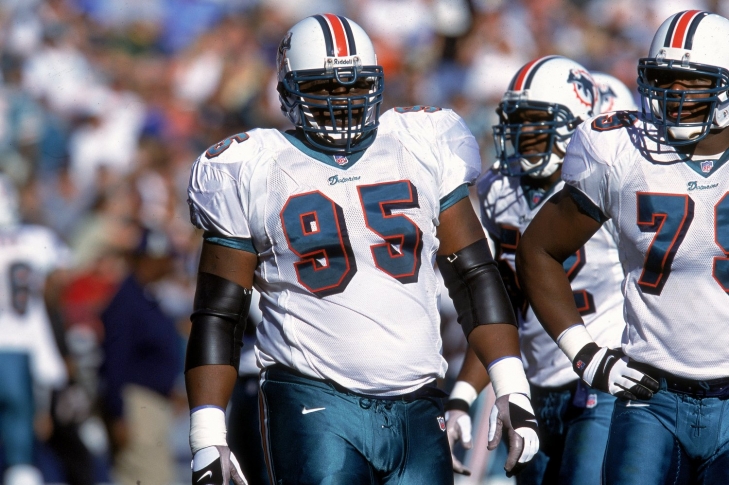
Tim Bowens joined the Dolphins as the 20th overall pick in 1994, a big, raw defensive tackle out of Ole Miss. Questions lingered about his college tape and conditioning, but he settled in quickly. He started almost immediately, helped the defense control the run, and earned AP Defensive Rookie of the Year honors as Miami won the AFC East.

He stayed on the left side of the defensive line for the next decade. Bowens was never a pure pass-rush specialist; instead, he was the kind of interior lineman who took on blockers, clogged running lanes, and freed the linebackers to make plays. Teammates later called him “Tim Badass Bowens” for the physical, no-nonsense style he brought every week. He was remarkably durable, starting nearly every game he played, and the Dolphins reached the playoffs seven times during his tenure. In 1997, he even scored a touchdown by recovering a fumble in the end zone against the Raiders. That same steady production earned him Pro Bowl nods after the 1998 and 2002 seasons.

In 11 seasons and 157 games (155 starts), he finished with 414 tackles, 22.0 sacks, nine forced fumbles, five fumble recoveries, and one interception. The Dolphins later inducted him into the Ring of Honor, a fitting tribute to the quiet, physical anchor who held down their defensive interior for more than a decade.

35. Ricky Williams

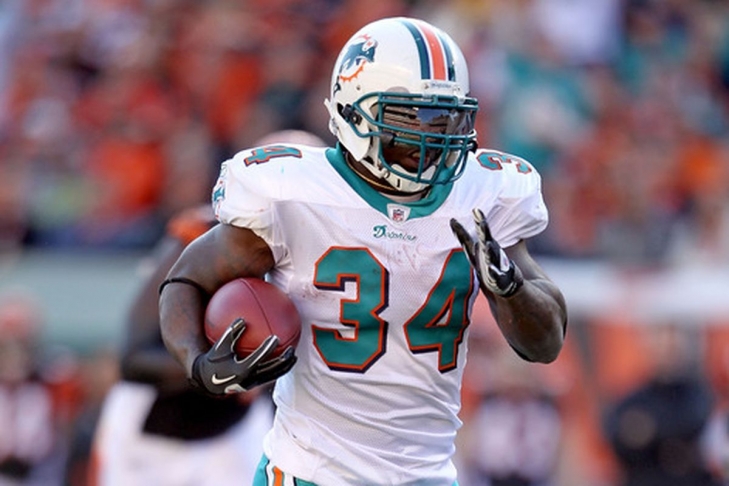
Ricky Williams arrived in Miami via trade before the 2002 season after three productive but uneven years with the New Orleans Saints. The Saints had mortgaged their entire 1999 draft (and more) to select the Heisman Trophy winner fifth overall; when results and off-field issues didn’t match the price, both sides benefited from a change. Miami sent a 2002 first-round pick and a conditional 2003 pick (which became another first after Williams hit 1,500 yards) the other way and installed him as the clear lead back.

His first season in aqua and orange finally matched the hype. Williams led the NFL with 1,853 rushing yards and 16 touchdowns on a league-high 383 carries, averaging 4.8 yards per carry and 115.8 yards per game. He earned first-team All-Pro and Pro Bowl honors, set the Dolphins’ single-season rushing record (still standing), and racked up more than 2,200 yards from scrimmage. Multiple 200-yard games and ten 100-yard performances made him the franchise’s most dominant offensive weapon in years. The team finished 9-7 and missed the playoffs, but the individual season remains one of the best by any Dolphins running back.

The rest of his Miami tenure was more stop-and-start. He followed with 1,372 yards and nine touchdowns in 2003, then abruptly retired before the 2004 season amid marijuana-related issues that also cost him the entire 2006 campaign (he spent that year in the CFL with the Toronto Argonauts). He returned in 2005 in a limited role (743 yards, six touchdowns in 12 games), dealt with further suspensions and injuries, and settled into a complementary role alongside Ronnie Brown.

Even so, he delivered another strong year in 2009: 1,121 yards and 11 touchdowns on 4.7 yards per carry after Brown was injured, setting an NFL record for the longest span between 1,000-yard seasons. He contributed to the 2008 AFC East title and playoff run in the Wildcat offense, then closed his Dolphins chapter in 2010 before one final season with Baltimore.

Across 93 games with Miami, Williams finished with 6,436 rushing yards and 48 touchdowns on 1,509 carries (plus 197 receptions for 1,431 yards and six more scores). Those numbers rank him second in franchise history behind only Larry Csonka in rushing yards. When he was on the field and focused, he was a punishing, high-volume force who gave the Dolphins the ground game they had long lacked; the suspensions and absences simply kept the full version of that career from unfolding.

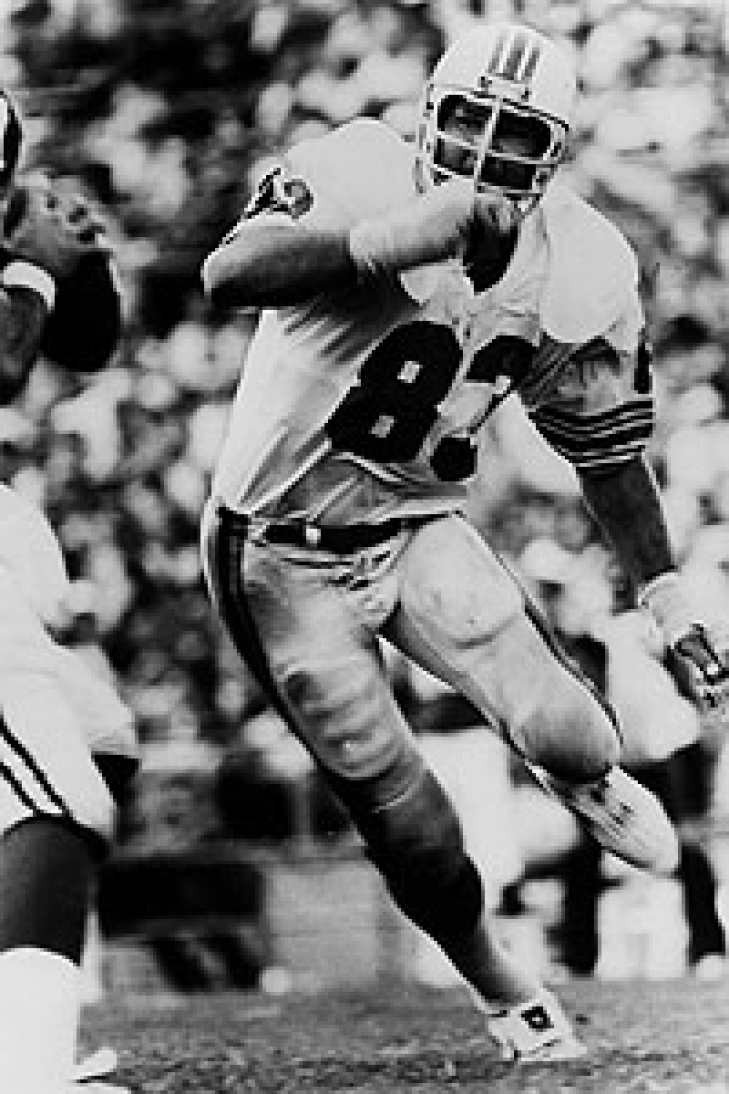
34. Vern Den Herder

Vern Den Herder showed up in Miami as a ninth-round pick out of Central College in Iowa in 1971 and never left. He spent his whole career with the Dolphins, starting as a backup before locking down the left defensive end spot in 1972 and holding it for the next ten years. He started 144 of his 166 games with the team.

He was a reliable piece on the left side of that defensive line during the perfect 1972 season and the back-to-back Super Bowl wins. Sacks weren’t officially tracked yet, but Den Herder is credited with 64.5, including a five-sack game in 1973 and a couple of four-sack outings. He led the Dolphins in sacks multiple times in the 1970s and earned All-AFC honors in 1972. He wasn’t flashy, but he was a steady, physical presence who held up against the run and kept working the edge. Don Shula later called him one of the most dependable players he ever coached, the kind of guy who showed up every week and got the job done without much fuss.

He stayed a starter through 1981 before shifting to a backup role in the strike-shortened 1982 season, which turned out to be his last.

As a Dolphin, he finished with 64.5 sacks, 14 fumble recoveries, and two Super Bowl rings.