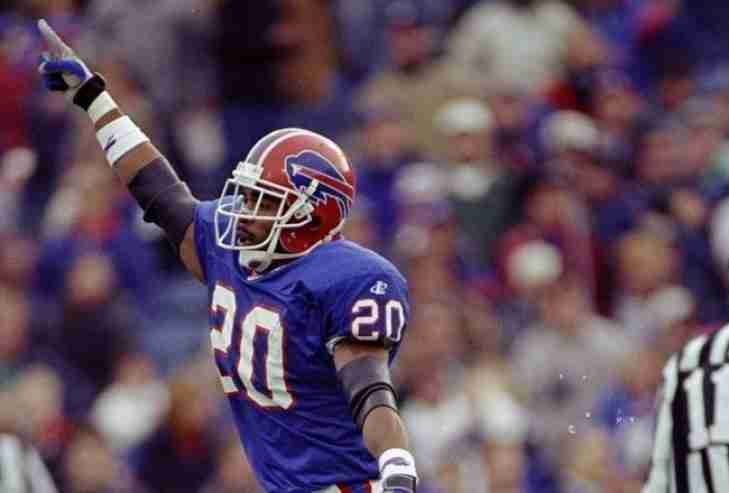
Taken in the first round (26th overall) of the 1991 NFL Draft out of Illinois, Henry Jones joined the Buffalo Bills during the peak of their championship contention. Stepping into the secondary as a strong safety, Jones combined hard-hitting physicality in run support with sharp defensive instincts, making himself a staple in Buffalo's defensive backfield for a decade.
Jones possessed the size to defend against physical running backs in close proximity and the range to retreat into deep zone coverage. From his position as a strong safety, he demonstrated exceptional skill in reading the quarterback's eye progression, utilizing a rapid closing burst to intercept intermediate passing lanes or deliver powerful hits to receivers over the middle. His capacity to transform pass defenses into immediate high-yardage return opportunities rendered him a consistent and formidable threat for big plays during his prime.
Following his initial season in 1991, during which he primarily participated as a special teams player and a rotational defensive back, Jones distinguished himself dramatically in 1992 by ascending to prominence on the national stage. In one of the most exemplary individual seasons by a safety in franchise history, Jones jointly led the entire National Football League (NFL) with eight interceptions, which he returned for a league-leading 263 yards and two touchdowns. He also contributed 92 tackles and two forced fumbles, resulting in his inclusion on the 1992 Pro Bowl roster and his designation as a First-Team All-Pro. His outstanding performance played a pivotal role in guiding the Buffalo team to its third consecutive Super Bowl appearance.
Although Jones never replicated those extraordinary statistical contributions again, he established a notably consistent role as a reliable, multi-season starter within Buffalo's defensive backfield. Throughout the remaining years of the 1990s, he continued to serve as a durable enforcer, starting all 16 games in five separate seasons for the Bills.
After ten seasons as a Western New York anchor (1991–2000), Jones left the Bills after 2000 during their rebuilding phase. He played two final NFL seasons: 2001 with the Minnesota Vikings and 2002 with the Atlanta Falcons before retiring. With the Bills, Jones appeared in 148 games (129 starts), with 18 interceptions, 455 return yards, and four touchdowns.