Menu
A+ A A-
Site Admin

Site Admin

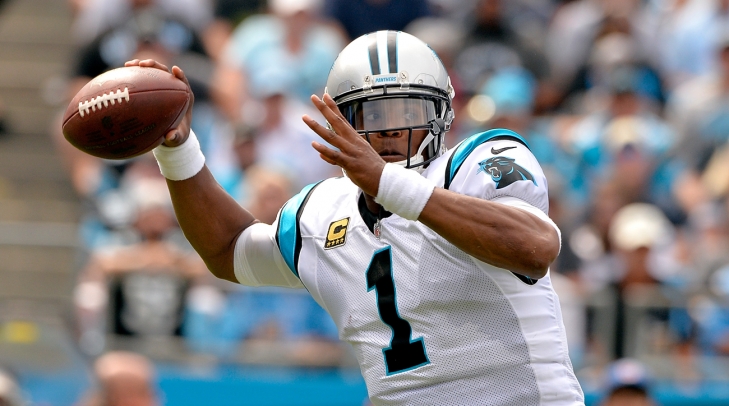
3. Cam Newton

Cam Newton, the top pick in the 2011 NFL Draft after winning the Heisman Trophy at Auburn, debuted in the league as a rare physical talent. Standing 6 feet 5 inches and weighing 245 pounds, he combined the size of a linebacker, a strong arm like a pocket passer, and the agility of a running back, immediately transforming Carolina's offense.

Newton transformed how defenses considered the quarterback in the run game. Designed to withstand direct hits at the goal line, he displayed remarkable strength on QB sweeps, draws, and power-read options, reliably converting short-yardage plays that typical passers wouldn't attempt. As a passer, Newton leveraged his exceptional arm strength to throw into tight boundary windows, combining his rushing ability with a confident deep-ball approach.

Newton created instant history in his 2011 rookie season. He made a remarkable debut with 422 passing yards and ended the year with 4,051 yards passing, 21 passing TDs, plus 706 rushing yards and 14 rushing TDs—setting an NFL record for a quarterback in a single season. His outstanding debut earned him AP NFL Offensive Rookie of the Year and his first Pro Bowl selection.

Over the following three seasons, Newton consistently demonstrated durability and dual-threat effectiveness. In 2012, he passed for 3,869 yards and rushed for 741 yards. In 2013, he guided Carolina to a 12–4 record, secured a division title, and earned his second Pro Bowl selection. The franchise's postseason return in 2014 was also part of his accomplishments.

His career peaked during his legendary 2015 MVP season. He led Carolina to a franchise-record 15–1 regular season, tallying 45 total touchdowns—3,837 passing yards with 35 passing scores, plus 636 rushing yards and 10 rushing touchdowns. He earned multiple awards, including AP NFL MVP, AP Offensive Player of the Year, and Bert Bell Award, along with First-Team All-Pro and Pro Bowl selections.

Newton led Carolina through decisive postseason wins over Seattle and Arizona to reach Super Bowl 50. However, facing the Denver Broncos in the Championship, he faced obstacles. Denver's fierce pass rush limited him, resulting in 265 passing yards and six sacks. The crucial point was late in the fourth quarter when, trailing 16–10, Newton was strip-sacked by Von Miller. As the ball scattered on the field, Newton hesitated and chose not to dive for it, a move that drew much public criticism as Denver recovered and secured the victory.

Despite the disappointing end to the Super Bowl, Newton continued to be the team's driving force, passing for more than 3,100 yards in each complete season from 2011 to 2018. During this period, he established himself as the most productive goal-line quarterback in NFL history, surpassing Steve Young's record for the most career rushing scores by a quarterback.

A foot injury limited Newton to just two games in 2019, leading to his release in early 2020. After spending the 2020 season with the New England Patriots, he returned to Charlotte midway through 2021 for a brief second stint, providing memorable touchdown moments for the home crowd despite operating in a reduced role.

Newton started 133 regular-season games, holding franchise records with 29,725 passing yards, 186 passing touchdowns, 5,036 rushing yards, and 63 rushing touchdowns. He stands as one of only two quarterbacks in NFL history to rush for over 5,000 yards with a single franchise.
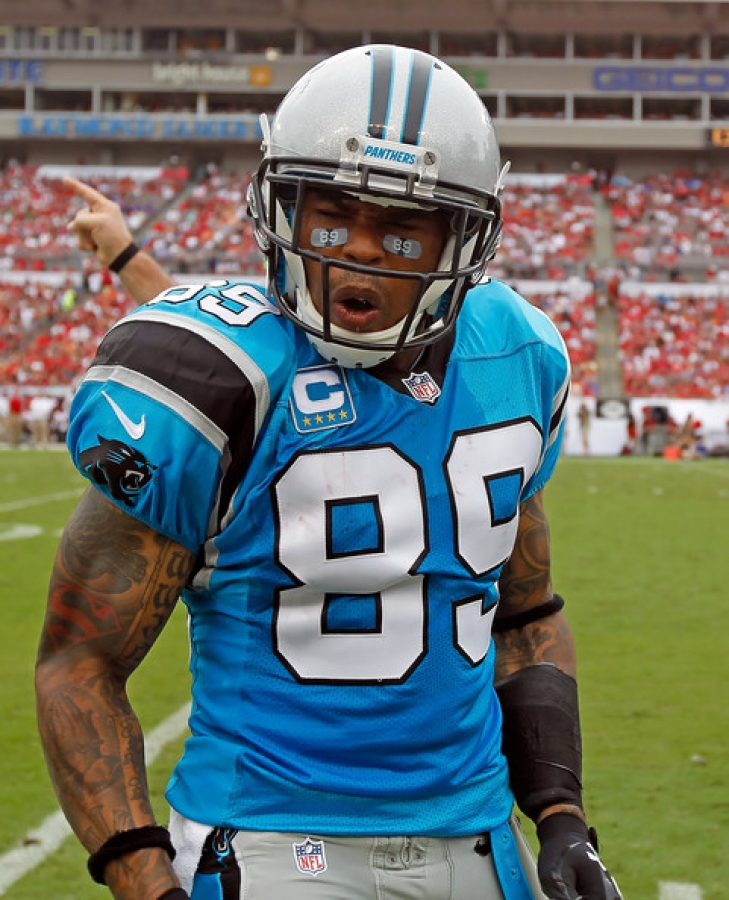
2. Steve Smith

Drafted as the 74th overall pick in the third round of the 2001 NFL Draft from Utah, Steve Smith Sr. came to Charlotte marked by a strong motivation. Standing 5 feet 9 inches, he frequently encountered skepticism about his stature, which he turned into a fierce, competitive game approach. Throughout 13 seasons with the Panthers, Smith evolved from a remarkable special teams contributor to the franchise's all-time leading offensive star.

Smith displayed a rare level of intensity for a receiver. He used his quickness off the line to beat press coverage and relied on his frame to shield larger defenders. In the air, he had exceptional timing and consistently caught contested passes over taller opponents. After catching the ball, he ran with the agility of a running back, breaking tackles and resisting tackles from defenders in open space.

Smith demonstrated his exceptional talent right from his rookie year in 2001, earning First-Team All-Pro honors as a return specialist. He made history as the first NFL player to score a touchdown on both a kickoff and a punt in his debut month. After shifting to a full-time receiver role, he achieved his first 1,000-yard season in 2003 with 88 catches for 1,110 yards and seven touchdowns. His performance was crucial in Carolina's journey to Super Bowl XXXVIII, especially with his memorable 69-yard walk-off touchdown in double overtime against the St. Louis Rams during the Divisional Round.

In 2004, adversity hit when a broken leg in Week 1 sidelined him for the rest of the season. His 2005 response stands out as one of the greatest wide receiver seasons in modern football. He achieved the NFL's wide receiver Triple Crown, leading the league in receptions (103), receiving yards (1,563), and touchdowns (12). That year, he received AP Comeback Player of the Year, was named a First-Team All-Pro, and made the Pro Bowl, and was most memorable for finishing with a legendary 218-yard, two-touchdown game against Chicago in the postseason.

Smith remained a top-tier pass-catcher for the rest of his tenure in Charlotte, earning three additional Pro Bowl invitations in 2006, 2008, and 2011. During his 2011 campaign, he teamed with rookie quarterback Cam Newton to record 1,394 receiving yards on 79 catches.

Before spending his final three NFL seasons in Baltimore, Smith completed a 13-year run in Carolina, where he was the team's undisputed all-time leader in receptions (836), receiving yards (12,197), receiving touchdowns (67), and all-purpose yards (16,614). The organization enshrined him in the Carolina Panthers Hall of Honor in 2019.

26. Verne Lewellen

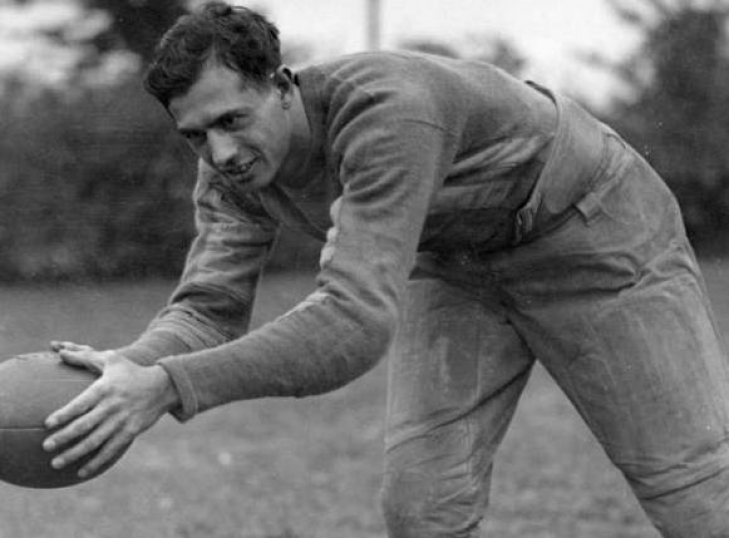
Long before Green Bay became synonymous with aerial circuses and passing dominance, Verne Lewellen arrived as Curly Lambeau's ultimate foundational weapon. A native Cornhusker who starred at Nebraska as both a law student and gridiron hero, Lewellen signed with the Packers in 1924 and immediately stepped into the starting backfield, bringing unprecedented strategic polish and all-around utility to professional football's frontier era.

As a dual threat who could run, throw, catch, and defend, Lewellen became the NFL's premier tailback in the late 1920s. His rare combination of open-field vision and perimeter quickness earned him four consecutive First-Team All-Pro selections from 1926 through 1929. Beyond his ball-carrying prowess, Lewellen was widely considered the finest punter of his era, using precise coffin-corner boots to routinely flip field position and trap opposing offenses deep in their own territory.

Lewellen’s peak years aligned perfectly with Green Bay's rise into a national powerhouse, serving as the offensive linchpin for pro football’s first-ever championship three-peat. Working alongside Johnny "Blood" McNally and Arnie Herber, Lewellen drove the Packers to consecutive NFL titles in 1929, 1930, and 1931. In an era before post-season playoffs, his clutch touchdown scoring and game-managing punts secured crucial low-scoring victories throughout those historic title runs.

Off the field, Lewellen was as sharp as he was on the turf, serving as the elected Brown County District Attorney while simultaneously starring on Sunday afternoons for the Packers. His cerebral approach to the game and natural leadership made him one of Wisconsin's most respected civic figures, laying down roots in the community that would endure long after his playing days concluded.

Two decades after hanging up his cleats as the NFL's all-time leader in total touchdowns (51), Lewellen returned to the franchise to serve as Green Bay's General Manager from 1954 to 1958. During his administrative tenure, he laid vital groundwork for the club's upcoming golden era, including overseeing the construction of new City Stadium (later renamed Lambeau Field) and drafting future Hall of Fame cornerstones like Bart Starr, Forrest Gregg, Jim Taylor, and Ray Nitschke.

In 1970, the Green Bay Packers formally celebrated his multi-decade legacy as a player, executive, and pioneer by inducting him as a charter member of the Green Bay Packers Hall of Fame.  Lewellen compiled 51 career touchdowns, 2,369 rushing yards, 1,243 receiving yards, and three NFL Championship rings as a Packer.

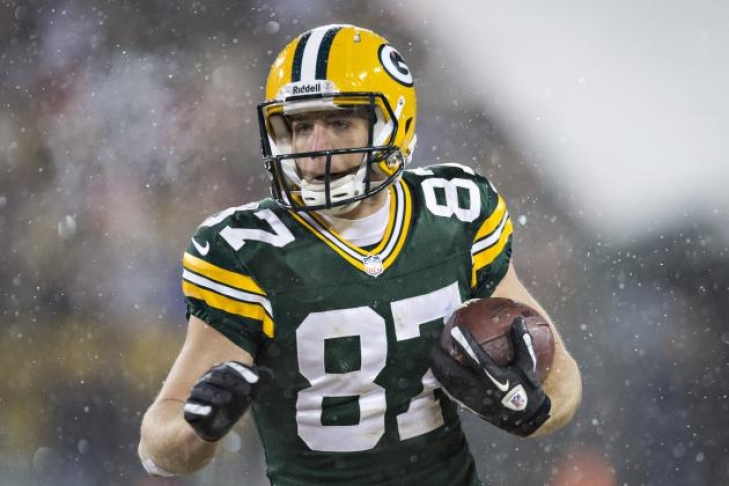
47. Jordy Nelson

Drafted in the second round (36th overall) of the 2008 NFL Draft out of Kansas State—where he originally walked on as a safety before developing into a consensus All-American wide receiver—Jordy Nelson arrived in Green Bay just as Aaron Rodgers stepped into the starting quarterback job. Nelson logged rotational duty behind Donald Driver, Greg Jennings, and James Jones during his first three seasons, gradually refining his sideline footwork and deep-threat acceleration. His breakout arrived on the biggest stage imaginable: Super Bowl XLV, where he hauled in nine receptions for 140 yards and a touchdown to ignite Green Bay's 31–25 victory over Pittsburgh.

After that championship performance, Nelson became one of the most prolific perimeter weapons in professional football. Possessing rare body control along the boundary and telepathic chemistry with Rodgers on back-shoulder throws, he reeled off four 1,000-yard receiving campaigns over a six-year stretch. His individual apex came in 2014, when he set Green Bay's then-single-season franchise record with 1,519 receiving yards on 98 catches, scoring 13 touchdowns to earn Pro Bowl and Second-Team AP All-Pro honors.

After a torn ACL cost him the entire 2015 season, Nelson demonstrated remarkable resilience in 2016. Returning at age 31, he led the NFL with 14 touchdown receptions while catching 97 passes for 1,257 yards, sweeping consensus NFL Comeback Player of the Year honors and powering Green Bay back to the NFC Championship Game.

Following a single final season with Oakland in 2018, Nelson signed a ceremonial one-day contract to officially retire as a Green Bay Packer. In 2023, the franchise formally immortalized his legacy by inducting him into the Green Bay Packers Hall of Fame. Stat-wise, Nelson tabulated 550 receptions for 7,848 receiving yards and 69 touchdown catches.