Menu
A+ A A-
Site Admin

Site Admin

17. Jonathan Stewart

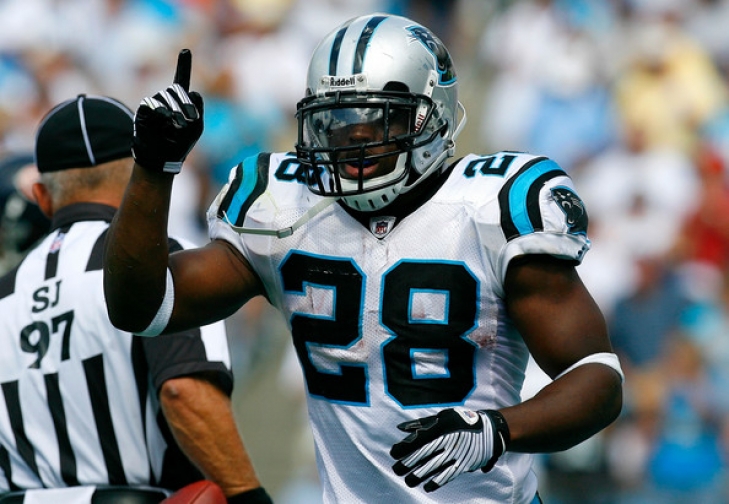
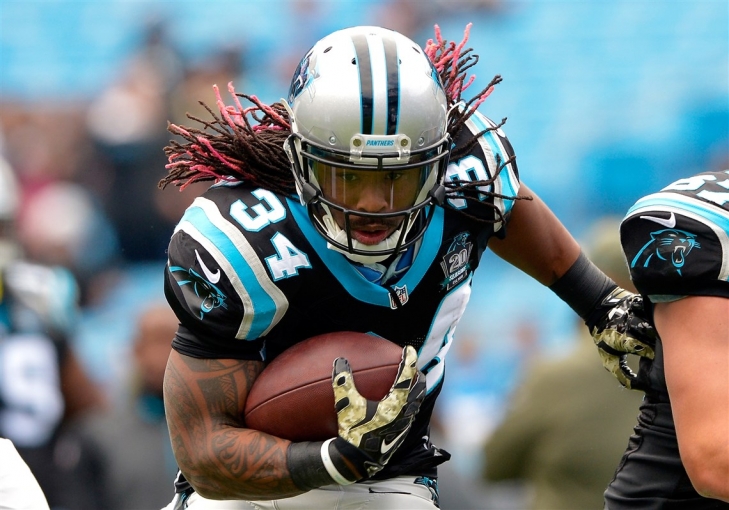
Selected 13th overall in the first round of the 2008 NFL Draft out of Oregon, Jonathan Stewart entered Charlotte as a bone-crushing, physical runner. Teaming up with DeAngelo Williams, "J-Stew" formed the smash-mouth half of Carolina's legendary "Double Trouble" backfield, giving the franchise a relentless ground attack that punished defenses for a decade.

Stewart was built like an iron bowling ball. Possessing a rare combination of lower-body power and nimble footwork, he specialized in running through arm tackles, bouncing off linebackers at the line of scrimmage, and wearing down opposing front sevens in the fourth quarter. Stewart was a master of contact balance, routinely turning potential losses into hard-fought four-yard gains and punishing defensive backs who tried to tackle him in the open field.

Stewart made an immediate impact during his rookie season in 2008, setting a franchise record for rookies with 10 rushing touchdowns and accumulating 836 rushing yards. His most outstanding individual statistical season occurred in 2009. Collaborating with Williams, Stewart achieved 1,133 rushing yards at an average of 5.1 yards per carry and scored 10 touchdowns. On December 27, 2009, in a game against the New York Giants, he delivered one of the most commanding rushing performances in the history of the franchise, rushing for 206 yards. During that season, Stewart and Williams became the first pair of teammates in NFL history to each rush for over 1,100 yards in the same year.

Whether functioning as part of a tandem or assuming the role of the primary bell-cow back during Cam Newton’s MVP period, Stewart’s rugged running style constituted the cornerstone of Carolina's offensive strategy. His contributions reached a pinnacle in 2015, when he accumulated 989 rushing yards and six touchdowns over 13 games, securing his inaugural Pro Bowl selection. He concluded that remarkable year by scoring two touchdowns in the postseason, including the opening touchdown in Super Bowl 50.

After ten bruising seasons as the heart of Carolina’s rushing attack, Stewart spent his final NFL season with the New York Giants in 2018, appearing in three games before retiring. In April 2019, he signed a one-day contract with Carolina to officially retire as a Panther.

Stewart appeared in 131 regular-season games (62 starts) with the Panthers. He departed as the franchise’s all-time leading rusher with 7,318 rushing yards and 51 rushing touchdowns, while adding 162 receptions for 1,295 receiving yards and seven touchdown catches.
12. Wesley Walls

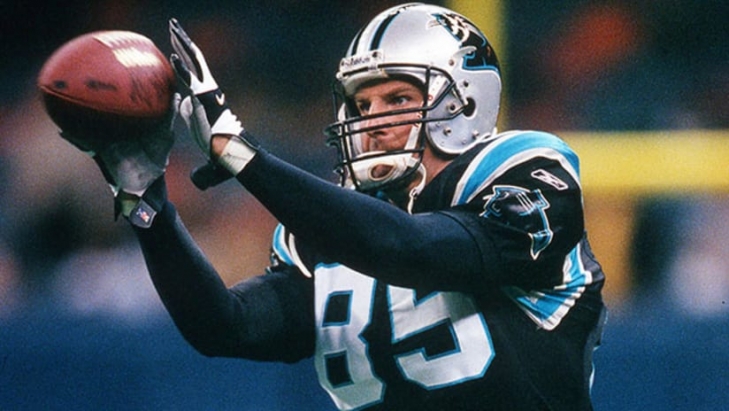
Wesley Walls, after earning a Super Bowl ring as a reserve with the 49ers and spending two solid seasons in New Orleans, joined Charlotte in 1996 as a high-profile free agent. This move drastically changed his career path—and the Panthers' offense—immediately, establishing him as one of the top tight ends of the late 1990s and early 2000s.

Walls blended traditional inline strength with the smooth route-running of a large wide receiver. Serving as Kerry Collins and Steve Beuerlein's reliable safety net and main target in red-zone situations, he excelled at running intermediate seam routes, finding openings in zone coverage, and using his ability to high-point the ball to out-jump linebackers and safeties in confined areas.

In 1996, during Carolina's second year, Walls made a notable impact. He caught 61 passes for 713 yards and scored 10 touchdowns, earning his first Pro Bowl selection and Second-Team All-Pro honors. His performance helped the expansion team win the NFC West division and reach the NFC Championship Game.

In 1997, he repeated that elite performance, recording 58 catches for 746 yards and six touchdowns, earning a second consecutive Pro Bowl selection and a Second-Team All-Pro honor.

His stellar statistical campaign came in 1999. Walls delivered an outstanding season, catching 63 passes for 822 yards and 12 touchdowns—tying the NFL single-season record for touchdown catches by a tight end at that time. That impressive performance earned him a third Second-Team All-Pro honor and his fourth straight Pro Bowl invitation. Walls celebrated his fifth and final Pro Bowl selection in 2001 after making 43 catches and scoring five touchdowns.

Following seven seasons as a fixture in Charlotte, the organization shifted toward a youth movement in 2003, leading to Walls' release. He spent his final NFL season with the Green Bay Packers in 2003 before hanging up his cleats.

Walls played seven seasons with the Panthers (1996–2002), appearing in 98 games (95 starts), with 324 receptions, 3,902 yards, and 44 touchdowns—the franchise record for tight ends. In 2019, he was inducted into the Panthers Hall of Honor alongside Jake Delhomme, Jordan Gross, and Steve Smith Sr.

15. DeAngelo Williams

With the 27th overall pick in the first round of the 2006 NFL Draft, DeAngelo Williams arrived in Charlotte as an explosive, home-run-hitting playmaker. Pairing with heavy-hitting rookie Jonathan Stewart in 2008, Williams anchored the backfield half of Carolina's famous "Double Trouble" duo—one of the most lethal two-headed backfield tandems in modern pro football history.

Williams had exceptional acceleration, a low center of gravity for contact balance, and a powerful second gear on the open field. Playing in John Fox's run-focused system, he excelled at setting up blocks on zone stretches before swiftly cutting back into the secondary. Once past the initial tackles, Williams seldom got caught from behind, often turning what looked like simple gap plays into long touchdown runs.

Williams continued his initial two-year development, but his performance truly skyrocketed in 2008, establishing himself as a superstar. With exceptional efficiency, he totaled a franchise-high 1,515 rushing yards, averaged 5.5 yards per carry, and led the NFL with 18 rushing touchdowns. Despite having one of the best seasons ever by a running back that year, he was surprisingly omitted from the Pro Bowl but was later recognized as a Second-Team All-Pro to correct the mistake.

He demonstrated that his breakout season in 2009 was no coincidence. Sharing duties with Stewart in a historic backfield—the first in NFL history to have two 1,100-yard rushers in a single season—Williams accumulated 1,117 yards and scored seven touchdowns over 13 games. This achievement earned him his first Pro Bowl selection, a well-deserved recognition.

Although injuries and shared backfield duties prevented him from reaching 1,000 yards again in Charlotte, Williams stayed a consistent part of the Panthers' offense through 2014. He was a reliable veteran presence, frequently making significant plays during crucial moments, especially after Cam Newton's arrival.

Following nine seasons with the Carolina Panthers, the veteran running back was released in March 2015. Williams subsequently signed with the Pittsburgh Steelers, where he experienced a resurgence in his career by stepping in during Le'Veon Bell's absences—culminating in tying the NFL lead with 11 rushing touchdowns in 2015—before retiring after the 2016 season. During his tenure with the Panthers, Williams participated in 117 regular-season games (starting 62), amassing 6,846 rushing yards and 46 rushing touchdowns. Additionally, he recorded 1,621 receiving yards and seven receiving touchdowns. His total of 8,467 yards from scrimmage and 53 touchdowns ranks among the highest in franchise history at the time of his departure.

14. John Kasay

Drafted by the Seattle Seahawks in the fourth round of the 1991 NFL Draft out of Georgia, John Kasay spent four solid years in the Pacific Northwest before taking a leap in 1995. Signing as an unrestricted free agent with the expansion Carolina Panthers, the left-footed placekicker became the very first star player signed in franchise history and served as the scoring backbone of the organization for 16 seasons.

Kasay developed a lengthy career based on smooth mechanics, icy composure under pressure, and exceptional leg strength from long range. Throughout two decades of football in the Carolinas, he excelled in high-pressure situations, delivering low, powerful kickoffs and precise, rhythmic kicks on critical fourth-quarter drives. This made him one of the most dependable long-range kickers of his era.

Kasay made a remarkable impact during Carolina's 1995 expansion, scoring 26 field goals and establishing the franchise. His most outstanding individual achievement came in 1996 (not 2006), during a historic season that propelled the second-year Panthers to the NFC Championship. Kasay set an NFL single-season record at that time with 37 field goals and scored a league-high 145 points. His exceptional performance earned him his first Pro Bowl selection and Second-Team All-Pro honors.

Despite roster changes and championship campaigns, Kasay was the team's steady heartbeat. He made crucial postseason kicks in Carolina's journey to Super Bowl XXXVIII in 2003, successfully converting 9 out of 10 playoff field goals that month.

Even in his late thirties, his leg remained strong; Kasay, in 2006, made over 88% of his kicks and scored 28 field goals in 2008, contributing to Carolina's return to the playoffs.

After serving as the team's leading scorer for 16 years, Carolina released the veteran in August 2011 to make space for younger players. Kasay quickly signed with the NFC South rival New Orleans Saints for the 2011 season, where he made 28 field goals at age 42 before retiring. During his time with the Panthers, he made 351 field goals and scored a total of 1,482 points, a franchise record that remains unmatched. In 2019, he was inducted into the Panthers Hall of Honor.