
- Published in Top 50 Oakland Athletics
14. Home Run Baker
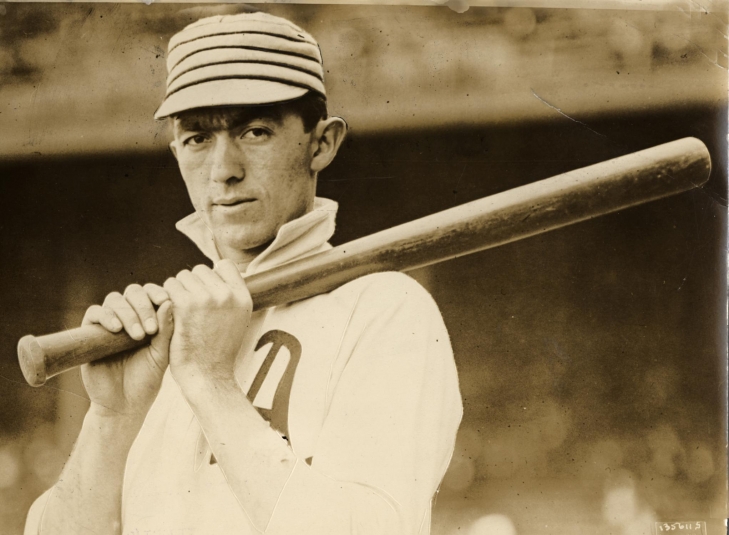
John Franklin Baker's arrival in Philadelphia before the 1908 season went unnoticed by most in Pennsylvania, with only quiet press mentions. He joined the Athletics as a minor league prospect to complete an earlier deal with Reading. However, everything changed in 1909 when manager Connie Mack gave the 23-year-old the starting role at third base. Baker brought a powerful, rare left-handed swing to the team, leading the American League with 19 triples as a rookie and quickly establishing himself as a distinctive talent.
In the 1910s, Baker established himself as the key member of the famed and efficient "$100,000 Infield” alongside Jack Barry, Eddie Collins, and Stuffy McInnis, forming the most renowned unit of the dead-ball era. His iconic nickname was earned during the 1911 World Series against the New York Yankees when he hit a go-ahead home run off star pitcher Christy Mathewson in Game 2, followed by a crucial, game-tying blast off Rube Marquard in Game 3. In a time when knocking the ball over the fence was uncommon, these clutch moments forever earned him the nickname "Home Run" Baker.
Modern fans might smile at the numbers that earned him four straight American League home run titles from 1911 to 1914—achieving totals of 11, 10, 12, and 9—but he was the clear power leader of his time. During this dominant four-year stretch, Baker was consistently in the MVP conversation, finishing among the top seven in balloting each summer. He was more than just a slugger; he was a disciplined, top-tier run producer who led the league in RBIs twice, with batting averages of .334, .347, .337, and .319.
That consistent performance in the regular season carried over smoothly to the sport's biggest stage. Baker was the driving force behind the Athletics' three world titles in 1910, 1911, and 1913. October was his time to shine, as he batted .409, .375, and .450 in those series, with nine hits in each to systematically break down opposing pitchers.
The powerful dynasty fell just as rapidly as it had risen. After a surprising sweep by the "Miracle Braves" in the 1914 World Series, Connie Mack launched a harsh, money-saving fire sale to stabilize the club's finances. When Baker demanded a fairer contract before the 1915 season, Mack refused to compromise. Baker then sat out the entire summer in protest, playing semi-pro baseball near his Maryland farm. Recognizing that this dispute was harming the league, AL President Ban Johnson urged Mack to resolve the deadlock, leading to Baker's contract being transferred to the New York Yankees before the 1916 season.
His numbers with the Athletics would see Baker accumulate 1,103 Hits, 48 Home Runs, and a Slash Line of .321/.375/.471.
Baker would enter the Baseball Hall of Fame in 1955 and the Philadelphia Baseball Wall of Fame in 1993.