

Site Admin
39. Daniel Murphy
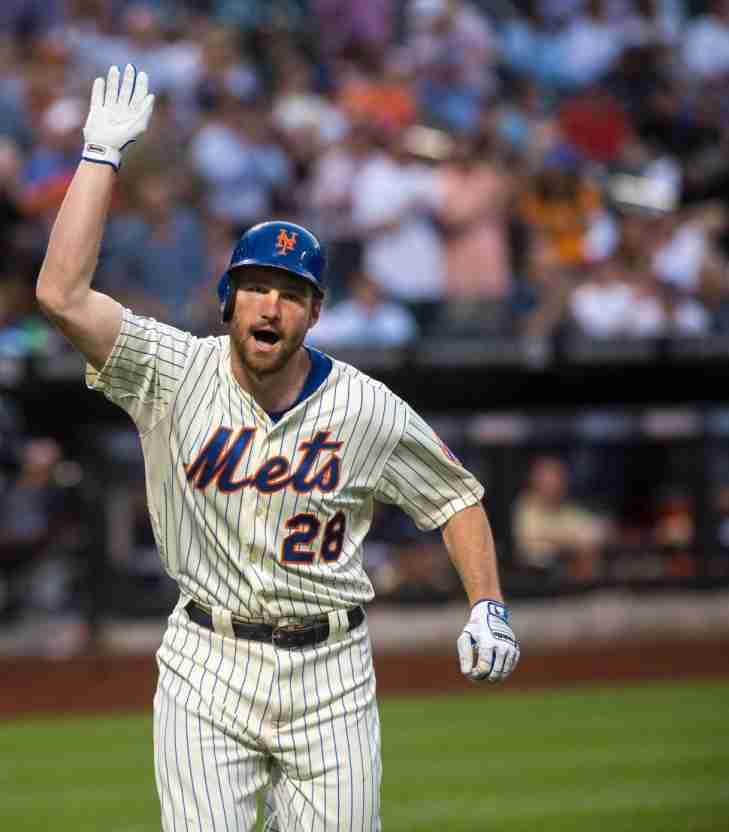
Daniel Murphy first broke into the Major Leagues with the New York Mets in August 2008 as a focused contact hitter drafted from Jacksonville University. Initially, without a fixed defensive position, he moved between first base, third base, and outfield corners before settling at second base. Though his defense often drew media criticism, Murphy was a relentless line-drive hitter in the middle of the order.
Murphy was a mainstay for the Mets, hitting .286 in 2012 and a career-high 181 hits in 2013, leading with 38 doubles. In 2014, he hit .289 with 37 doubles, earning his first NL All-Star. He was efficient, striking out only 38 times in almost 500 at-bats in 2015.
Over seven summers in Queens, Murphy compiled a superb .288 career average and 967 hits. He secured permanent, golden immortality in franchise folklore with an absolute masterpiece of an outlier during the 2015 postseason. Carrying the team on his back, he delivered a high-voltage display of sudden power that shocked the baseball world. He launched home runs off premier aces Clayton Kershaw, Zack Greinke, and Jon Lester, setting an all-time Major League record by homering in six consecutive postseason games. In the National League Championship Series, where he batted a mind-boggling .529 with four home runs to easily claim the 2015 NLCS MVP Award and propel the Mets to their first World Series appearance in fifteen years.
Right after that remarkable October run, the front office thought his power spike was a temporary anomaly and chose not to extend a lucrative long-term contract. As a result, he became a free agent and signed with the division-rival Washington Nationals in December 2015. This decision quickly backfired for New York, as Murphy reached new heights of performance in the nation's capital, winning the NL slugging and OPS titles and finishing as the close runner-up for MVP in 2016.
3. Jacob deGrom
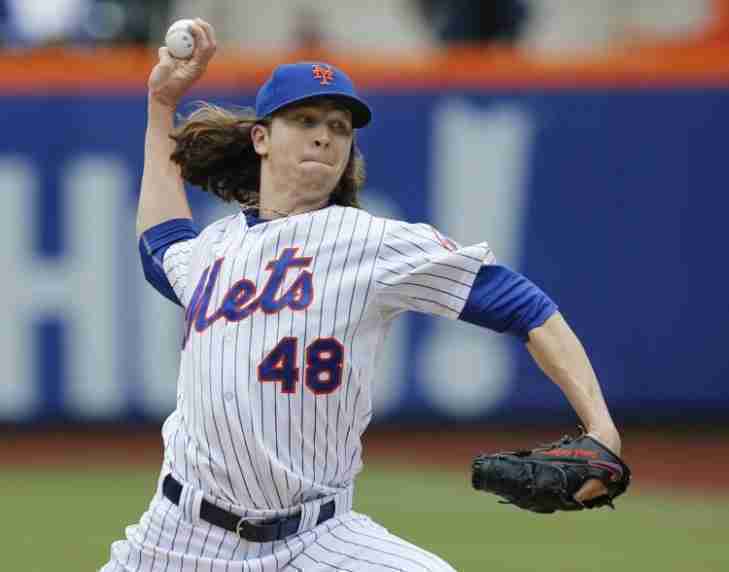
Jacob deGrom was a late-blooming converted shortstop with flowing hair and a "simple" 94 mph fastball. While he wasn't the most hyped prospect in a rotation that featured Matt Harvey and Noah Syndergaard, he immediately provided a brand of surgical precision that made the rest of the league look like they were swinging underwater.
Debuting in 2014, deGrom's first MLB season was an "out of nowhere" ascent that culminated in the 2014 National League Rookie of the Year Award. He famously tied a major-league record by striking out the first eight batters he faced in a September start. In 2015, he earned his first All-Star nod and finished seventh in the Cy Young voting, posting 14 wins and a 0.98 WHIP that left opposing hitters wondering if he was throwing a wiffle ball. He showcased a high-caliber cool in the postseason, winning two games in the NLDS against the Dodgers and proving he could handle the bright lights of October. While a nerve issue in his elbow hampered his 2016 campaign, he showed the organization a specialized resilience by returning in 2017 to toss over 200 innings and record 15 wins, signaling that he was ready for a historic leap.
deGrom was already a known commodity going into the 2018 season, but arguably, he was about to have a monster season, and do so while changing what the “win” meant for pitchers. He captured his first National League Cy Young Award, leading the league with a sparkling 1.70 ERA while earning only 10 wins. Despite the Mets' offense providing him with about as much support as a screen door on a submarine, his efficiency was undeniable; he set a record by allowing three runs or fewer in 29 consecutive starts.
2019 was pure absurdity, where he became one of the few pitchers in history to go back-to-back, capturing his second consecutive Cy Young Award. He showcased a high-caliber durability that year, leading the National League with 255 strikeouts and proving that his previous season wasn't a fluke. During this stretch, he became a perennial superstar, finishing in the top ten of MVP voting in both seasons… and again, he did so with a low number of wins (11).
The 2021 season provided what might be the most "Jacob deGrom" statistical anomaly in the history of the sport. Before injuries shortened his campaign to just 15 starts, he was pitching to a 1.08 ERA with 146 strikeouts in just 92 innings. At one point, he actually had more RBIs as a hitter than earned runs allowed as a pitcher, a feat of high-quality versatility that made him the most "must-watch" player in New York. While he constantly battled physical setbacks, he remained a professional mainstay when healthy, providing a foundation that made every deGrom start feel like a holiday in Queens.
After the 2022 season, deGrom shocked the Big Apple by opting out and signing a massive deal with the Texas Rangers. With New York, he had an 82-57 record with a 2.52 ERA and 0.998 WHIP.
46. Dave Magadan
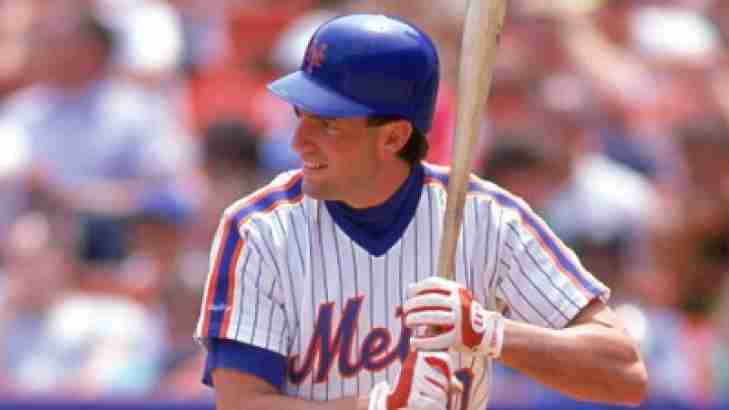
When Dave Magadan first made the major league roster in September 1986, he entered a clubhouse full of star players. Drafted by the Mets in 1983 after winning the Golden Spikes Award at Alabama, he was a disciplined left-handed hitter. Although he earned a championship ring as a reserve in 1986, his early days with the team were an ongoing struggle to get regular playing time.
In the following seasons, Magadan fought for every plate appearance. Despite a strong 1987 season batting .343 in limited play, the front office continually sought high-profile options at the corners. Magadan quietly accepted his role as a disciplined hitter, often filling in for Keith Hernandez or Howard Johnson, building a reputation for elite strike zone discipline and avoiding bad pitches.
His persistence finally earned him a starting opportunity in 1990, leading to a career-defining offensive season. As the everyday first baseman, Magadan dominated National League pitching all summer, batting .328 to finish third in the batting race behind Willie McGee and Eddie Murray. He also posted a .417 on-base percentage, drawing 74 walks and striking out 52 to anchor the Mets’ lineup.
Magadan remained a fixture in the New York infield for two more summers, showcasing his on-base skills. He hit .288 in 1991 and played a career-high 144 games in 1992, mainly at third base. Though lacking traditional power, his ability to grind out at-bats made him a tough out in the NL East.
His seven-year chapter in New York drew to a close following the 1992 season when he departed in free agency to sign with the Florida Marlins. Magadan left Queens with 610 hits, a stellar .391 on-base percentage, and a robust .292 batting average.
47. Tommie Agee
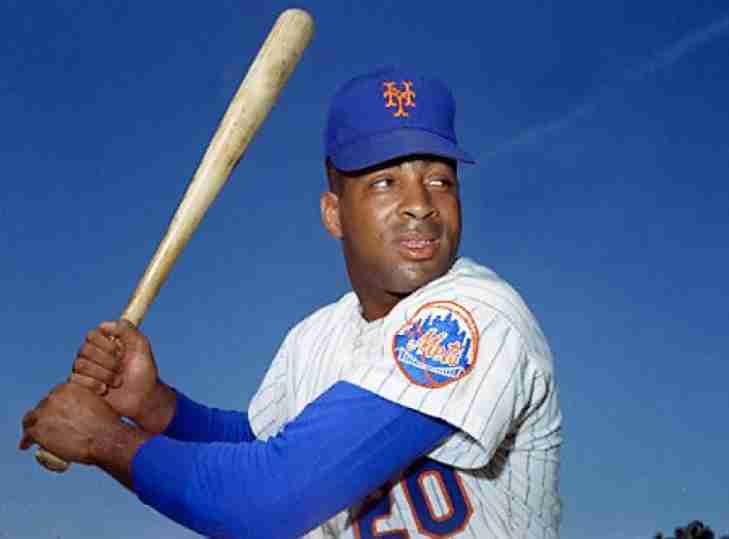
Tommie Agee arrived in New York before the 1968 season through a high-profile trade with the White Sox, bringing high expectations as a former American League Rookie of the Year. His first summer in Queens, however, was disastrous; he struggled with a severe hitting slump and was hit by a terrifying beanball from Bob Gibson, finishing with a poor .217 batting average. Despite this tough beginning, that difficult first year laid the groundwork for one of the most remarkable turnarounds in franchise history, reflecting the team's own dramatic evolution.
The 1969 season made Agee a legendary figure in Mets history. Once fully acclimated to the National League, the lively center fielder became the driving force behind the "Miracle Mets." On April 10, he hit a historic, long-distance home run off Montreal's Larry Jaster into the upper deck of left-field at Shea Stadium, a shot so iconic that the organization marked the spot with a white line on the seat to honor where it landed. Agee led the team with 26 home runs, 97 runs scored, and 76 RBIs, helping the Mets climb out of last place and finishing sixth in the National League MVP voting.
That regular-season surge was just a warm-up for his legendary showing in the 1969 World Series against the heavily favored Baltimore Orioles. In Game 3, Agee delivered what is arguably the greatest single-game performance in Fall Classic history. He started by hitting a solo home run in the first inning to set the tone, then made two incredible diving catches in center field, first robbing Elrod Hendricks in the snow-coned webbing of his glove, and later sliding across the warning track to prevent Baltimore from scoring with the bases loaded.
He maintained a high level of production into 1970, delivering a strong season with a .271 batting average, 24 home runs, 31 stolen bases, and earning a Gold Glove for his defense. Although ongoing knee injuries gradually reduced his speed and power during his last two seasons in New York, limiting his total with the franchise to 632 hits and a .329 on-base percentage, his most significant contributions were integral to the team's first championship identity.
After the 1972 season, the Mets traded him to the Houston Astros, ending his energetic five-year tenure in New York. While advanced metrics may see his career stats as humble, the franchise understood that his impact went beyond traditional box scores. Almost thirty years after his remarkable defensive plays helped win a title, the organization honored his legacy by inducting Agee into the New York Mets Hall of Fame in 2002.