
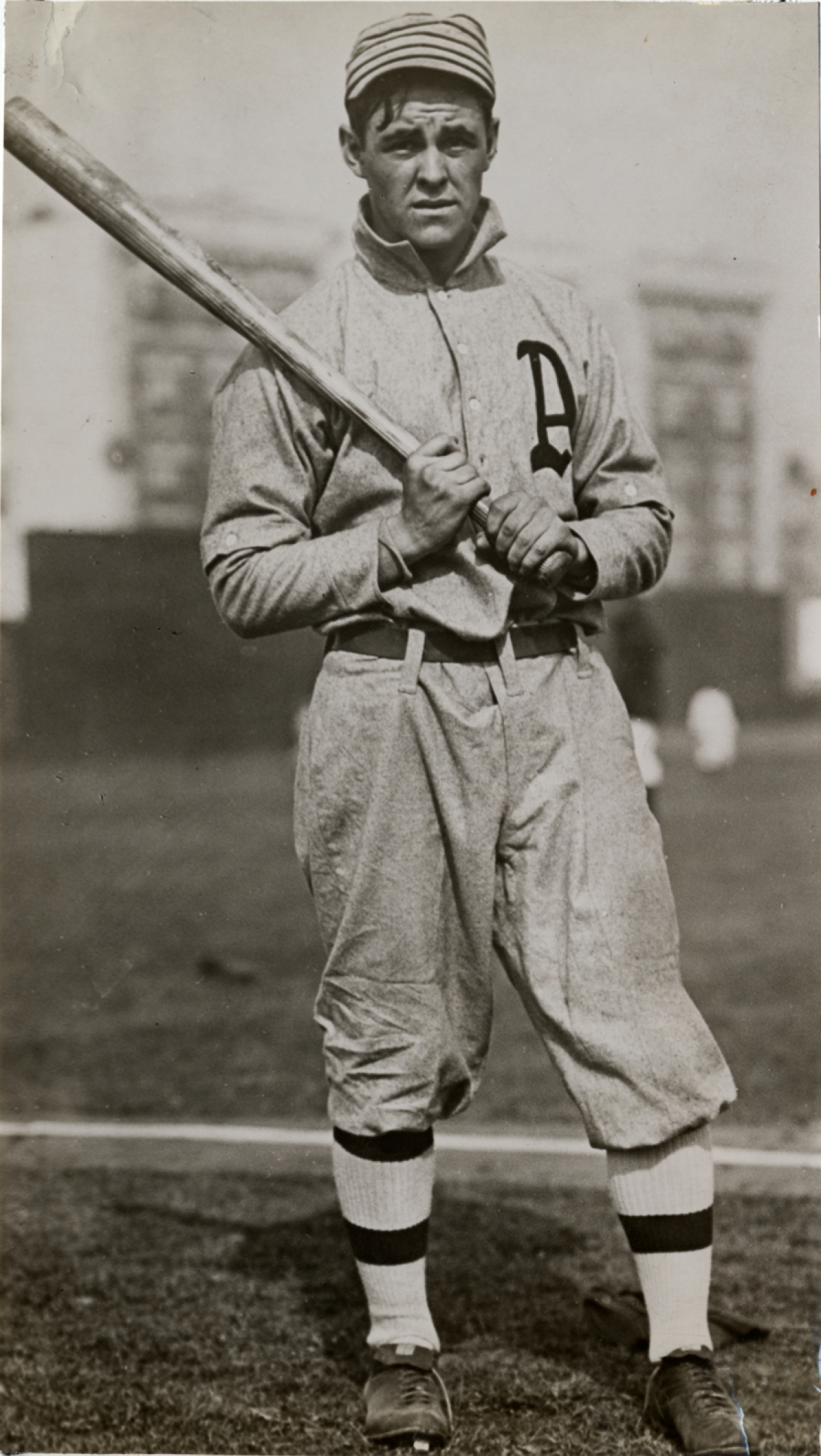


“Stuffy” McInnis first signed with the Philadelphia Athletics prior to the 1909 season, but his immediate path to the lineup was completely blocked. Connie Mack’s legendary infield was already crystallizing, forcing the versatile teenager to bide his time as a utility player, primarily logging reps at shortstop off the bench during his first two major league summers.
Mack saw a unique blend of contact ability and defensive instinct in the young player. When a vacancy at first base appeared before the 1911 season, McInnis quickly claimed the role, becoming the youngest and fiercest member of Philadelphia's renowned "$100,000 Infield,” joining Eddie Collins, Jack Barry, and Home Run Baker.
The structural shift transformed the Athletics into a buzzsaw. Standing just 5-foot-9, McInnis redefined dead-ball-era hitting mechanics by choking up significantly on his bat, wielding a short, compact swing that made him nearly strikeout-proof. He put on an offensive clinic from the moment he took over the bag, batting a spectacular .321 in 1911 and driving in 95 runs.
That breakout summer led to a remarkable, high-volume peak; McInnis would later surpass the .300 batting average in six of his seven seasons as Philadelphia's regular starter through 1917, just missing a perfect score when he posted a solid .295 in 1915.
Nevertheless, his lethal bat only conveyed half the narrative. On the baseball field, McInnis converted first base into an absolute vacuum, integrating exceptional agility with a distinctive, backhanded sweeping technique for fielding low throws from the dirt. He complemented his superior defensive range with rapid instincts on the basepaths, consistently stealing double-digit bases to exert continual pressure on opposing pitching staffs.
This relentless, multidimensional excellence was a vital cornerstone of the franchise's first golden era. McInnis anchored the infield, guiding the Athletics to three American League pennants in four years (1911, 1913, and 1914) and serving as a central catalyst for the historic World Series championships in 1911 and 1913.
When financial pressures eventually forced Mack to famously dismantle his high-priced powerhouse following the 1914 pennant, McInnis remained behind as the steady, veteran heartbeat of the rebuilding club, grinding through several tough seasons before finally being traded to the Boston Red Sox before the 1918 season.
McInnis would later win two more World Series Titles, one with Boston (1918) and another with Pittsburgh (1925). With the Athletics, he would accumulate 1,192 hits with a .313 batting average.

Comments powered by CComment