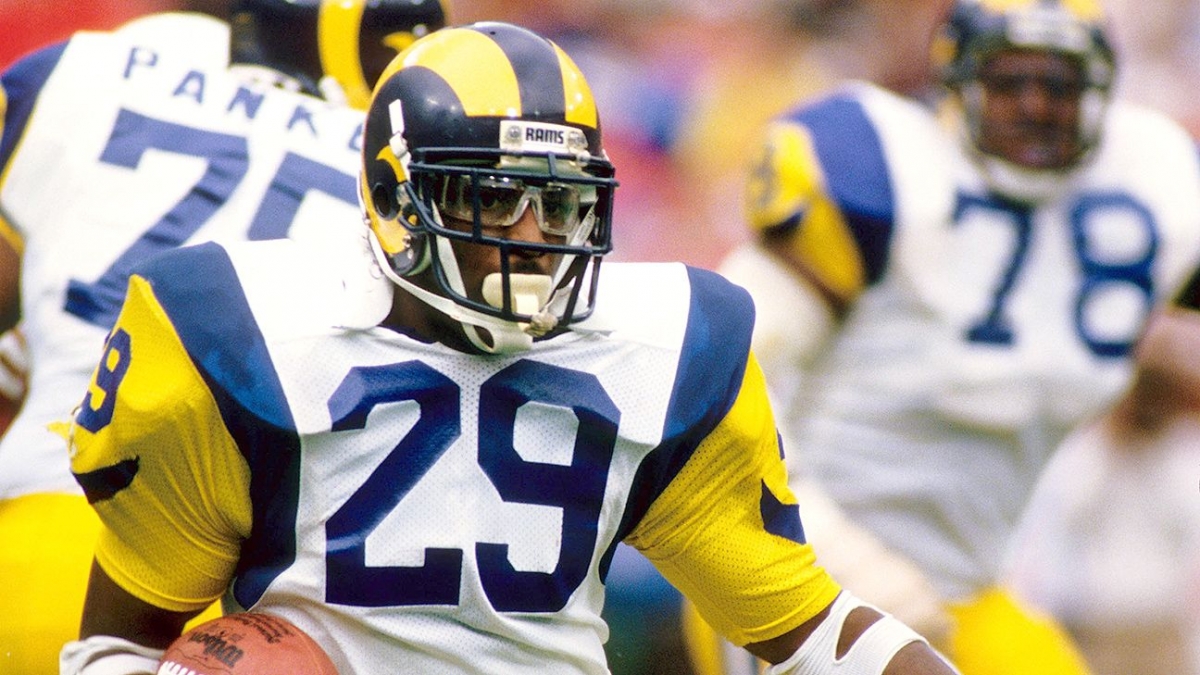
Eric Dickerson arrived in Los Angeles as the second overall pick out of SMU in 1983 and immediately looked like the league’s most explosive runner. As a rookie, he led the NFL with 1,808 rushing yards and 18 touchdowns on 390 carries, earning Offensive Rookie of the Year honors while also catching 51 passes for another 404 yards. He ran upright with a long, smooth stride that made him hard to bring down once he got into the open, combining rare size and speed in a way that forced defenses to account for him on every play. That season he had multiple 100-yard games and scored in bunches, including a three-touchdown performance against Detroit.
The following year he broke O.J. Simpson’s single-season rushing record with 2,105 yards and 14 touchdowns on 379 carries. He topped 100 yards in twelve games, including a 215-yard outing against Houston and a 208-yard day against the Cardinals. That total still stands as the NFL mark. Dickerson was a First-Team All-Pro that season, and the production carried the Rams into the playoffs. He followed it with another solid year in 1985 (1,234 yards and 12 scores despite missing time), then topped 1,800 yards again in 1986 on a league-high 404 carries. In those peak seasons, he earned multiple First-Team All-Pro nods and led the league in rushing more than once.
He was just as dangerous in the postseason. In the 1985 playoffs, he ran for a then-record 248 yards and two touchdowns in a win over Dallas, a performance that still ranks among the greatest single-game rushing efforts in playoff history. The combination of volume and big-play ability made him the clear centerpiece of the Rams’ offense for four seasons. Contract issues eventually ended the run. Midway through the 1987 season, the Rams traded him to Indianapolis in a multi-team deal after prolonged disputes over money. His time in Los Angeles was relatively short, but the production was unmatched.
With the Rams, he finished with 7,245 rushing yards and 56 touchdowns in 65 games. Those numbers remain among the best stretches any back has ever put together for the franchise.
The Pro Football Hall of Fame inducted him in 1999, and the Rams retired his number 29. It recognized the runner who set the single-season record and redefined what a franchise back could look like in Los Angeles.
Comments powered by CComment