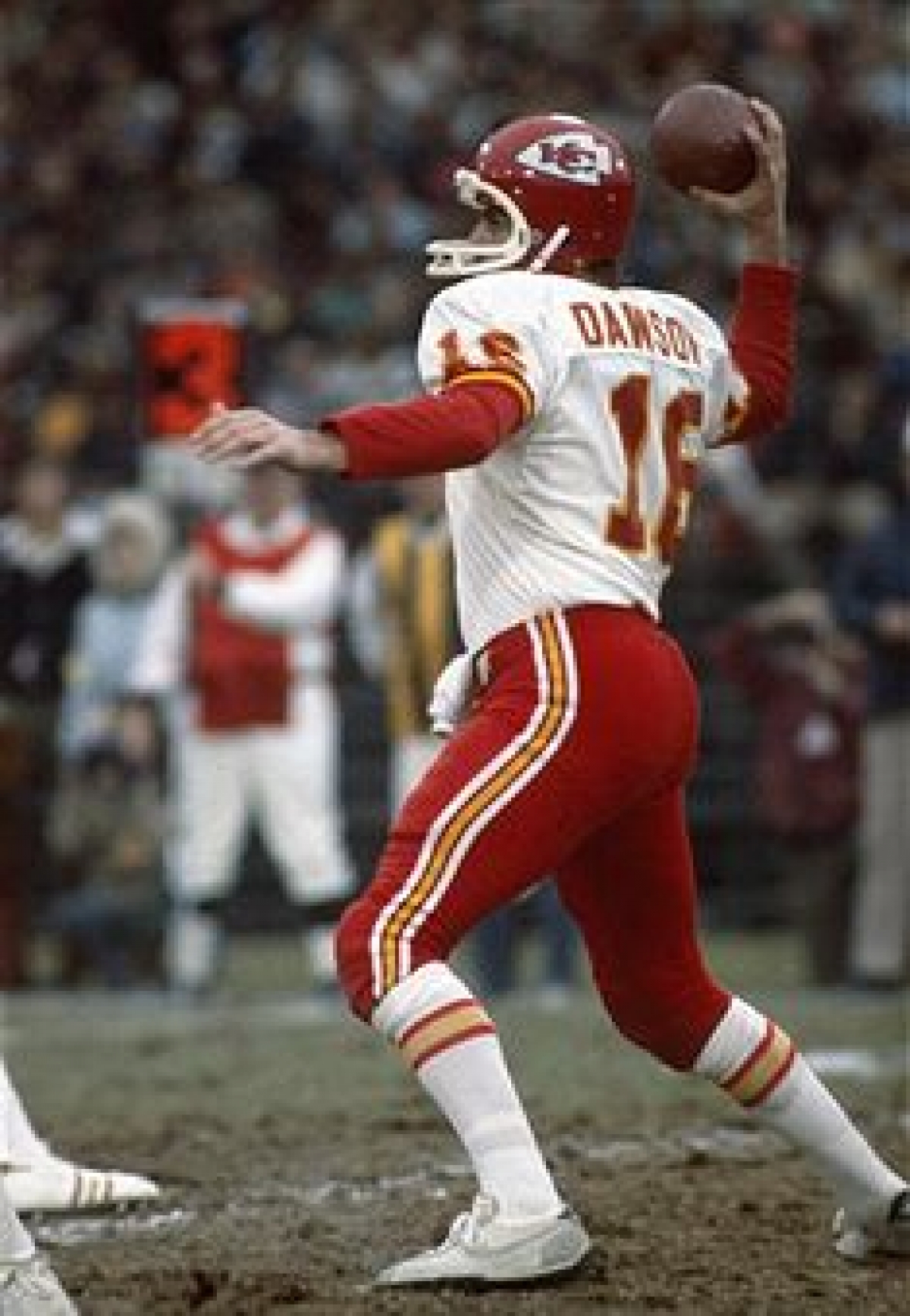
Before he became the undisputed royalty of Kansas City football, Len Dawson looked like a first-round draft bust buried on NFL sidelines. Selected fifth overall by Pittsburgh out of Purdue in 1957, Dawson spent three anonymous seasons underutilized by the Steelers before being shipped to Cleveland, where he languished behind Milt Plum. Released after five NFL seasons with just two career touchdown passes to his name, Dawson’s professional career seemed dead on arrival until former Purdue assistant Hank Stram threw him a lifeline with the AFL’s Dallas Texans in 1962.
Reunited with Stram, Dawson immediately unspooled one of the most remarkable career turnarounds in pro football history. Taking the reins of Stram’s innovative "moving pocket" offense, Dawson brought clinical precision and icy composure to a fledgling league often criticized for chaotic play. Nicknamed "Lenny the Cool" for his unflappable demeanor under pressure, he transformed the Texans into an instant juggernaut, leading the AFL with 29 touchdown passes and a 98.3 passer rating in his very first season as a full-time starter.
The memorable 1962 campaign ended with a double-overtime win against the Houston Oilers in the AFL Championship, earning the franchise its first league title. When Lamar Hunt moved the team north to Missouri to form the Kansas City Chiefs the next year, the team’s location shifted, but Dawson's consistent brilliance did not change. He became the standard for efficiency throughout the decade, consistently leading the AFL in passing.
Dawson’s mastery of Stram’s scheme was unmatched in his era. He won six AFL passer rating titles (1962, 1964–1968)—including five straight seasons on top—and led the league in touchdown passes four times (1962, 1963, 1965, 1966). Unlike opponents who focused on deep vertical throws, Dawson dissected defenses with pinpoint accuracy, leading the league in completion percentage in eight seasons and consistently achieving touchdown-to-interception ratios that were far ahead of his time.
In 1966, Dawson led Kansas City to an 11–2–1 record and a decisive victory over Buffalo in the AFL title game, securing their place in the first AFL-NFL World Championship Game (Super Bowl I). Although the Chiefs ultimately lost to Vince Lombardi’s Green Bay Packers, Dawson impressed many by completing 16 of 27 passes against a renowned NFL defense, demonstrating to skeptical fans across the country that the AFL’s top quarterback had exceptional, world-class skills.
Three years later, Dawson created his career's defining masterpiece in 1969. Although he missed five games due to a knee injury and faced false, sensationalized gambling accusations before Super Bowl IV against the favored Minnesota Vikings, Dawson stayed resilient. His steady leadership kept Kansas City focused as they dominated Minnesota's renowned "Purple People Eaters" defense, winning 23–7. Dawson received Super Bowl MVP honors, confirming the AFL's strength just months prior to the official merger.
Dawson was more than just a champion with his awards; he was a tough physical player who took harsh hits during an era with almost no protective rules for quarterbacks. He led the Chiefs through their integration into the unified NFL, starting until he retired after the 1975 season at age 40. By retirement, he had played 14 seasons in Chiefs red, setting statistical records that stood for nearly 50 years until Patrick Mahomes came along.
His post-playing career further cemented his reputation as a local legend. Dawson smoothly shifted into a popular broadcaster, leading local sports coverage in Kansas City and working for decades as the color commentator for the Chiefs Radio Network, while also hosting HBO's Inside the NFL. His unique ability to earn trust both on the field and at home made him the enduring elder figure in Kansas City sports culture.
With the Chiefs, Dawson compiled 28,507 passing yards, 237 passing touchdowns, and 178 interceptions in red and gold, along with 1,241 rushing yards and nine rushing touchdowns. A Super Bowl IV champion and MVP, three-time AFL Champion (1962, 1966, 1969), six-time AFL All-Star, 1968 Pro Bowler, and 1962 First-Team All-AFL selection, Dawson had his No. 16 jersey retired by the Chiefs and remains a universally revered pillar of football history; he was inducted into the Pro Football Hall of Fame in 2009.


Comments powered by CComment