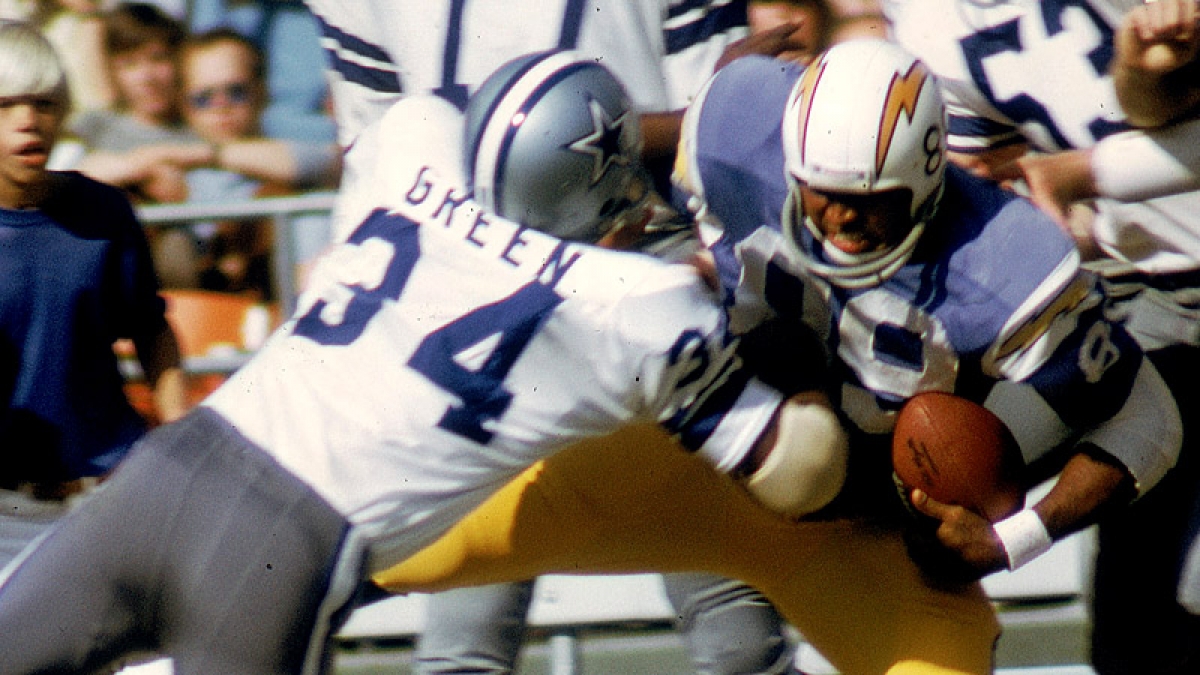
During a time when scouting departments mostly focused on well-known college football programs, the early Dallas Cowboys front office was known for discovering overlooked talent from unusual sources. One example is Cornell Green, a two-time All-American basketball player at Utah State with no prior football experience. Acting on a tip from the Aggies’ basketball coach, legendary personnel executive Gil Brandt offered Green, a 6-foot-3, 208-pound forward, a $1,000 signing bonus. Brandt and head coach Tom Landry believed Green’s height, agility, and rebounding skills would successfully transfer to football—and they were overwhelmingly correct.
Green emerged as a natural talent, joining the 1962 roster as an undrafted free agent and earning a spot on the NFL All-Rookie team. By 1963, he had become the full-time starting left cornerback, demonstrating a keen ball-hawking instinct by recording a career-high seven interceptions. Significantly taller than most cornerbacks of his era, Green used his impressive stature to disrupt pass routes at the line of scrimmage and had the raw speed to recover quickly downfield.
Tom Landry’s intricate "Flex Defense" required high discipline and intelligence from the secondary, and Green quickly became one of its most reliable anchors. He earned his first Pro Bowl in 1965, beginning a dominant period during which he led Dallas in interceptions four times in his first eight seasons. Between 1966 and 1969, Green was regarded as the NFL's top boundary defender, earning three First-Team All-Pro honors (1966, 1967, 1969) and helping transform Dallas from a new franchise into a consistent championship contender.
In 1970, Landry challenged Green to move inside to strong safety, testing his athletic versatility. Green adapted effortlessly, providing physical run support in the box and effectively covering tight ends and slot receivers. This smooth transition elevated the secondary's performance, earning him Pro Bowl selections in 1971 and 1972. Significantly, Green anchored the secondary during Super Bowl VI, leading Dallas to a 24–3 victory over the Miami Dolphins and securing the franchise's first Lombardi Trophy.
Perhaps most remarkably, the former hoopster was a true ironman throughout his 13-year career. Green played in 182 consecutive regular-season games—never missing a single contest during his entire playing run—and recorded 145 consecutive starts for the Cowboys. He also proved to be a secret weapon on special teams, using his leaping ability to record a franchise-record 10 blocked kicks, eight of which came on field goal attempts.
Green played in 182 regular-season games, compiling 34 interceptions, two defensive touchdowns, seven fumble recoveries, and one Super Bowl championship. A five-time Pro Bowler across two positions, three-time First-Team All-Pro, and member of the Cowboys’ 25th Anniversary Team, Green spent over three decades following his playing days as a scout for the organization. Green might be one of the greatest success stories in franchise history.


Comments powered by CComment