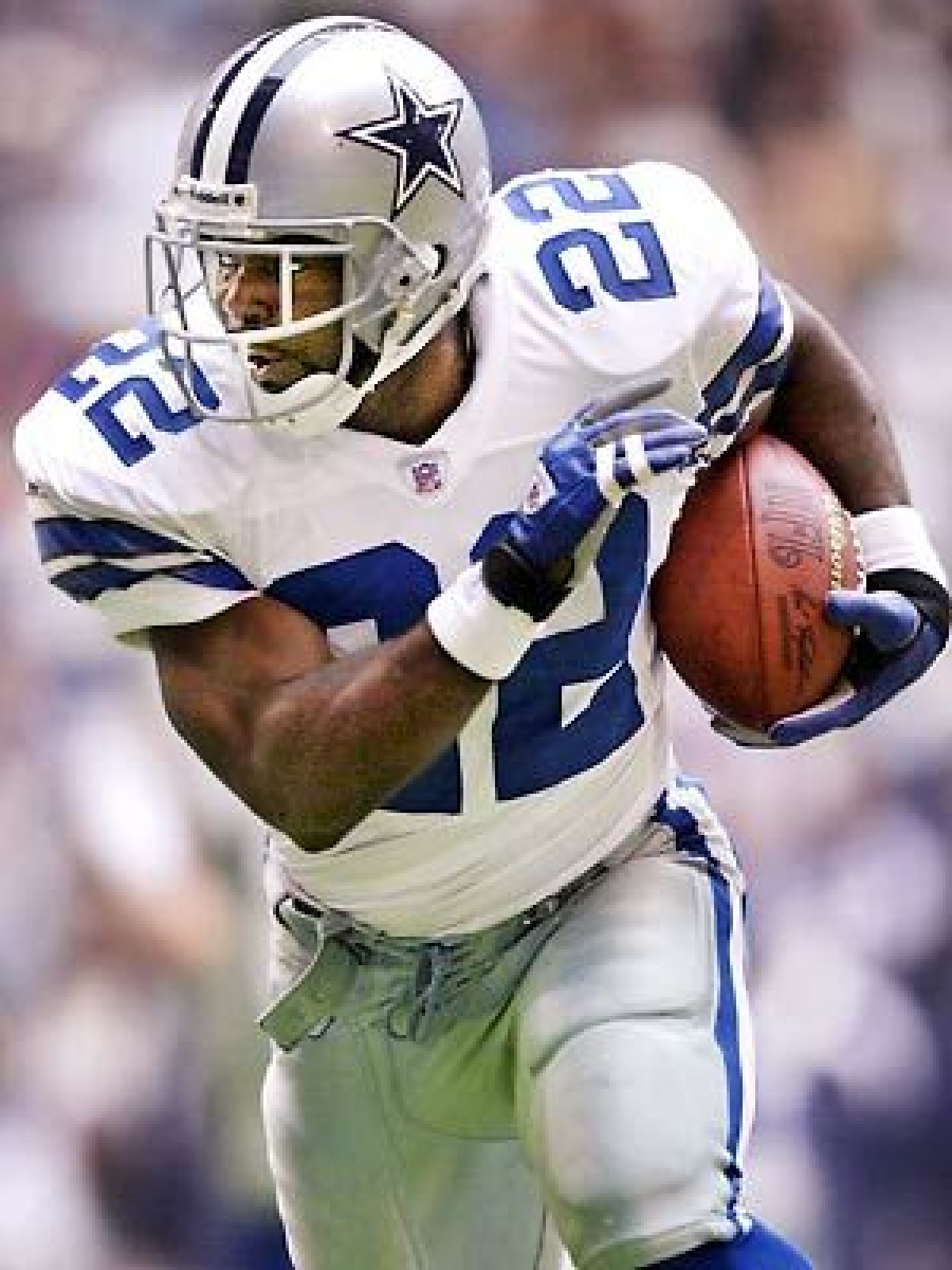
When you look at "America's Team," you have a team that not only had a lot of eyeballs on it but also produced a plethora of Hall of Famers. Choosing the greatest Dallas Cowboy wasn't easy, but in the end, we decided on the player who, statistically speaking, is the greatest Running Back of all time.
Emmitt Smith arrived in Dallas as the 1990 17th pick amidst skepticism surrounding his modest height and top-end speed. The former Gator quickly silenced critics by capturing NFL Offensive Rookie of the Year honors, embarking on an unprecedented run that cemented him as the cornerstone of the 1990s Cowboys dynasty and the all-time leading rusher in football history.
Smith had exceptional vision, a low center of gravity, and lateral agility. Instead of depending on pure speed, he mastered setting up blocks behind Dallas’ formidable offensive line, pushing the hole to displace linebackers before executing a decisive cut. Smith handled contact with ease, powered through initial tackles, and demonstrated legendary durability to sustain heavy workloads week after week.
Smith distinguished himself from others of his era through his exceptional, almost telepathic understanding of blocking schemes and outstanding body control upon contact. He excelled at the “press"—initially slashing toward a designated gap just enough to attract linebackers into the wash, then planting his outside foot, dropping his hips, and executing a jump-cut into a nearby lane before defenders could adjust. Instead of taking direct hits at full speed, he rolled off arm tackles, kept a low center of gravity, and kept his legs moving to gain two or three yards after contact on nearly every run.
His legendary physical toughness was exemplified in the memorable 1993 regular-season finale against the New York Giants. Despite playing with a separated shoulder, Smith had 32 touches for 229 yards in total, including 41 yards on a vital game-winning drive in overtime, securing the division title and home-field advantage. His readiness to endure punishment and stay central to team strategies centered on defense established him as the premier high-usage, clutch player.
After his rookie season, when he was named Offensive Rookie of the Year, Smith began a remarkable period of individual success in the NFL. In 1991, he won his first rushing title with 1,563 yards, then improved in 1992 to 1,713 yards and led the league with 18 rushing touchdowns. Playing alongside quarterback Troy Aikman and wide receiver Michael Irvin—known as the"Triplets"—Smith led a dominant offense that ended with a 52–17 victory over Buffalo in Super Bowl XXVII. He became the first player to earn both a league rushing title and a Super Bowl ring in the same season.
In 1993, following a contract holdout that prevented him from participating in the initial two games of the regular season, Smith demonstrated exceptional value. Over the course of merely 14 games, he led the National Football League (NFL) in both rushing yards (1,486) and scrimmage yards (1,900). He was conferred the AP NFL Most Valuable Player (MVP) award, guided Dallas to victory in Super Bowl XXVIII with a remarkable performance of 132 yards and two touchdowns, and was subsequently named Super Bowl MVP—becoming the sole player in NFL history to achieve the feat of winning the regular-season MVP, Super Bowl, Super Bowl MVP, and league rushing title within a single season.
Smith achieved his highest statistical performance during the 1995 season. Operating behind "The Great Wall of Dallas," he secured his fourth rushing title with a career-best 1,773 rushing yards and broke the NFL single-season record with 25 rushing touchdowns, in addition to 62 receptions for 375 yards. His fourth consecutive First-Team All-Pro selection culminated in a commanding postseason run, finalized by his two-touchdown performance against Pittsburgh in Super Bowl XXX, which secured the franchise's third Lombardi Trophy in four years.
As the Cowboys underwent roster changes in the late 1990s, Smith remained a reliable workhorse, recording 11 consecutive 1,000-yard rushing seasons. On October 27, 2002, against the Seattle Seahawks, he surpassed Walter Payton to become the NFL's all-time career rushing leader.
After 13 seasons in Dallas (1990–2002), Smith played his final two professional seasons with the Arizona Cardinals (2003–2004) before retiring from football. His time in Dallas yielded 17,162 rushing yards, 153 rushing touchdowns, and 3,012 receiving yards. He remains the NFL's all-time leader in both career rushing yards (18,355) and rushing touchdowns (164).
Smith was inducted into the Dallas Cowboys Ring of Honor in 2005 and joined the Pro Football Hall of Fame in Canton in 2010 on his first ballot.


Comments powered by CComment