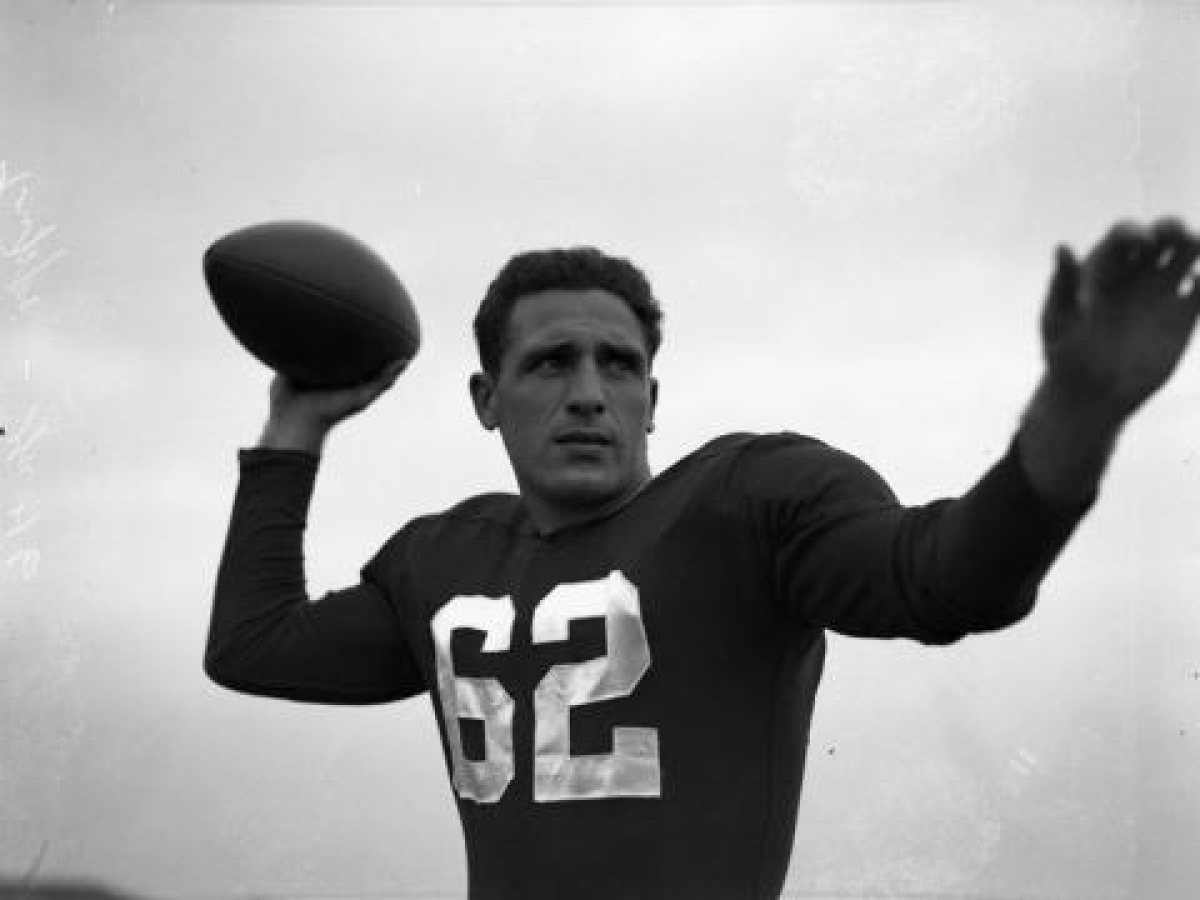
The Cardinals football team's long history can be traced back to a pivotal tug-of-war in winter 1947. Charley Trippi, a prominent college star from the University of Georgia who won the 1946 Maxwell Award and was the Heisman runner-up, became the center of a fierce bidding contest between the NFL and the rising All-America Football Conference. The AAFC’s New York Yankees thought they had secured the superstar, but Chicago Cardinals owner Charles Bidwill shifted the odds with a groundbreaking financial move. He signed the versatile rookie to a historic $100,000 four-year contract, completing a crucial piece of his championship plans.
Standing 6 feet tall and weighing 186 pounds, Trippi was a prototype for the versatile, positionless offensive weapon long before the term existed. As a runner, he had an explosive burst and elite open-field elasticity, slicing through defenses with a 5.1 yards per carry career average. His ability to execute at every skill position made him a tactical nightmare — a lethal passer on halfback options, a skilled route runner with soft hands, and a rugged blocker. When needed, his leg produced a 40.3-yard punting average, and later in his career, he flipped jerseys to become an elite, hard-hitting defensive back.
His arrival in 1947 sparked a legendary chapter in franchise history, as Trippi became the dynamic force behind Chicago’s renowned "Million Dollar Backfield." Playing alongside Paul Christman, Pat Harder, and Elmer Angsman, the rookie halfback immediately led the Cardinals to a remarkable 1947 NFL Championship. Trippi cemented his Chicago legacy with a stellar performance in the icy 1947 Title Game against the Philadelphia Eagles. Wearing basketball shoes to maneuver the icy Comiskey Park turf, he gained 206 all-purpose yards, scoring on a stunning 44-yard touchdown run and a historic 75-yard punt return, contributing to a 28-21 victory. His 206 yards and two long touchdowns in the extreme cold remain among the most clutch individual feats in NFL title game history.
He sustained that dizzying peak into the 1948 campaign, guiding the Cardinals back to the championship game while putting together a masterpiece of individual efficiency. Trippi dominated the league, leading the NFL with 1,485 all-purpose yards and a league-best 5.4 yards per carry, earning consensus first-team All-Pro honors. He replicated that dominance in 1949, again pacing the entire National Football League with 1,552 all-purpose yards while remaining the most feared kick and punt returner in the game.
As the franchise moved into the 1950s, Trippi's exceptional versatility became a crucial support for the coaching staff. During the 1951 and 1952 seasons, he almost entirely played quarterback, leading the offense from under center and earning Pro Bowl honors in 1952 and 1953. Demonstrating total disregard for personal stats or safety, he shifted to the defensive side for his last two seasons in 1954 and 1955, intercepting passes and chasing down opponents with the same fierce determination he showed on offense.
The arduous gridiron marathon culminated in a disappointing end during the 1955 season when a hard pre-season hit resulted in a fractured skull, leading to his retirement after 99 regular-season games. Trippi left Chicago with a legendary stats record, totaling 3,506 rushing yards, 1,321 receiving yards, 2,547 passing yards, and 37 touchdowns, along with 2,321 return yards. At his retirement moment, his remarkable versatility had set the record for the most total offense yards by a single player in NFL history.
Trippi was named to the NFL 1940s All-Decade Team, and his connection to the sport's elite was finalized in 1968 when he was inducted into the Pro Football Hall of Fame. In 2006, he was inducted into the Arizona Cardinals Ring of Honor as a founding member.