
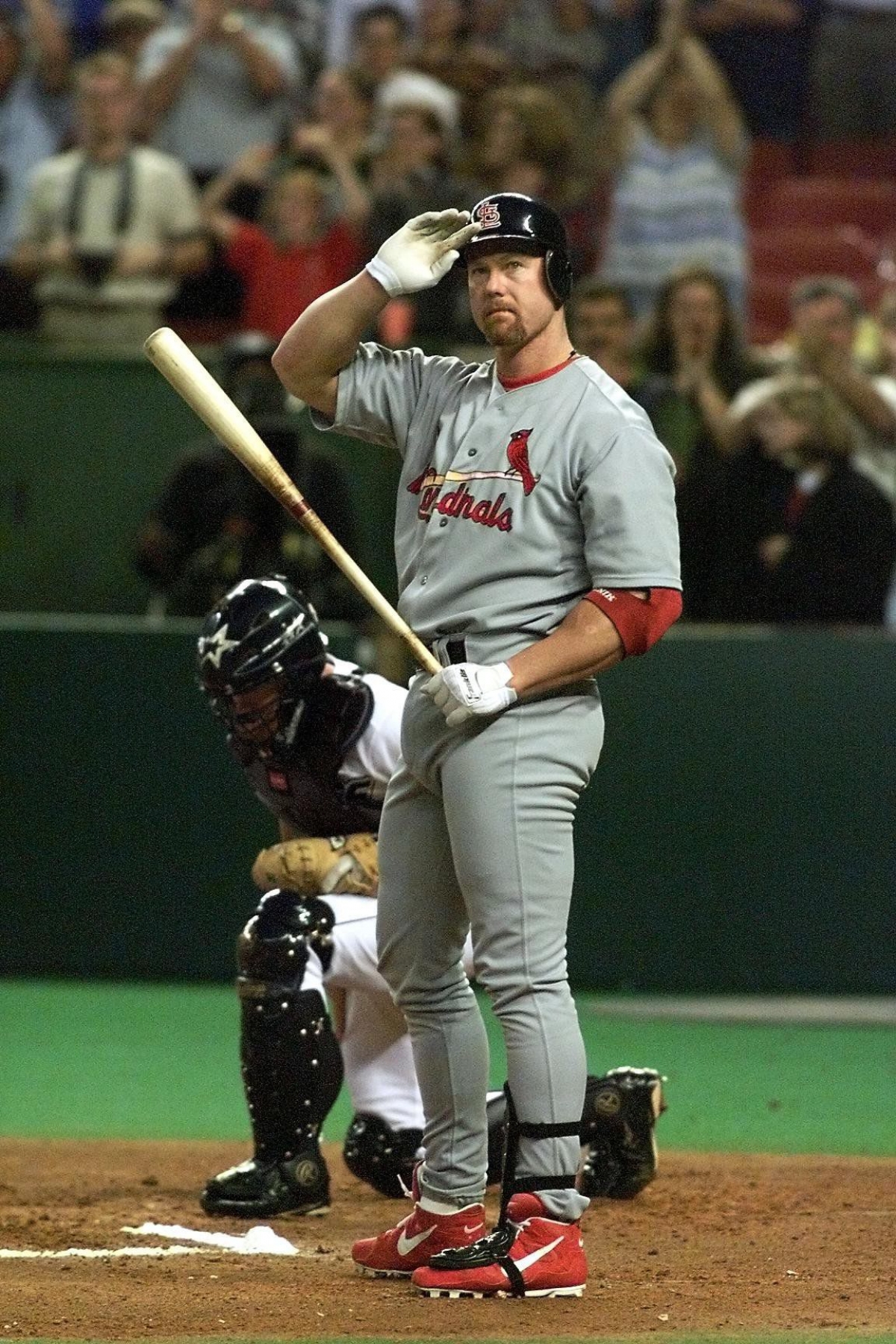






The arrival of Mark McGwire in downtown St. Louis midway through the 1997 season completely shifted the franchise's gravity. Coming over in a trade from Oakland, he brought a cartoonish brand of power that instantly made Busch Stadium a nightly destination. For baseball fans who didn't live through the era, it is difficult to overstate the monoculture McGwire created. In a sport still recovering from the wounds of the 1994 strike, he forced everyone—from diehards to casual evening news viewers—to tune in every time he stepped into the batter's box. He single-handedly made baseball central to the cultural conversation again.
That cultural wave peaked in 1998. In a summer-long chase that captivated the sports world, McGwire shattered Roger Maris’ single-season record by launching an unfathomable 70 home runs. He didn't just clear fences; he paired that historic power with a staggering .299/.470/752 slash line and 147 RBIs. Although he finished as the runner-up for the National League MVP, the season remains a monumental moment in modern sports history. He proved it wasn't a fluke the following year, backing it up with a 1999 campaign in which he bashed another 65 home runs and posted a .278/.424/697 line, earning a fifth-place finish in the MVP voting.
The final two years of his tenure saw a sharp decline as severe knee injuries and age finally caught up to his massive frame, limiting his playing time and efficiency. Yet across his four and a half seasons wearing the birds on the bat, the sheer concentration of his impact was staggering: 220 home runs and a massive .683 slugging percentage.
Evaluating a tenure like McGwire's requires looking beyond traditional longevity templates. For those arguing that performance-enhancing drugs should disqualify him, that is outside the scope of this project; he played in an era of rampant, tacitly permitted use, with leadership looking the other way. Conversely, for those who feel his raw home run totals should elevate him even higher in the franchise ranks, the reality of his overall game serves as a tether. His St. Louis years offered virtually nothing defensively, and the brevity of his peak naturally caps his volume-based value compared to multi-decade franchise icons. He was a short, blinding burst of pure offense—an unforgettable chapter of unmatched peak impact.
The permanent stamp on his legacy in Missouri came later. In 2017, the organization recognized the indelible mark he left on the city by inducting McGwire into the St. Louis Cardinals Hall of Fame.

Comments powered by CComment