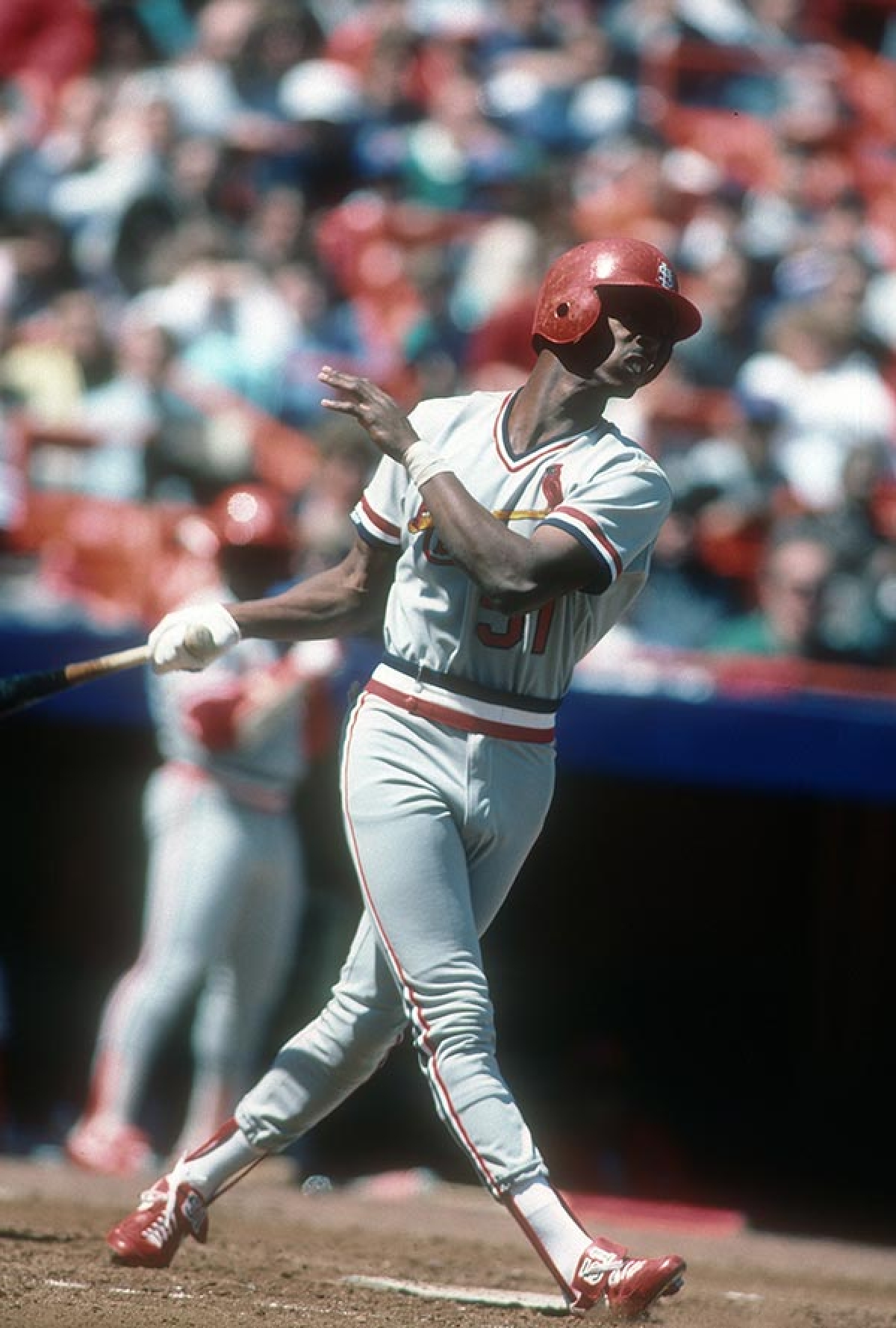
The foundation of the 1980s "Whiteyball" era in St. Louis was built on a fierce commitment to speed, turf coverage, and putting the ball in play. No one embodied this identity more than Willie McGee. Originally a first-round pick by the New York Yankees in the 1977 January draft, the slim, soft-spoken center fielder faced obstacles in reaching the Bronx due to a crowded roster of veteran stars. Sensing an opening, St. Louis general manager Whitey Herzog executed a discreet, seemingly minor trade in October 1981, sending left-handed pitcher Bob Sykes to New York in exchange for an unproven minor leaguer. This deal turned out to be one of the most lopsided in baseball history; although a damaged Sykes never pitched in the majors again, McGee arrived in St. Louis and immediately transformed the franchise.
McGee's rise from an overlooked prospect to a postseason hero happened remarkably fast. Stepping into the starting center field position in 1982, his long, smooth strides effortlessly covered the expansive Busch Memorial Stadium. He gained national fame during Game 3 of the 1982 World Series against the Milwaukee Brewers, delivering a legendary performance by hitting two home runs and making a spectacular leaping catch at the wall to deny Gorman Thomas a crucial late-inning fly. His heroic plays helped lead the Redbirds to a world championship, establishing him as a beloved figure in eastern Missouri.
Instead of leveling off, McGee achieved a huge professional breakthrough in the 1985 season. As the key, high-speed force at the top of Herzog's lineup, he challenged National League pitchers with a league-leading .353 batting average. He also led the Senior Circuit with 216 hits and 18 triples. His dominance was clear. With a career-high 56 stolen bases and 114 runs scored, McGee used a powerful Silver Slugger season to lead the Cardinals to the Fall Classic, ultimately earning the 1985 National League Most Valuable Player Award.
McGee’s legacy presents a fascinating analytical dichotomy. While his classic counting numbers and triple-digit run production are legendary, his aggressive, free-swinging style produced a weak .329 on-base percentage that caps his overall efficiency. Furthermore, while his speed earned him a trio of Rawlings Gold Gloves, modern defensive tracking suggests his overall routes and range efficiency were closer to a steady, average baseline rather than a historic positional outlier.
Despite his analytical limits, his pure, bat-to-ball utility was an elite regular-season constant. He proved his hitting value in 1990, earning his second Senior Circuit batting title with a sharp .335 average after being traded to the Oakland Athletics in late August for pitching depth. Later chapters in San Francisco and Boston followed, and a poetic late-career reunion brought him back to St. Louis from 1996-1999, where he was a beloved reserve and clubhouse mentor.
As a Cardinal, he had 1,683 hits, 83 triples, 301 steals, and a.294 average in 1,664 games. In 2014, he was honored as part of the Cardinals' first Hall of Fame class.
Comments powered by CComment