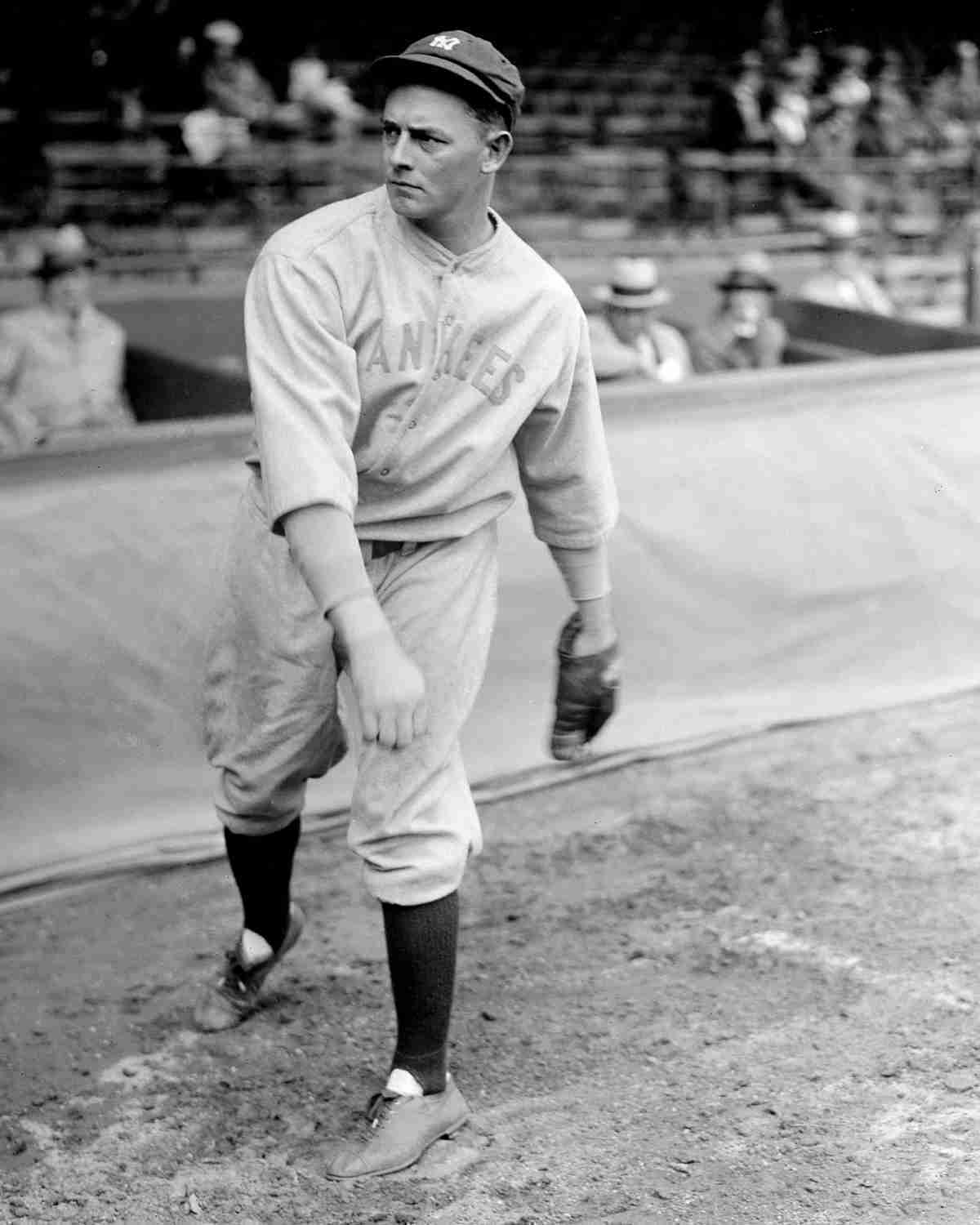
In December 1920, when the New York Yankees targeted the financially struggling Boston Red Sox to acquire a 21-year-old right-hander, they were more than just conducting a typical roster acquisition. They were securing the cornerstone pitcher for what would become the most legendary dynasty in baseball history.
Waite Hoyt, born in Brooklyn, was a prodigy who was signed by John McGraw's Giants at just 15, earning him the nickname "Schoolboy" for life. By the time he wore the pinstripes, he had developed into a highly skilled and polished pitcher, seamlessly supporting Babe Ruth's powerful hits and the formidable "Murderers' Row" lineup.
Hoyt approached the art of pitching with an exceptional, calculated precision. He didn't rely on raw, arm-shredding velocity to overpower junior circuit hitters. Instead, he weaponized a sharp, biting curveball, a deceptive change of pace, and a pinpoint, surgical control that allowed him to repeatedly paint the corners of the strike zone.
He quickly became manager Miller Huggins's most reliable worker, surpassing 200 innings in eight of his nearly ten seasons in New York. While fans in the Bronx often focused on Ruth's long home runs, Hoyt was quietly racking up wins at an impressive rate. He exceeded 19 wins four times with the Yankees, reaching his peak during the legendary 1927 season. That summer, Hoyt demonstrated exceptional efficiency, leading the American League with 22 wins against just 7 losses, posting a 2.63 ERA and completing 23 games to help secure the championship. His performance was no fluke the following year, as he matched it with a 23–7 record in 1928, helping the team win another pennant.
When October arrived and the pressure of the championship intensified, Hoyt became an exceptional big-game performer. Over 12 World Series appearances for the Yankees, he achieved an impressive 6–4 record with a minuscule 1.83 ERA, remaining completely composed on baseball's biggest stage. His greatest postseason feat occurred during the 1921 Fall Classic against his former team, the Giants, where Hoyt pitched three complete games without allowing a single earned run over 27 innings. He was the main pitcher for the franchise's first three world championship teams (1923, 1927, and 1928), establishing himself as a vital part of early Yankee history.
His arm eventually began to surrender to the heavy, structural toll of his massive 1920s workload, leading to a mid-season trade in 1930 that kick-started a multi-team journey through the twilight of his career. He formally walked away from the diamond in 1938, concluding his legendary stay in the Bronx with a spectacular 157–98 with a 3.48 ERA. In 1969, the Veterans Committee officially elected Hoyt into the National Baseball Hall of Fame.
Comments powered by CComment