
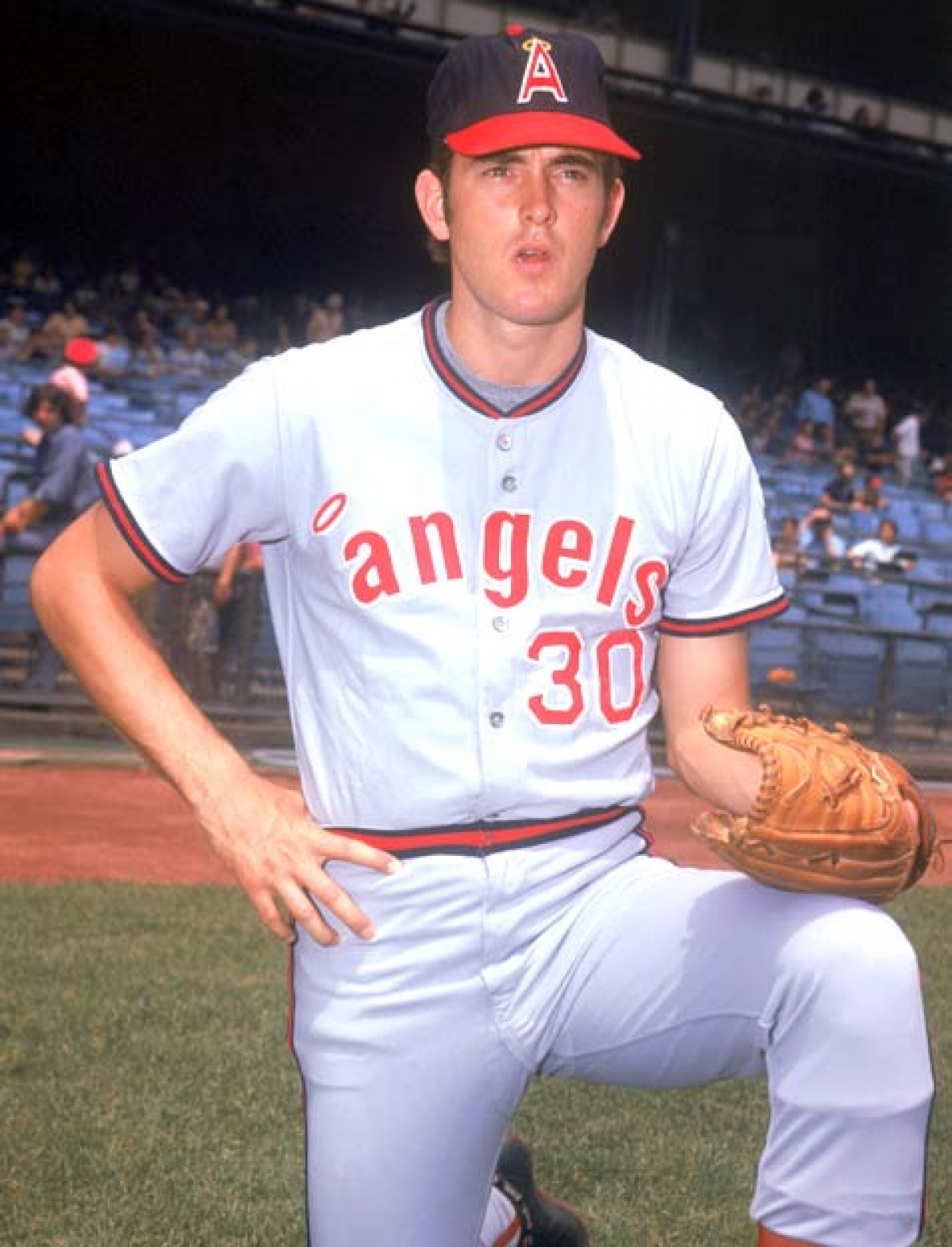



The arrival of Nolan Ryan in Anaheim in 1972 is often cited as the greatest trade heist in baseball history. While the Mets sought a veteran bat in Jim Fregosi, the Angels acquired a lightning bolt in a glove. Ryan didn't just find his footing in California; he transformed into the "Ryan Express," a high-velocity phenomenon that spent eight seasons redefining what was physically possible on a major league mound. While he is a legend in Texas, his years in an Angels uniform were his most explosive, marked by a relentless pursuit of strikeouts and a refusal to let anyone put the ball in play.
Ryan’s tenure in California began with an immediate major turning point for his career trajectory. After years of struggling with his control in New York, he landed in the American League and instantly became its most terrifying outlier. In his 1972 debut season with the club, he reached a new level of dominance, winning 19 games and leading the league with 329 strikeouts and a microscopic 5.3 hits per nine innings. He possessed a focused intensity that turned every start into a potential historical event, a style that reached a career peak just one year later. In 1973, Ryan fanned 383 batters, moving past Sandy Koufax to set the modern single-season strikeout record—a milestone that remains the gold standard of the live-ball era.
The middle of his run was defined by a steady-state of sheer power. Between 1972 and 1974, he averaged over 20 wins and 360 strikeouts per season, cementing his status as the premier flamethrower in the sport. He was a model of physical resilience, famously throwing 235 pitches in a single 13-inning start in 1974, only to return to the mound three days later. Even during a slight dip in his win totals in 1975, he remained a high-frequency threat, leading the American League in strikeouts nearly every year of the late seventies. He showed the organization that a pitcher could become a franchise pillar through intimidation and raw speed, eventually amassing 2,416 punchouts in just eight seasons with the club.
His time in Anaheim also saw him master the art of the no-hitter, tossing four of his record seven gems while wearing the Halo. He reached a crescendo of efficiency in 1977 and 1979, earning two more All-Star nods and proving his arm hadn't lost a tick of its specialized heat. Despite his status as a local icon and a five-time All-Star, the reality of the era’s burgeoning free agency led to his departure. Following the 1979 season, Ryan returned to his home state to sign with the Houston Astros, leaving California as the most prolific strikeout artist in the history of the franchise.
The story in Anaheim reached its closing punctuation in 1992. In a ceremony held while he was still an active player for the Rangers, the Angels retired his number 30 and inducted him into their Hall of Fame.

Comments powered by CComment