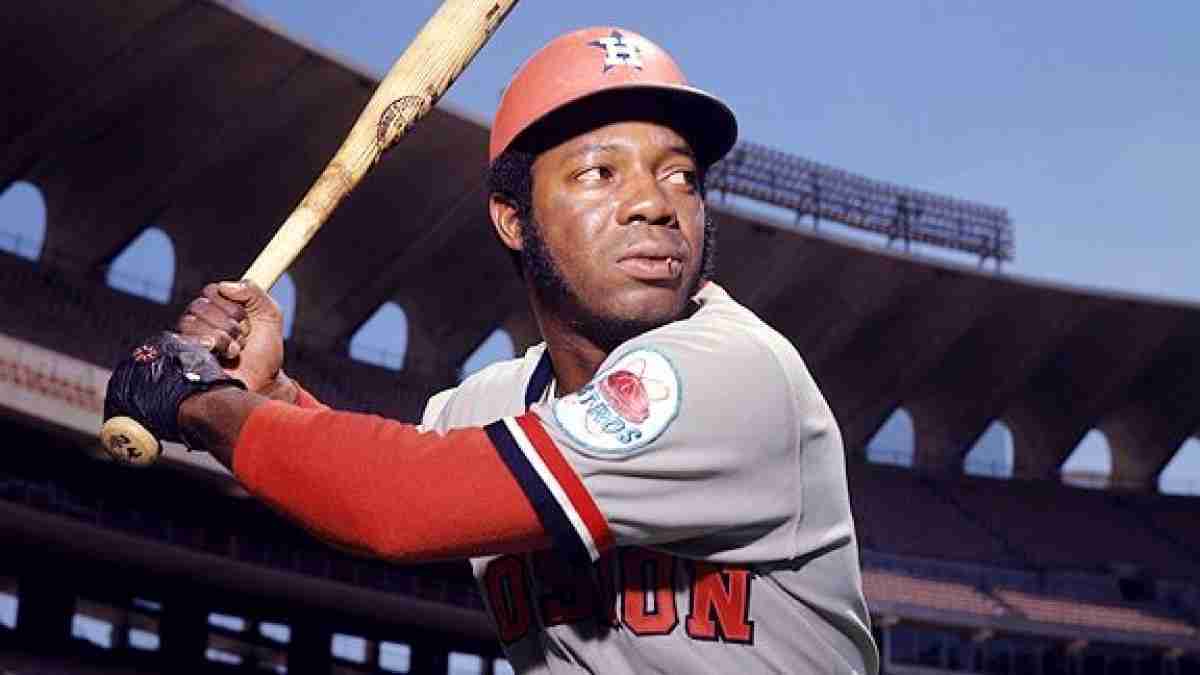
Jimmy Wynn’s career in Houston is a masterclass in why raw box scores can be deceiving. Standing only 5’ 9”, the man they called the “Toy Cannon” spent a decade launching high-frequency drives into the deepest reaches of the cavernous Colt Stadium and the Astrodome—parks that were notorious graveyards for power hitters. While his batting averages often hovered in the .250 range, modern evaluation has revealed a player who was decades ahead of his time, a specialized weapon who valued the walk and the long ball long before they became league-wide standards.
Wynn’s ascent in Houston began in 1963 with the Colt .45s, but it was the move to the Astrodome in 1965 that defined his professional resilience. In an era when "small ball" was the tactical norm, he defied the "Dome" in 1967 by launching 37 home runs—a staggering total for a park where the ball simply didn't carry. He combined this specialized power with elite speed, swiping 16 bases and providing the expansion franchise with its first legitimate superstar. He wasn't a contact specialist; he was a model of efficiency who forced pitchers to navigate a tiny strike zone that he protected with a focused intensity.
The center of his residency was marked by a 1969 campaign that served as a statistical outlier for the decade. That season, Wynn led the National League with 148 walks. While his .269 average appeared modest to contemporary eyes, his on-base percentage soared to .436, proving that he was one of the most difficult outs in the game. He followed this with another high-frequency power surge in 1970, hitting 27 homers and stealing 24 bases. He showed the organization that a player could become a franchise pillar simply by refusing to expand the zone, a steady-state approach that kept him at the top of the league's OPS leaderboard for years.
The final chapters of his Houston tenure saw a gradual decline in batting average, but the "Toy Cannon" remained a dangerous outlier until his departure. Even as injuries began to take a physical toll, he managed 20 home runs and 91 walks in 1972, maintaining a professional poise during a period where the Astros were struggling to find a supporting cast. He was eventually traded to the Dodgers following the 1973 season, leaving the Lone Star State with 1,291 hits and 223 home runs, numbers that would have been significantly higher had he played in a hitter-friendly environment.
The story in Houston reached its final punctuation in 2005 when the organization retired his number 24, followed by his induction into the Astros Hall of Fame in 2019.
Comments powered by CComment